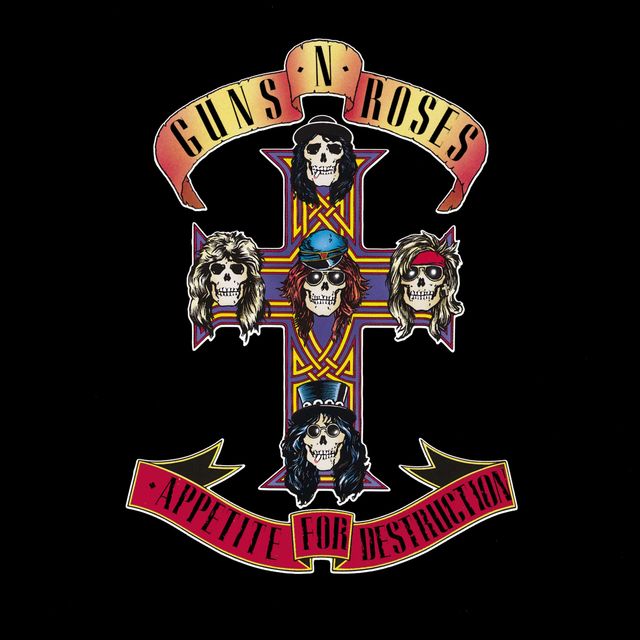

By late 1987, Guns N' Roses' first album looked like a flop. Appetite for Destruction had sold about 200,000 copies, and MTV would not play the video for “Welcome to the Jungle.” Geffen Records was ready to move on. Then David Geffen made a personal call to MTV.
The album came out on July 21, 1987, and entered the Billboard 200 at No. 182. MTV aired the video once, at 4 a.m., and viewers flooded the channel with requests. On August 6, 1988, more than a year after its release, Appetite reached No. 1.
It has since sold more than 30 million copies worldwide. In America it is certified 18 times platinum. It was made for about $370,000 by five young men whose drinking, drug use and arrests worried everyone around them.
“[Appetite is] authenticity and an anti-authoritarianism that proclaimed the value of every individual, every soul, even the souls of urchins from under the street. A blue-collar grand slam!”
The Most Dangerous Band on the Strip
In 1986 the Sunset Strip in Los Angeles belonged to big-haired bands like Mötley Crüe, Ratt and Poison. Guns N' Roses were rougher. The lineup was singer Axl Rose, guitarists Slash and Izzy Stradlin, bassist Duff McKagan and drummer Steven Adler. Their sound mixed Aerosmith and the Rolling Stones with the Sex Pistols.
The booking agent Vicky Hamilton met them when Rose phoned her and asked to play her their songs. She said she had no stereo in her office. “He said, ‘That's okay, I have a ghetto blaster,’” she told Billboard. Rose and Stradlin turned up a few hours later with many of the songs that became Appetite. “All the bands had gotten so girly,” Hamilton said. “Guns N' Roses just felt different, and dangerous.”
Bryn Bridenthal, who later ran Geffen's publicity department, first saw them at the Whisky a Go Go on April 5, 1986. Zutaut had pulled her away from a charity party to come. Backstage, she noticed that nobody went near Rose. “He felt like a feral cat who might attack at any moment,” she said, “so of course I walked right across the no-man's space and introduced myself.”
Geffen's talent scout Tom Zutaut signed them in the spring of 1986, after five or six major labels had shown interest. Rose was pleased with the contract. “The deal is the best thing we could have fucking hoped for from any label,” he said in 1987. Zutaut knew the risk. “There are plenty of bands that probably did less heroin than Guns N' Roses and drank less alcohol, but imploded,” he told Loudwire.
The early months were chaotic. Their first manager, Arnold Stiefel, rented them a house in the hills. According to Classic Rock, it ended with a $22,000 bill for damage. When Alan Niven first saw them at the Troubadour that summer, he noticed that management had sent flowers, and that McKagan tossed them into a trash can. Niven became their manager soon after.
Paul Stanley and the Missing Hook
Finding a producer took months. Zutaut first paid Spencer Proffer $15,000 to record “Nightrain” and “Sweet Child O' Mine” as a test. The band did not like his mixes. They tried demos with Manny Charlton of Nazareth. Robert John “Mutt” Lange was too expensive.
Kiss guitarist Paul Stanley came to their apartment to talk about producing. He listened to the demo of “Nightrain” and suggested the chorus needed an extra hook. According to Rolling Stone, Rose never spoke to him again.
The job went to Mike Clink, an engineer who had worked on UFO's Strangers in the Night and with guitarist Michael Schenker. Niven wanted someone who would not polish the band too much. “People tend to forget the perfection in recording lies in knowing the imperfections you have to keep,” he said. Clink also had patience. Rose said Clink rarely told the band to change anything. Instead he would question a part until they either proved it worked or found something better.
Rumbo, Take One and a $2,500 Guitar
Recording began in January 1987 at Rumbo Recorders in Canoga Park, in the San Fernando Valley. The band cut the basic tracks of drums, bass and rhythm guitar there in about two weeks. Slash's guitars and Rose's vocals were then overdubbed at Take One Studio in Burbank.
The band members kept different hours. “Slash would come in at 11 in the morning to record guitars,” assistant engineer Micajah Ryan remembered. Rose came in after dinner and sang until late. The studio took Wednesday nights off because the band went to a club called the Cathouse, where they were stars. “I reckon Mike knew he wouldn't get much out of them on the morning after,” Ryan said.
Slash had a problem. He had pawned most of his guitars, and the ones he had left, two Jacksons and a B.C. Rich, sounded terrible on tape. Niven arrived at Take One one day to find a borrowed Gibson SG stuck neck-first through the band's van windshield. “That's a message that even I can understand,” he told the LA Weekly.
Niven went to a guitar shop in Redondo Beach called Music Works and bought a handmade copy of a 1959 Gibson Les Paul for about $2,500. It had been built by a local luthier, Kris Derrig. Clink heard it on the first day. “We knew instantly that was the tone for the record,” he said.
It wasn't, ‘Oh, let me think about it.’ It was, we finally had found the sound for Slash.
Slash played it through a rented, modified Marshall amplifier. For the clean parts of “Sweet Child O' Mine” he used a Roland Jazz Chorus amp that happened to be in the studio. Derrig never heard the result. He died on May 17, 1987, aged 32, two months before the album came out. In 2010 Gibson released a Slash signature Les Paul based on his guitar.
“The Last Great Rock Record Made by Hand”
Clink deliberately worked the old way. “We used classic instruments and classic amps,” he told Rolling Stone. “Our approach was reminiscent of stuff that was done in the sixties and early seventies.” Edits were made with a razor blade on two-inch tape. The final mix was done at Media Sound in New York on a mixing desk without automation, with five people moving the faders by hand.
At one point Geffen worried there was no record at all. Zutaut spent two weeks trying to get a mix out of Clink and began to wonder whether he even had it on tape. Niven had a reel sent over and did a quick mix of “Mr. Brownstone” himself. Only Stradlin turned up to hear it. “By the first chorus, Iz was launched out of the studio sofa and pumping his fists,” Niven said. “It was there.”
Nobody agreed on how well it would sell. According to Classic Rock, Niven predicted 500,000 copies, Clink two million and Zutaut five million. Ryan, the assistant engineer, assumed radio would never play an album with so much swearing on it. When Stradlin asked him for a guess, he said 200,000. “I thought we'd sell a couple of million,” Stradlin replied. “We were both wrong,” Ryan said.
The vinyl had no side A or B. Instead there was a side G and a side R. The G side held the harder songs about the street, including “Welcome to the Jungle” and “Paradise City.” The R side held songs about love and relationships, including “Sweet Child O' Mine” and “Rocket Queen.”
Nigel Dick's video, shot at the Whisky a Go Go and on the streets of Los Angeles. MTV first aired it once, at 4 a.m. Eastern time.
A Robot, a Monster and a Cross of Skulls
The title came from a 1978 painting by the underground cartoonist Robert Williams. It shows a robot that has attacked a woman, about to be punished by a red armored monster leaping over a fence. Rose came across the image by chance. “I submitted it to the band as a joke, and they all went ‘this is it,’” he said in 1987. “The picture is really strange; you can't quite figure out what's going on, and that always bothers you. But it captures the band.”
Williams warned them. “I suggested that they come over to my house and look through some slides and pick something other than ‘Appetite for Destruction’ for the cover,” he told Revolver, “because I knew they were gonna get in trouble with it.” Niven said he and Zutaut expected the fuss. They printed only 30,000 copies with the painting, and had the replacement cover printed before the album was even released.
Some stores refused to stock the original, and others hid it in brown paper. The painting moved inside the sleeve. The new cover started as a tattoo design by Billy White Jr., an art student in Long Beach. “The cross and skulls that looked like the band was Axl's idea. The rest was me,” White said. “The knot work in the cross was a reference to Thin Lizzy, a band Axl and I both loved.” Rose had the design tattooed on his arm.
Essential Tracks
“Welcome to the Jungle”
“Welcome to the Jungle” was the first song Slash and Rose wrote together. Its words come from Rose's first impressions of Los Angeles after he arrived from Indiana. It opens the album, and sets the tone for everything after it.
The song paints Los Angeles as a place that will sell you anything and then eat you alive. Slash's descending riff and Adler's loose, slightly behind-the-beat drumming give it a swing that the tidier hair-metal bands of the time did not have. Classic Rock called it “the definitive Guns N' Roses song.”
Nigel Dick shot the video at the Whisky a Go Go. Niven borrowed ideas from Midnight Cowboy, The Man Who Fell to Earth and A Clockwork Orange. During the shoot Slash drove off in the production's motor home. The next day Dick banned alcohol on set, and Slash came straight over to ask if he could have a beer. Rose was harder to manage. “If the guy ain't Axl, he ain't Axl,” Dick told Rolling Stone, after other managers asked him to do for their bands what he had done for Guns N' Roses.
“Sweet Child O' Mine”
The band's biggest hit started as a riff Slash was playing while the band sat around together. “Izzy was the first one to start playing behind it,” Slash told Total Guitar in 2012, “and once that happened Axl started making up words, and it took off that way.” Rose wrote the words.
Slash did not like it much at first. “One of the things that always bugged me about ‘Sweet Child’ was that it was an uptempo ballad, which didn't fit what Guns N' Roses was all about,” he said. The riff was also hard to play after a few drinks. “It really disturbed my drinking,” he joked. He did like the solo. “The saving grace for me was the solo section,” he said.
The song turns dark near the end, with a slower, heavier section and a long guitar solo. The Quietus argued that only that solo, moving “from plaintiveness to melancholy to fiery anger,” carries the song to its ending. It topped the US Hot 100 for two weeks in September 1988, the band's only No. 1 single.
“Mr. Brownstone”
“Mr. Brownstone” is about heroin, and Slash and Stradlin wrote it from experience. According to Loudwire, it came to them quickly. The groove is light and bouncy, which makes the subject harder to hear at first.
The drug use around the band was real. “Axl was the only sober one and he was surrounded by guys that were either strung out on heroin, drugged out on pills or in an alcoholic stupor,” Zutaut said. The band's European publicist, Arlett Vereecke, remembered Slash telling her that the second time you take heroin, you are addicted.
It was also the song that convinced the band their album was done. Niven's rough mix of it was the one that sent Stradlin jumping off the sofa. Alice Cooper, who took the band on tour when they were still a bar band, named it his favorite. “Something about that song is very, very cool,” he said. “It just jumps out at me.”
The band's only No. 1 single, played on the handmade Kris Derrig Les Paul that Alan Niven bought for Slash.
One Play at 4 a.m.
The first single, “It's So Easy,” did nothing. The band toured hard, but by December the album had sold only about 200,000 copies. MTV had the “Welcome to the Jungle” video but would not put it in rotation. Zutaut said MTV feared it would be dropped by local cable companies if it played the band. Geffen executives told Zutaut the label was pulling its support.
Niven pushed from his side too. He sent what he called a “blistering letter” to MTV's head of programming about what the channel was and was not playing. “They haven't even looked at this video for six months,” he remembered thinking. He said the programmer took it “in a very amused spirit.”
Zutaut went over his boss's head to David Geffen himself. Geffen called MTV's chief, who agreed as a favor to air the video once, at 4 a.m. Eastern time. The next afternoon Zutaut's head of promotion called him in a panic. “He was yelling hysterically and said MTV finally added the video into rotation after just one play,” Zutaut told the LA Weekly. The video had lit up MTV's switchboard.
The album climbed through the spring of 1988. “Sweet Child O' Mine” went to No. 1 that September. “Welcome to the Jungle” was reissued to radio and reached the Top 10, and “Paradise City” became a third big hit. Appetite reached No. 1 on August 6, 1988, spent five weeks there in all, and stayed in the Top 10 for 52 weeks in a row.
Mixed Reviews for a Record That Swore
Critics were not sure at first. In Metal Hammer, the British writer Dave Ling dismissed it as a second-rate reheating of AC/DC, Aerosmith and Hanoi Rocks, according to The Quietus. Robert Christgau gave it a B-minus in his Consumer Guide. He admired Rose as a singer. “Axl cruise[s] where other ‘hard rock’ singers strive,” he wrote, and “he has a knack for believability, which in this genre is the most technical matter of all.”
Christgau also objected to how the album treats women, and he was not the last. Writing for its 25th anniversary, The Quietus called “It's So Easy” a “relentlessly ugly yet grimly compelling splurge of boyish posturing and dead-eyed misogyny.” The same writer still called Appetite “the greatest hard rock record of the 80s.”
The cover drew fire too. Tipper Gore's Parents Music Resource Center complained about the original Robert Williams painting. Inside Geffen, people were nervous but loyal. The label's publicist Bryn Bridenthal said the staff wore buttons that said “Patience” while they waited for it to break. “These guys were dangerous, genuine ROCK STARS,” she said.
The Bridge to the Nineties
Appetite changed the sound of mainstream rock. Brian Hiatt of Rolling Stone called its punky rawness “a bridge between commercial Eighties hard rock and the alternative music of the next decade.” The Quietus went further. It argued that Appetite, not Nirvana's Nevermind, was “the first nail in the coffin” of the polished hair-metal bands, and that within a year every rocker in Los Angeles wanted to sound bluesier.
The lineup that made it did not last. Adler was the first to lose control of his drug use, and Matt Sorum replaced him before the next album. Stradlin later left too. The Quietus believes something went missing with Adler's loose, behind-the-beat drumming. The band's next studio albums, Use Your Illusion I and II, were far bigger and slicker productions.
Slash and McKagan rejoined Rose in 2016 for the Not in This Lifetime tour. Adler and Stradlin were not part of it. Appetite remains the only album the original five made together. Engineer Vic Deyglio, who helped mix it, still sees it as the end of an era of records made without computers.
“It could almost be seen as the last of one of those types of records, from Layla to Abbey Road on down. It could be seen as the last great rock record made totally by hand.”