
On May 1, 1993, Melody Maker reviewed a single by a Paris indie band called Darlin'. The critic, Dave Jennings, called their songs “daft punky thrash.” Two of the band's members, Thomas Bangalter and Guy-Manuel de Homem-Christo, kept the insult as a name.
Four years later, as Daft Punk, they released Homework. It came out on January 20, 1997, on Virgin Records and the Scottish label Soma. They had made it in Bangalter's bedroom in Paris, a few hours a week over five months.
The album reached No. 3 in France and No. 8 in Britain. It included the hit singles “Da Funk” and “Around the World.” It sold two million copies worldwide, and its success drew international attention to French dance music.
“Whether you're talking about Bangalter and Homem-Christo's predilection for global-kitsch nostalgia, their canny and self-possessed sense of business savvy, or their willingness to wear their influences on their sleeve like ironed-on jean-jacket patches—it all began with Homework.”
Darlin' and a “Daft Punky Thrash”
Bangalter and Homem-Christo met at school in Paris. In 1992 they started a rock band with a third friend, the guitarist Laurent Brancowitz, who later joined Phoenix. Brancowitz found them through a handwritten ad in a Paris record shop. It listed the Velvet Underground, Spacemen 3, the 13th Floor Elevators and the Beach Boys. “This combination stood out immediately,” he said.
They named the band Darlin', after a Beach Boys song they covered. Brancowitz handed their demo tape to Tim Gane of Stereolab at a concert. Gane put two of their songs on a split seven-inch on Stereolab's Duophonic label, with Huggy Bear and Stereolab on the other sides. “It felt like having a platinum record,” Brancowitz said, “even if it was a pressing of maybe five hundred copies.”
The Melody Maker review was not kind. Jennings predicted that “lots of copies of this immensely indulgent curio will be making their way into record shops' second hand racks over the next few weeks.” Brancowitz shrugged it off. “It wasn't true, but the name stuck,” he said. “Just having a review was cool.” Darlin' played only two or three shows.
By then Bangalter and Homem-Christo had started going to raves. Brancowitz did not follow them. In 1993 the pair put down their guitar and bass and bought synthesizers, drum machines and samplers. Music was already in Bangalter's family. His father, Daniel Vangarde, had written and produced disco records for acts such as Ottawan and the Gibson Brothers.
A Demo Tape at a Euro Disney Rave
In 1993 the Glasgow DJs Stuart McMillan and Orde Meikle, who worked together as Slam, came to France to play a rave at Euro Disney. A French DJ introduced them to two “very quiet, shy guys.” Back at a friend's flat, Bangalter and Homem-Christo played them a demo. “They were such quiet guys and this music was aggressive, raw sounding,” McMillan told Resident Advisor. “I didn't expect that kind of sound.”
Slam ran their own label, Soma. In April 1994 it released the demo track as Daft Punk's first single, “The New Wave.” A rougher techno track, “Rollin' & Scratchin',” followed. Then Bangalter played McMillan something different in his flat: “Da Funk.”
McMillan admitted he “wasn't a real fan.” At 112 beats per minute it was too slow for his techno sets. “You'd have to stop your set to play it,” he said. But the rest of the Soma team loved it, and the Da Funk EP came out in May 1995. According to a 1997 Muzik profile, its first pressing of 2,000 copies was “virtually ignored.”
Then the Chemical Brothers started playing it in their DJ sets and live shows. So did Richie Hawtin and Kevin Saunderson. Calls from major-label talent scouts began coming into the Soma office in Glasgow. By the spring of 1997, the Montreal Mirror reported, “Da Funk” had sold almost 250,000 copies as a single.
“Control Is Freedom”
The labels got into a bidding war, and Virgin won in 1996. The deal was unusual for two unknowns in their early twenties. Daft Punk kept ownership of their master recordings through their own company, Daft Trax, and licensed the music to Virgin. Soma was allowed to co-release the album in thanks for its early support.
Bangalter explained the thinking a few years later. “We've got much more control than money,” he told Yahoo! Music in 2001. “We live in a society where money is what people want, so they can't get the control. We chose. Control is freedom.” He added: “People say we're control freaks, but control is controlling your destiny without controlling other people.”
Control included their faces. Early magazine stories had run ordinary photos of the pair, but by the Homework promotion they would only be photographed in masks, including latex pig heads. “We were sick of having our photos taken,” Bangalter told the Montreal Mirror in April 1997. “To us, the Daft Punk logo should be the star.” The robot helmets came later, for Discovery in 2001.
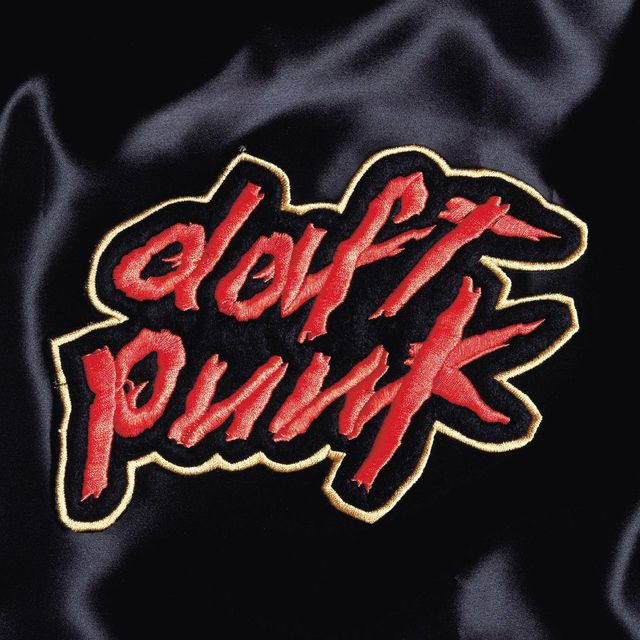
The cover followed the same rule. It shows no people at all, only the Daft Punk logo, which Homem-Christo had designed, embroidered as a patch on the back of a black satin jacket. Photographer Nicolas Hidiroglou said it took about a week. “They wanted to try out a number of different fabrics before they found exactly what they wanted – the black satin,” he said.
Homework in the Bedroom
Homework was recorded in Bangalter's bedroom, and the title is a joke about that. “You always do homework in the bedroom,” Bangalter told the Swedish magazine Pop. He told CMJ that they “made the record at home, very cheaply, very quickly, and spontaneously, trying to do cool stuff.”
They were not in a hurry. According to Pitchfork, drawing on the same Pop interview, they worked no more than eight hours a week over five months. “We have not spent much time on Homework,” Bangalter said. “The main thing is that it sounds good.” He also saw it as practice.
We see it as a training for our upcoming discs. We would as well have been able to call it Lesson or Learning.
The equipment was cheap and mostly Roland. In a 1999 interview with a Japanese magazine, summarized by MusicRadar, the duo listed TR drum machines, a TB-303 bass synthesizer, a Juno-106 and an E-mu SP-1200 sampler. Sounds went through a small Mackie mixer and a compressor onto a DAT tape machine. Then they were chopped up in a Roland sampler and sequenced on a Mac. Files were saved on zip disks.
They did not set out to make an album. The tracks were made one at a time as possible singles. Once they had enough, they arranged them to fill the four sides of a double vinyl LP. “There was no intended theme because all the tracks were recorded before we arranged the sequence of the album,” Homem-Christo told Dance Music Authority. “The idea was to make the songs better by arranging them the way we did; to make it more even as an album.”
Spike Jonze's video follows a man with a dog's head around New York. The song plays from his boombox, and Daft Punk never appear.
Sixteen Tracks, Four Sides
The album runs about 75 minutes. It opens with “Daftendirekt,” a clip of the music Daft Punk used to start their live sets, recorded at the I Love Techno festival in Ghent in 1995. It closes with “Funk Ad,” a short clip of “Da Funk” played backwards. In between are hard techno tracks like “Rollin' & Scratchin'” and “Rock'n Roll,” and lighter disco loops like “Fresh” and “Phoenix.”
Almost every track starts with one sound, usually a four-to-the-floor kick drum, and adds pieces one by one. The production leans hard on compression, which squeezes loud and quiet sounds together. Chris Power of BBC Music heard it as “a sonic tribute to the FM radio stations that fed Daft Punk's youthful obsessions.” The second track, “WDPK 83.7 FM,” is a short tribute to American FM radio.
“Teachers” is a list of thank-yous. Over a stuttering groove, a pitched-down voice reads out the names of the producers who shaped them. Many are Chicago and Detroit house and techno artists such as DJ Sneak, Romanthony and Jeff Mills, alongside Brian Wilson, George Clinton and Dr. Dre. “We show instead our taste,” Bangalter said of their decision not to show their faces.
Bangalter did not want any one song to carry the record. People promoting the album told him it was hard to push, because DJs were not focusing on any one track. “It's true that there's not one track that is more important than the other on the album,” he said in 1997.
Essential Tracks
“Da Funk”
“Da Funk” started as an attempt at American hip-hop. “It was around the time Warren G's ‘Regulate’ was released and we wanted to make some sort of gangsta rap and tried to murk our sounds as much as possible,” Bangalter told Pop in 1997. Nobody heard it that way. “We've heard that the drums sound like Queen and The Clash, the melody is reminiscent of Giorgio Moroder,” he said. “No one agrees with us that it sounds like hip-hop.”
It is about 20 beats per minute slower than their earlier techno tracks. Its main hook is a squelchy, wah-wah-like synth riff. Carlos Hawthorn of Resident Advisor called it “one of the most recognisable riffs in electronic music” and “the first hint of the duo's pop potential.”
Virgin reissued it with a new B-side, “Musique,” and it reached No. 7 in Britain. Spike Jonze's video helped. It follows a man with a huge dog's head around New York, carrying a boombox that plays the song. The music is there, but the musicians are not, which matched how Daft Punk wanted to be seen.
“Around the World”
“Around the World” is the album's pop song, though it has only three words. A voice put through a vocoder sings the title over and over. Albumism counted 144 repetitions. Under it sits a rubbery, funky bassline and a few bright keyboard notes.
Chris Power of BBC Music called it “one of the decade's catchiest singles” and “a perfect example of Daft Punk's sound at its most accessible: a post-disco boogie bassline, a minimalist sprinkling of synthetic keyboard melody and a single, naggingly insistent hook.” The NME was less sure. Its 1997 review called the track a “note-perfect pastiche” of vocoder disco-funk but said that, at over seven minutes, it was “perhaps a joke too far.”
It became the album's biggest hit, reaching No. 5 in Britain in 1997. Michel Gondry's video, with costumed dancers including a troupe of robots, became an MTV fixture. Stereogum's Tom Breihan thinks the dancing robots in that video may have given Daft Punk the idea for the helmets they wore from 2001.
Michel Gondry's video for the album's biggest hit, which reached No. 5 in Britain in 1997.
“Revolution 909”
“Revolution 909” opens with the sound of a party. Then come police sirens and a voice on a megaphone ordering everyone to stop the music and go home. The title names the Roland TR-909, a drum machine central to house music.
The track is a protest against the French authorities, who were cracking down on raves in the mid-1990s. “They pretend it's drugs, but I don't think it's the only thing,” Bangalter told Dance Music Authority. “They probably wouldn't have a problem if the same thing was going on at a rock concert, because that's what they understand. They don't understand this music which is really violent and repetitive, which is house; they consider it dumb and stupid.”
It was the fourth and last single from the album. Roman Coppola directed the video. Police try to break up a rave, and one officer gets distracted by a tomato sauce stain on his jacket. The video then cuts to a cooking lesson on how to make the sauce. Homem-Christo saw it the same way. “I don't think it's the music they're after—it's the parties,” he said.
A “Mighty Mash-Up of a Debut”
British critics were used to dance acts by 1997, and most compared Daft Punk with the Chemical Brothers. The NME's review, dated January 18, 1997, opened with a joke about French food and French pop. It praised the duo's “masterful gourmet blend of serious dancefloor attitude” with “effortlessly sophisticated continental cool.”
The NME also found it far too long. It called the album an “80-minute mammoth” full of “57 flavours of madness and self-indulgence,” where “the joke is stretched way beyond breaking point.” Still, it ended on praise: “this is a mighty mash-up of a debut which radically redefines France's pop credentials.”
The Chemical Brothers comparison annoyed Homem-Christo. “There is no relation between them and us. None at all,” he said in 1996. Bangalter was more diplomatic. “They are so much more rock-influenced than us,” he told the Montreal Mirror. “So the fact that people who like The Chemical Brothers like our stuff too is good.” To him it meant people were “getting steps closer to dance music, to house music.”
The public agreed. Homework reached No. 3 in France in its second week on the chart. In Britain it reached No. 8 and spent 41 weeks on the chart. Bangalter was not ready to call it a movement. “We're not gonna say ‘yeah, we're the leaders!’” he told Dance Music Authority. He thought their success might be motivating other people in France to make dance music.
America was slower. Daft Punk spent the spring of 1997 on a DJ tour of North American clubs and parties while the album came out there. Many American listeners found the long, repetitive tracks hard going. Tom Breihan of Stereogum admitted that when Homework was new, he hated it. “For a suburban American kid in 1997, Homework sounded like homework,” he wrote. The album still went gold in the US, largely on the strength of the two singles and their videos.
A Boat in Glasgow and a Live Show
Daft Punk played live long before the album came out. On September 30, 1995, they played their fourth-ever show on the Renfrew Ferry, a boat on the Clyde in Glasgow, at a party run by Slam. About 600 people came. The duo played with a mixing desk, a 909, a 303, a sampler and a keyboard. According to Slam, the boat shook so hard that people worried it might sink.
The album's opening track comes from that period. “Daftendirekt” is the intro music from their set at the 1995 I Love Techno festival in Ghent, Belgium. Starting Homework with it made the record sound like the start of one of their shows.
Their full live tour was due to start in May 1997. Bangalter promised it would be played, not mimed. “It's myself and Guy-Manuel up on stage with our equipment with no DAT or prerecorded sequences,” he said. “Everything is done right there.” In a later interview he described how it worked. The drum machines and bass lines were synced to a sequencer, and the two of them brought layers of samples in and out on top.
They spent most of 1997 on the road. “We spent most of 1997 touring and doing our live show,” Bangalter told Remix. The first half of 1998 went into their own labels and a collection of their videos. In 1999 and 2000 they split their time between those labels and the next album.
From French Touch to Ed Banger
Homework did not invent house music, and Daft Punk never said it did. Angus Harrison made the point in Vice for the 20th anniversary. “Homework didn't introduce the dance music to the masses,” he wrote. “Homework introduced Daft Punk.” What it did do was put France at the front of dance music. Clash later grouped Daft Punk with Air, Cassius and Étienne de Crécy as the French acts that set “the electro soundtrack for the next decade.”
The filtered-disco side of the album took over European pop. In 1998 Bangalter made “Music Sounds Better with You” with Alan Braxe and Benjamin Diamond as Stardust. It was one of the biggest dance hits of the year. The harder side lasted too. Daft Punk's manager Pedro Winter founded the Ed Banger label. Pitchfork argues that its duo Justice owe almost all of their 2007 debut to the grinding sound of “Rollin' & Scratchin'.” In 2002 LCD Soundsystem released “Daft Punk Is Playing at My House.”
Daft Punk themselves moved on quickly. Discovery in 2001 swapped the raw loops for full songs and brought in the robot helmets. Their 2007 Alive tour, named after one of Homework's last tracks, turned this music into a stadium show. Breihan argued that Homework's willingness to sell long, strange grooves to American teenagers was “maybe the most forward-thinking thing Daft Punk have ever done.”
The duo split in February 2021. Exactly a year later, on February 22, 2022, they released a 25th anniversary edition of Homework with a disc of remixes. They also streamed a full 1997 concert from the Mayan in Los Angeles on Twitch, one time only, from before the helmets.
“For every bagatelle like High Fidelity or Phœnix, though, there's a gleaming techno machine like Alive ready to hover into view and throw you forward into an LED-coated future of Kanye samples, Grammys, Tron soundtracks, movies and pyramids. The rise of the robots started here.”