
Some time in 1985, Daniel Lanois ran out of patience with Peter Gabriel. Gabriel kept putting off the lyrics for the album they were making at his home studio. So Lanois nailed him inside until he had written them.
The studio was a converted cow shed at Ashcombe House, near Bath, and the cows still came by to lick the windows. The record that came out of it was So, released on May 19, 1986.
It was the first Gabriel album with a real title. It went to No. 1 in Britain and No. 2 in America. Its lead single, “Sledgehammer,” replaced his old band Genesis at the top of the US singles chart.
Its stop-motion video swept the MTV Video Music Awards. After a decade as a cult figure, Gabriel was suddenly a pop star.
“I wanted his emotions to come to the forefront. To wear no mask and no veil. To have no mirrored contact lenses. No trickery. Just take everything off and let the songs be heard.”
A Cult Artist With a Few Hits
Gabriel left Genesis, the band he had co-founded and fronted, in 1975. His first four solo albums were all called Peter Gabriel, each with an obscure cover. They produced occasional hits, “Solsbury Hill,” “Games Without Frontiers,” and “Shock the Monkey,” but after each one he retreated to his country house to experiment without deadlines.
The early 1980s were hard on him. He came home from his 1982 tour feeling “hollow and empty,” his marriage to his wife Jill strained, and the couple went into therapy. He later called the period “18 months of torment.” “I uncovered a lot and it's all in the songs of the album,” he told Rolling Stone in 1986.
When the blues singer sits there and pours out his heart he's purging his soul a little bit, and he's doing so for all the audience.
Meanwhile, director Alan Parker asked him to score the film Birdy. Short of time, Gabriel brought in Daniel Lanois, the Canadian producer who had just co-produced U2's The Unforgettable Fire. Lanois built the score from Gabriel's archive of unfinished songs and demos. Gabriel was so pleased that he asked him to stay on and produce the next album. Nile Rodgers and Bill Laswell had both been considered for the job.
This time he wanted something lighter. “I wanted to get back to a more traditional form of song-writing, to have some fun, to be a bit less sombre and mysterious,” Gabriel said. “I'd been revisiting my childhood obsession with 1960s soul music and was even considering doing a full album of covers, but instead I wrote ‘Sledgehammer’ as more of a tribute to singers like Otis Redding.”
The Three Stooges in a Cow Shed
Work began in earnest in February 1985. Rather than book an expensive commercial studio, Gabriel converted the cow barn at Ashcombe House. “It's all done here, so I'm not paying vast sums for studio time,” he told Sounds. “My advances from royalties go towards the studio equipment and it gives me the opportunity to experiment.” The room had little acoustic treatment and no sightline between the players and the control room. “That studio was very home‑spun,” Killen said, “but it somehow managed to sound quite true.”
For the first stretch it was just Gabriel, Lanois, and guitarist David Rhodes. They wore yellow construction hard hats as their “going to work” outfit and called themselves the Three Stooges. Gabriel started with rhythms, as he always did. “I came up with the rhythms first on a new drum machine and then laid down the chord foundations for about twenty songs, which eventually got whittled down to twelve,” he said. His demos were a Linn 9000 drum pattern and chords on a Prophet‑5 or Yamaha CP70 piano, which the band then played over.
Lanois liked to blur instruments together. “It wasn't unusual to have Dan playing a 12‑string electric guitar, David Rhodes playing his Steinberger six‑string guitar or Strat, and Peter playing the CP70, Fairlight or Prophet 5,” Killen recalled. Instead of three separate tracks, the three parts were recorded as a single sound, so that the result was neither clearly a guitar nor clearly a keyboard.
Then the guests arrived. Drummer Manu Kitché and bassist Tony Levin formed the core rhythm section. Kate Bush, the Senegalese singer Youssou N'Dour, Stewart Copeland, Nile Rodgers, and Laurie Anderson all contributed. For “Sledgehammer,” Gabriel recruited trumpeter Wayne Jackson of the Memphis Horns, who had played with Otis Redding when Gabriel saw Redding in London in 1967.
Gabriel cared about where those sounds came from. In 1982 he had organized the first WOMAD festival, putting musicians from around the world on the same stage. “For any of us musicians who get ideas from other cultures, we get accused of cultural imperialism,” he told Spin in 1986. “I think it's important to digest it a little rather than imitate it.”
Directed by Stephen R. Johnson with Aardman Animations and the Brothers Quay, the 'Sledgehammer' video was made in just over a week.
A Nailed Door and a Smashed Phone
Lanois expected to be at Ashcombe for about six weeks. Engineer Kevin Killen, hired in May 1985 for what he was told would be four to six weeks of overdubs, was warned on arrival by Gabriel's assistant that he would be there until the following March. “I know Peter,” the assistant said. “Things don't move that quickly in his world.”
Killen's first job with Gabriel's voice was a blind test. Gabriel normally sang through a basic Shure SM57, but Lanois set up about six microphones at matched levels and had Gabriel walk in blindfolded, singing into each one. He picked a vintage Neumann U47. When a faulty cable on it was repaired, it sounded fuller and lost the airiness they liked, so the engineers rigged a second, deliberately flawed signal path and blended the two.
The holdup was always the words. Gabriel would sing nonsense syllables into a track, which he called “Gabrielese,” and slowly turn them into lyrics. Musicians often recorded parts to a song with no vocal at all. “Peter was constantly upgrading his ideas,” Killen told Sound on Sound, “and so original parts would have to be replaced to accommodate the new arrangements.”
Deadlines in July and December passed. Lanois, used to working fast, grew frustrated. On one occasion he smashed the telephone to stop Gabriel using it; on another he nailed the studio door shut until the lyrics were done. Gabriel agonized over the running order too, testing sequences on cassettes of the songs' openings and endings.
The album was mastered in mid-February 1986. “It took us a year to finish So, almost to the day,” Lanois said, “and I wasn't aware of this but was told after the fact that it's the fastest record Peter ever made.”
The long wait for words did not reflect a weak singer. Once Gabriel settled on a lyric, he needed only a handful of takes. “It's rare that Peter sings out of tune and he's really got the most soulful sounding voice,” Killen said. When executives from Virgin and Geffen came to Ashcombe that autumn to hear rough mixes of six or seven songs, their verdict was entirely positive.
Essential Tracks
“Sledgehammer”
Gabriel wrote it as a tribute to the Stax soul he had loved as a teenager, and stuffed it with innuendo. When Killen arrived, the track existed only as drums, bass, guitar, and keyboards, close to ten minutes long with no vocal and no horns. The team edited it down, and Gabriel and Lanois flew to New York in September 1985 to add the horns.
It opens with a synthesized shakuhachi flute that Gabriel played on his Fairlight, then drops into a greasy horn break. Katché and Levin push and pull against the beat, with Levin's bass run through a Boss octave pedal. Lanois suggested sampling and truncating the word “sledgehammer” in the chorus to make it sound robotic. In October the backing singers P.P. Arnold, Coral Lewis, and Dee Gordon came in, recorded facing one another around a pair of microphones. Gabriel's own lead vocal was built from five or six complete takes, which Killen combined line by line into one performance. Kraftwerk biographer David Buckley says Karl Bartos told him the band heard it at New York's Power Station and felt their own record “was puny sonically by comparison.”
It reached No. 4 in the UK and topped the US chart in July 1986, knocking Genesis's “Invisible Touch” off No. 1. It remains his biggest hit. Its video, by director Stephen R. Johnson, combined pixilation, claymation, and stop-motion from Aardman Animations, including the dance of the oven-ready chickens, animated by a young Nick Park.
“Don't Give Up”
The album's emotional center came from Dorothea Lange's photographs of Americans during the Great Depression. Gabriel wrote it as a duet, first hoping to sing it with Dolly Parton. When she declined, his friend Kate Bush, then riding the success of Hounds of Love, took the part.
The structure is simple and devastating. Gabriel sings the verses as a man worn down by unemployment, and Bush answers in the chorus with comfort. Richard Tee's gospel-tinged piano carries both voices through the song. In Britain, with unemployment high under Margaret Thatcher, the song struck a nerve.
It was a top-ten hit in the UK but stalled at No. 72 in America. Over time it has become arguably Gabriel's best-loved song, and its message of resilience has long outlived the specific hard times that inspired it.
“In Your Eyes”
It began life as “Sagrada,” inspired by Barcelona's Sagrada Família and its architect, Antoni Gaudí. By the time it was finished it had become a love song that treats romantic devotion with something close to religious awe.
Youssou N'Dour's vocal, sung in Wolof, lifts the final minute into something ecstatic. The song shows the album's method at its best: an African singer and a pop chorus in the same track, with neither reduced to decoration.
The song was rumored to have been inspired by the actress Rosanna Arquette. Its second life came in 1989, when Cameron Crowe used it in Say Anything; according to Crowe, it was Arquette who persuaded Gabriel to let him have it. John Cusack's character, Lloyd Dobler, blasts it from a boombox in the film's best-remembered scene, and a new generation found the song.
'Don't Give Up' was written with Dolly Parton in mind; Kate Bush took the part and made it one of Gabriel's best-loved songs.
Mozo, Milgram, and Anne Sexton
Beyond the hits, So keeps the strangeness of the earlier albums. The opener, “Red Rain,” came from a dream of a red sea dividing and glass bottles shaped like people filling with blood. It drew on Mozo, a wandering, Moses-like stranger who had flickered through Gabriel's songs for years. “I think with ‘Red Rain,’ fairly early on, that was going to be an opener,” Gabriel said.
“We Do What We're Told (Milgram's 37)” had been around since 1980. It takes its subject from Stanley Milgram's psychology experiments on obedience, in which volunteers kept following orders against their conscience. Placed among the singles, it reminded new listeners that Gabriel could still unsettle them.
“This Is the Picture (Excellent Birds)” began as a collaboration with Laurie Anderson for her album Mister Heartbreak, sparked by the video artist Nam June Paik. Nile Rodgers added guitar in New York. “I loved that sound that Daniel got,” Rodgers said.
“Mercy Street” was written for the poet Anne Sexton, who took her own life in 1974. Gabriel had heard the Brazilian forró style on a trip to Brazil, and the percussion was recorded in Rio de Janeiro. A tape accidentally played back slower than intended gave the track its drifting feel. “Big Time,” with Stewart Copeland on percussion, went the other way: a loud, funky satire of fame and greed.
“That Voice Again,” co-written with Rhodes and first titled “First Stone,” is a jangling, Byrds-like pop song about the judging voice in his own head, with Rhodes on Rickenbacker. Lanois heard a new candor running through all of it. “I think these songs are more revealing, they are more naked, they are taking risks,” he said, “and listeners feel that when a man takes a risk.”
A Title, a Face, and “So”
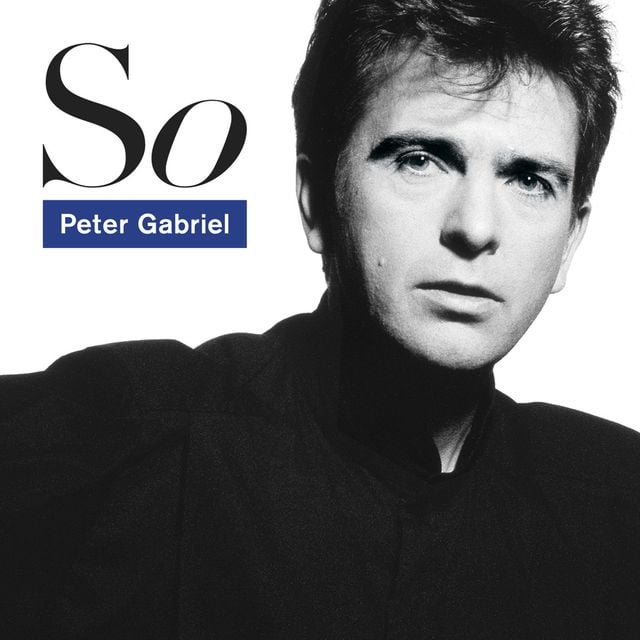
The finished album came with two conditions from the record company. It could not be called Peter Gabriel like the four before it, and it needed his face on the cover. Gabriel had made the record for a mass audience, so he reluctantly agreed.
He chose So because it was a short, empty word that looked good on a sleeve. Designer Peter Saville framed it beside a black-and-white portrait styled after David Bailey's 1960s photographs. “I was made to go with Peter Saville's idea for a retro-style portrait as I was told my usual obscure LP sleeves alienated women,” Gabriel said later.
Number One in Britain, Sledgehammer in America
“Sledgehammer” came out in April 1986, a month before the album, and its video did the rest. Johnson and Gabriel spent weeks planning it. Animators from Aardman in Bristol, along with the Brothers Quay, then shot, edited, and finished it in just over a week. Gabriel had to hold still for long stretches while each frame was photographed.
The video was impossible to ignore on MTV. At the 1987 MTV Video Music Awards it won a then-unprecedented haul of prizes, including Video of the Year. It also introduced Aardman, later the makers of Wallace and Gromit, to an international audience.
So topped the UK chart and went triple platinum there. In the US it reached No. 2 and was certified five-times platinum. “Big Time,” a satire of fame, reached No. 8 in America but only No. 13 at home; Stephen R. Johnson directed its video too, and MTV played it heavily. Meanwhile “Red Rain,” “Don't Give Up,” and “In Your Eyes” followed as singles. Paul Simon's Graceland, another big pop record built from world music, arrived three months later.
Not every critic bought the change. Robert Christgau gave it a B-minus and missed the political Gabriel of “Biko.” “Where is ‘Biko’ now that we need it more than ever?” he asked. Gabriel went on to play Amnesty International benefit shows and the Human Rights Now! tour.
No Shadows Left to Hide In
So remains the biggest seller of Gabriel's career. It made him an MTV fixture and sent him around the world on the long This Way Up tour. It also changed who listened. Fans who had followed him since Genesis now shared him with people who knew only “Sledgehammer.”
The album's quieter songs proved the more durable. “Mercy Street” became a staple of his concerts. “In Your Eyes” kept finding listeners through Say Anything. “Don't Give Up” became a song people turn to in hard times.
Gabriel was pleased but clear about what it cost. “When I first heard So I was really pleased,” he wrote. “It wasn't as rich with texture and sonic experiment as my earlier albums but it had a very strong spirit.”
Forty years on, the album still sounds like a careful negotiation: soul horns and African voices, confession and comedy, art-rock texture and three-minute hooks. Gabriel spent a year in a cow shed getting that balance right.
“With So this was the end of the idea of me being a sort of cult artist at the fringes of the mainstream, especially in America. There wasn't an option to go and hide in the shadows any more.”