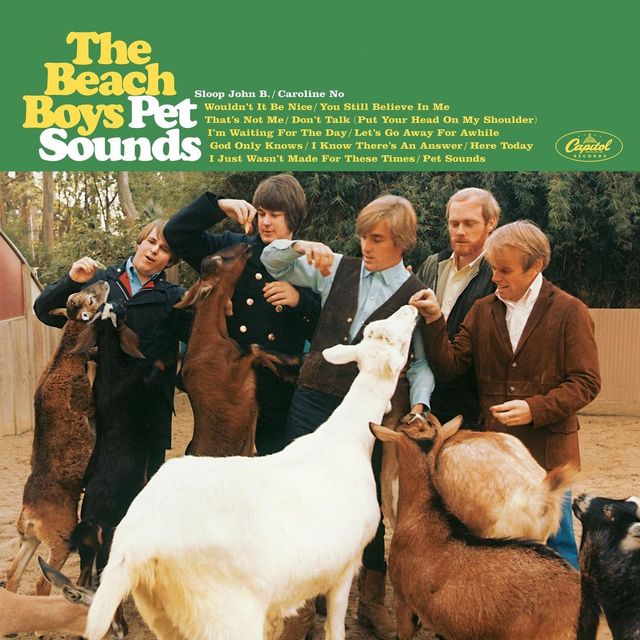

In late 1965, Brian Wilson heard the Beatles' Rubber Soul and decided to make an album on the same level. He was 23. While the rest of the Beach Boys toured Japan early in 1966, he stayed in Los Angeles and made it with an advertising copywriter and the city's best session players.
The result was Pet Sounds, released on May 16, 1966. Capitol Records' sales staff were disappointed by it. Within two months the label rushed out a greatest-hits album, which went gold. Pet Sounds stalled at No. 10 in America.
In Britain it reached No. 2, and John Lennon and Paul McCartney asked to hear it twice. The Beatles' producer, George Martin, later said Sgt. Pepper was an attempt to equal it.
“Now the album stands as the affluent, confident, brilliant, sentimental, insecure, vulnerable American response to ‘Rubber Soul’ that inspired ‘Sgt. Pepper.’”
“Rubber Soul Blew My Mind”
By 1965 the Beach Boys were one of America's biggest bands, selling songs about surfing, cars and girls. Brian Wilson wrote, arranged and produced them. In December 1964 he had a severe panic attack on a flight to Houston and quit touring. “It's going to be well worth it,” he recalled telling the band, “because I'm going to write you some good songs — and I did.” Glen Campbell, and later Bruce Johnston, filled in for him on stage while Brian stayed home to write and record.
The American version of Rubber Soul, released by Capitol at the end of 1965, changed his plans. “Rubber Soul blew my mind,” he told Paste in 2004. “I liked the way it all went together, the way it was all one thing. It was a challenge to me to do something similar.” He did not want to copy it. “I didn't want to do the same kind of music, but on the same level.”
Capitol had trimmed the Beatles' album into a consistent folk-rock record with no singles, to be heard as a whole, notes the critic Tom Smucker in his Library of Congress essay. Wilson wanted Pet Sounds to be heard the same way. He also had a bigger aim. “We were trying to capture spiritual love that couldn't be found anywhere else in the world,” he said.
“When I heard Rubber Soul I was so inspired and somehow I came up with ‘God Only Knows,’” he said in 2017. “I can't really explain how it happened, it just came to me.” Our review of Rubber Soul covers the album that started it.
A Lyricist From the Ad Agency
Wilson wanted words from outside the band's usual circle. In late 1965 he called Tony Asher, a copywriter at the Carson-Scott advertising agency who had written campaigns for Mattel toys and Max Factor. The two had met briefly in a studio where Asher was producing jingles.
“A few weeks later, I got a phone call,” Asher recalled. “And Brian said, ‘Listen, I have an album that is overdue. Would you want to help me write it?’ I thought it was somebody in the office playing a joke on me.” He took a leave of absence from his job and reported to Wilson's house in Beverly Hills a few days later.
Their sessions usually started as long conversations about life and love. “It's fair to say that the general tenor of the lyrics was always his and the actual choice of words was usually mine,” Asher said. “I was really just his interpreter.”
His first job was to replace the words of a finished track called “In My Childhood,” which kept its bike horn and bell. He came back the next day with “You Still Believe in Me” on a yellow legal pad. Wilson never let him hear the original lyric.
The music under those words was unusual for pop. In his book on the album, Jim Fusilli points out that “You Still Believe in Me” is in B major, a key rarely used in pop, and that Wilson put the same unexpected chord under the words “love” and “fail.” “It's as if Brian wanted there to be no confusion for the listener,” Fusilli wrote. “In his mind, at least in this song, love equals failure.”
Studio 3 at Western Recorders
The album was recorded between January 18 and April 13, 1966, at studios including United Western Recorders on Sunset Boulevard, with Chuck Britz engineering. Wilson cut the backing tracks with the Wrecking Crew, the group of Los Angeles session players who played on hundreds of hits. Drummer Hal Blaine, bassist Carol Kaye and pianist Don Randi were among them.
The instruments went far beyond a rock band. Sleigh bells, timpani, vibraphone, French horn, flutes and bongos all appear. Some sounds were improvised. For the title track, Wilson had drummer Ritchie Frost tap two empty Coke cans. On “God Only Knows,” the clip-clop rhythm came from plastic orange-drink bottles that Blaine cut down and taped together.
“Brian loved that kind of stuff,” Blaine said. Wilson had a name for the sound he wanted. “I thought of it as chapel rock,” he said. “Commercial choir music. I wanted to make an album that would stand up in 10 years.”
Smucker describes Wilson as “composing using the modern mid-1960s recording studio as his instrument.” Three Dog Night's Danny Hutton watched one session. “[Brian] would hear something wrong, and bam ‘One more time,’” he recalled. “I just shut up. What could I add?”
Two tracks had no vocals at all. Wilson called one of them, “Let's Go Away for Awhile,” “the most satisfying piece of music I have ever made.” The other, the title track, began as a James Bond-style theme. “We were gonna try to get it to the James Bond people,” he said. “But we thought it would never happen, so we put it on the album.”
Recorded on March 10, 1966, in a session that ran from 12:30 a.m. to 4:30 a.m. Brian Wilson gave the lead vocal to his brother Carl.
“Don't F--- With the Formula”
The rest of the band returned from Japan in February 1966 to add their vocals. They had been touring on the strength of “Barbara Ann,” a loose campfire-style cover Brian had tossed off the previous autumn. What they heard was very different.
One of the first tracks was “Hang On to Your Ego,” written with road manager Terry Sachen and inspired by Wilson's experiences with LSD. Mike Love, Brian's cousin, rejected it as “a doper song.” “I wasn't interested in taking acid or getting rid of my ego,” he explained in 1996. Wilson let him rewrite the title, and it became “I Know There's an Answer.”
Al Jardine saw it as a clash of instincts. “Mike's a formula hound,” he said. “If he can't hear a hook in it, he doesn't want to know about it.” Asher remembers Love hissing “Don't fuck with the formula!” at Wilson during one session. Love calls such stories “a bunch of bullshit,” but admits that “some of the words were so offensive to me that I wouldn't even sing ’em.”
The vocal sessions were long. “‘Wouldn't It Be Nice,’ we must have done 25 takes of certain sections of it, just to make sure it was perfect,” Love told The Vinyl Guide podcast. “I call him the ‘Stalin of the Studio.’ Because he wanted it perfect. And he was looking for something that normal human beings don't hear.”
Wilson also knew when to strip things back. For the fade-out of “God Only Knows,” he first stacked up the whole band, producer Terry Melcher, his wife Marilyn and her sister Diane. “It just got so overloaded; it was nuts,” Johnston said. “So he was smart enough to peel it all back.” The final fade has three voices: Brian, double-tracked, and Johnston. Not every slip was cleaned up. On the original mono mix, Johnston can still be heard chatting to a photographer about a camera during the instrumental break of “Here Today,” followed by Brian calling “Top, please!” to the engineer.
Essential Tracks
“Wouldn't It Be Nice”
The album opens with a young couple who wish they were old enough to marry. It is the brightest song on the record, a full Wrecking Crew arrangement with the band's harmonies stacked on top.
It is the cheerful door into a sadder record. Smucker traces a story that runs from “the opening anticipation of ‘Wouldn't It Be Nice’ to the isolation, if not despair, of the closing ‘Caroline No.’”
Its vocals were the hardest part. Love counted 25 takes of some sections as Wilson chased the blend he wanted. It became one of the band's concert staples, alongside “God Only Knows” and “Sloop John B.”
“God Only Knows”
Wilson told The Guardian in 2015 that he and Asher wrote it in 45 minutes. They argued over two things. Wilson thought Asher's opening line was too negative for a love song, but Asher fought for it. And Wilson worried about putting “God” in a pop title. “He said, ‘We'll just never get any airplay,’” Asher recalled. A few Southern radio stations did ban it.
The backing track was cut on March 10, 1966, with about 20 musicians in Studio 3. The famous French horn opening was played by Alan Robinson. Wilson sang the lead first, then gave it to his younger brother Carl. “I said my brother Carl will probably be able to impart the message better than I could, so I sacrificed that one,” he said.
Capitol put it on the B-side of “Wouldn't It Be Nice” in the US. It has since become the album's most praised song. Paul McCartney has cited it as one of his favourite songs, one that often brings him to tears.
“Caroline, No”
The closing song grew out of Wilson's high-school crush on a cheerleader named Carol Mountain. By 1966 both were married, and he had started calling her late at night to talk about music. He told Asher he felt the torch dimming. Asher wrote the chorus as a line to Carol, and Wilson misheard it as “Caroline, No.”
It moves at a slow crawl, with Blaine playing upturned water jugs like bongos. Wilson's father, Murry, suggested speeding the tape up by a full tone. It made Brian sound younger and sweeter, like the lovesick teenager the song describes.
As the flutes fade, a train passes and two dogs bark. The train came from a sound-effects record. The dogs were Wilson's own, a beagle called Banana and a Weimaraner called Louie.
The album's opening track. Mike Love says the band sang some sections 25 times before Brian Wilson was happy.
Goats at the San Diego Zoo
On February 15, 1966, the band went to the San Diego Zoo to shoot the cover. The photo shows five of them feeding goats in the children's petting area. Bruce Johnston, who had just become a full member, was left off for contractual reasons.
The shoot did not go smoothly. According to the Los Angeles Times, zoo officials accused the band of mistreating the animals. The band said it was the other way round. “The goats were horrible!” Johnston recalled. “They jump all over you and bite. One of them ate my radio.”
The recording took about ten months of Wilson's time and cost around $70,000, making it one of the most expensive albums of its day. The mixing was much quicker. Session musician Steve Douglas, then a producer at Capitol, says it was mixed down in a single long session. “It was full of noise,” he said. “You could hear him talking in the background.”
Capitol Wanted More “Barbara Ann”
Capitol heard the finished album in April and did not know what to do with it. “It was played at a sales meeting, and the marketing guys were really disappointed and down about the record,” said A&R man Karl Engermann, “because it wasn't the normal ‘Surfin' U.S.A.,’ ‘Help Me, Rhonda,’ ‘Barbara Ann,’ kind of production.”
Love remembers the same reaction. “Gee, guys, this is great. But could you do something more like ‘California Girls’ or ‘I Get Around’?” he recalls being asked. “In other words, they wanted that hit 45 formula to continue on ad infinitum.”
Capitol hedged its bets. Less than two months after Pet Sounds, it released Best of the Beach Boys, a collection of the old hits, and put its promotion behind that. The compilation went gold. Pet Sounds peaked at No. 10, a big drop from the band's earlier No. 1 albums. “They turned their back on him by releasing Best of the Beach Boys,” Johnston said at the album's 30th anniversary.
The sales figures stayed murky for decades. Pet Sounds was not certified gold in the US until 2000, because Capitol could not find its shipping records from 1966 to 1985. The executive in charge of the certification guessed it had really sold two million copies.
Keith Moon, a Hotel Suite and Two Beatles
Johnston decided to promote the album himself. On May 16, the day it came out in America, he flew to London “to do some hustling.” The Who's drummer, Keith Moon, a surf-music fan, adopted him and drove him around in his Bentley.
The visit paid off. Lennon and McCartney came to Johnston's suite at the Waldorf Hotel to hear the new album. “John and Paul made me play it twice,” Johnston said. “It was like collectively watching a great movie, and you go, ‘Wow!’ and just know it was cool.” Smucker notes that the album then rose steadily in esteem in Britain while it fell out of favour at home.
“Without Pet Sounds, Sgt. Pepper never would have happened. Pepper was an attempt to equal Pet Sounds.”
The influence showed quickly. According to legend, Lennon and McCartney went from the hotel to write the opening of “Here, There and Everywhere” in its style, and it appeared on Revolver that August. Martin said the bigger effect came a year later, on Sgt. Pepper.
Second Only to Sgt. Pepper
Wilson's next project was “Good Vibrations.” It had been on the early track lists for Pet Sounds, but he held it back. He spent six months on it, recording more than 90 hours of tape for over $50,000. It went to No. 1 that October and was his last No. 1 as a producer.
The album's reputation grew as the band's hits faded. Stereo remixes and the 1997 Pet Sounds Sessions box, with its separate instrumental and vocal tracks, made it, in Smucker's words, “a financial and critical success long after its original release.” The Library of Congress added it to the National Recording Registry in 2004.
In 2003 Rolling Stone ranked it No. 2 on its list of the 500 greatest albums, behind Sgt. Pepper. In his later years, Wilson toured it with a band of younger musicians, playing it in full in concert halls. He died on June 11, 2025, aged 82.
Sixty years on, it still sounds like what Wilson set out to make: a whole album about growing up and losing things, built from sounds nobody else was using. As Johnston put it, “This album is timeless and forever, and the label turned it into an ignored stepchild.”
“We were trying to capture spiritual love that couldn't be found anywhere else in the world.”