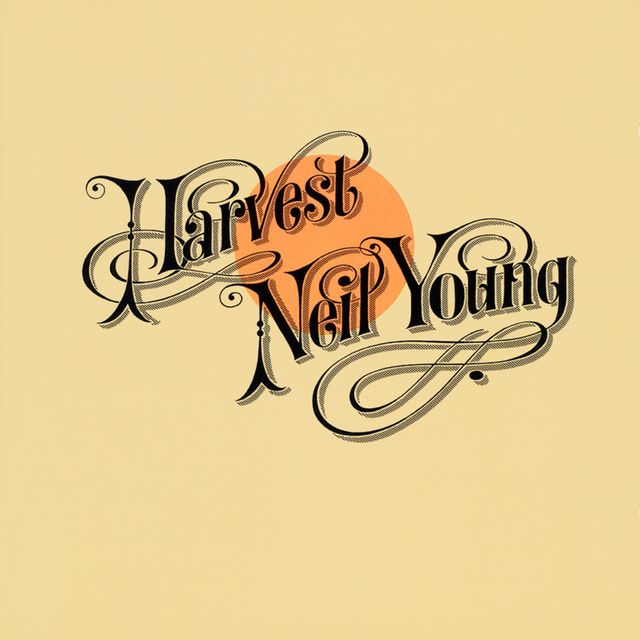

On February 5, 1971, Neil Young went to a dinner party at a new studio in an old house on Nashville's Music Row. He was in town to tape The Johnny Cash Show. The next evening, he recorded “Heart of Gold” there in two takes, with a band of Nashville session players he had just met.
Young was 25 and wearing a back brace. Slipped discs had kept him in and out of hospital for two years, and he could barely hold up an electric guitar. So he made the mellowest record of his career so far.
Harvest came out in February 1972. It knocked Don McLean's American Pie off No. 1, and “Heart of Gold” became Young's only No. 1 single. It was the best-selling album in America that year. Young spent the next few years running away from it. It turns 55 in February 2027.
“It's the one Neil Young album people who don't really like Neil Young own.”
Recorded in a Back Brace
In 1970, Young bought a ranch in the hills of Northern California for $350,000. It had redwoods, two lakes, two houses and an old barn. He named it Broken Arrow Ranch. Then his back gave out.
He described it to Cameron Crowe in Rolling Stone in 1975. “I was in and out of hospitals for the two years between After the Gold Rush and Harvest,” he said. “My discs slipped. I couldn't hold my guitar up. That's why I sat down on my whole solo tour.”
It took him 45 minutes to walk the 400 yards from his house to the studio, and he could stand for only four hours a day. “I recorded most of Harvest in the brace,” he said. “That's a lot of the reason it's such a mellow album. I couldn't physically play an electric guitar.”
So he toured alone, playing songs nobody had heard yet. At Toronto's Massey Hall in January 1971, he told his hometown crowd: “I've written so many new ones that I can't think of anything else to do with them other than sing them.” “Heart of Gold,” “Old Man” and “The Needle and the Damage Done” were already in the set.
One of those songs went straight onto the album. On January 30, 1971, the night after Massey Hall, Young played Royce Hall at UCLA. The live recording of “The Needle and the Damage Done” from that show is the version on Harvest.
Dinner at Quadrafonic Sound
A week later, Young was in Nashville. The Johnny Cash Show was taping at the Ryman Auditorium on February 6 and 7, and his fellow guests were James Taylor and Linda Ronstadt. On the evening of the 5th, producer Elliot Mazer invited all three to dinner at his new studio.
Quadrafonic Sound Studios was a converted two-story house. “The control room was the old porch,” Mazer recalled. “The living room and dining room became the two live rooms, and the kitchen became a drum area.” The name was a joke, he told Sound on Sound, “although it did have four speakers in the control room.”
By the end of the night, Young had booked a session for the next day. Mazer brought in four Nashville players: Kenny Buttrey on drums, Tim Drummond on bass, Ben Keith on pedal steel and Teddy Irwin on acoustic guitar. Young later named the core of this band the Stray Gators. “Harvest would have never happened without Elliot,” Young wrote on his archives website.
“Neil sat in the control room of Quadrafonic and played ‘Heart of Gold.’ Kenny and I looked at each other, and we both knew it was a number one record.”
The band played live in the room, as it did on every song on the album, Mazer said.
Young was particular. On “Out on the Weekend,” he told Buttrey his hi-hat was too busy. “So Kenny said, ‘Fine. I'll sit on my right hand,’” Mazer recalled. “He played the whole take sitting on his right hand.”
This was new for Young. His earlier records had country touches, but NME pointed out in 1972 that this was “the first time that actual country musicians or steel guitar had been used.” Keith's pedal steel became the sound most people now associate with the album.
On the first day they cut “Heart of Gold,” “Old Man” and an outtake called “Bad Fog of Loneliness.” “Heart of Gold” took two passes. “I guess it took less than two hours to record everything,” Mazer told Mix in 2023.
Taylor and Ronstadt stayed to sing harmonies, and Taylor played banjo on “Old Man.” Ronstadt remembered kneeling on the control-room couch to get level with Taylor, who is much taller. “Then we sang all night, the highest notes I could sing,” she told Mojo. “It was dawn when we walked out of the studio.”
Recorded in two passes on February 6, 1971, with James Taylor and Linda Ronstadt on harmonies. It is Young's only No. 1 single.
The London Symphony in Barking Town Hall
The second stage of the album happened in London in 1971. Young was there for a BBC TV concert and a show at the Royal Festival Hall. He also recorded two songs on piano with the London Symphony Orchestra, in the town hall of Barking, in east London.
The arrangements were by Jack Nitzsche, who had been Phil Spector's right-hand man on his 1960s productions. The two songs were “A Man Needs a Maid” and “There's a World.” They are the album's most divisive tracks.
“A Man Needs a Maid” began with a film. Young saw Diary of a Mad Housewife (1970) and fell for its star, Carrie Snodgress, who was nominated for an Oscar for the role. “I fell in love with the actress, she was playing a part that I could understand,” he said. He contacted her, and they started a relationship that produced a son, Zeke, in 1972.
The title was criticized as sexist at the time, and still is. Young said it came partly from being laid up: “I found myself not being able to move around too much, in bed a lot, and my mind started wondering.”
On stage in 1971 he warned audiences, “It doesn't really mean what it says. I don't really want a maid.” Snodgress later put it her own way. “My [career] choice was being an actress or a nurse, so Neil was right up my alley,” she said. “I just got to nurse the hell out of him.”
Snodgress runs through the whole record. Young has said that “A Man Needs a Maid,” “Heart of Gold,” “Out on the Weekend” and the title track were all inspired by their relationship. They are love songs from a man who is not sure he can cope with being in love, and the title track is the one Young himself considers the album's best.
Young had at least one important fan of the orchestral version. “Bob Dylan told me it was one of his favourites,” he said. “I listened closer to Bob.”
Back in the Barn at Broken Arrow
The last stage happened at home. Between sessions, Young had surgery on his back. “The doctors were starting to talk about wheelchairs,” he told Crowe, “so I had some discs removed.” Afterward he could play electric guitar again. Later in 1971 he brought the Stray Gators to the barn at Broken Arrow.
The barn sessions produced the album's three loudest tracks. “‘Are You Ready for the Country,’ ‘Alabama’ and ‘Words’ were all done after I had the operation,” Young said. David Crosby, Stephen Stills and Graham Nash added harmonies, some of them recorded at the Record Plant in New York.
Mixing was split between Quadrafonic and the ranch. When it was done, Young invited Nash to hear it, and the playback became a famous story. Young rowed Nash into the middle of the lake. Then Mazer played the album at full volume, using Young's house as the left speaker and his barn as the right.
“After the music stopped blaring, Elliot came down to the shore of the lake and shouted, ‘How was that, Neil?’” Nash wrote in his memoir Wild Tales. “And I swear this is true, Neil shouted back, ‘More barn!’” In 2016, Young confirmed it to the Huffington Post: “I think it was a little house heavy.”
The barn songs are the album's rougher side. “Alabama” returns to the subject and sound of “Southern Man” from After the Gold Rush, with Young back on electric guitar. “Words (Between the Lines of Age)” closes the album at more than six and a half minutes, most of it guitar. Mendelsohn found that solo “fumbling and clumsy.” Grammy.com's 50th-anniversary piece heard something else in it, calling the song's energy “wizened, molten, ancient-feeling.”
Essential Tracks
“Heart of Gold”
“Heart of Gold” is built on four simple chords, a harmonica line and a steady, unhurried beat. Young has said it was inspired by his new love for Snodgress. It is a song about searching for real love and getting older while you look. Young credited Buttrey for the feel. “He had his drums set up so that he could see my hand on the guitar,” he wrote on his archives site.
The single came out in January 1972, a few weeks before the album. It reached No. 1 on the Billboard Hot 100 and in Canada. It remains his only No. 1 single, and Ronstadt and Taylor's high harmonies on the chorus are a large part of why it worked on the radio. Mendelsohn was unmoved. He wrote that the song's “basic conceit would be laughed off the airwaves coming from another solo troubadour.”
Not everyone was pleased. Bob Dylan was living in Phoenix when it was a hit and thought it sounded like him. “I used to hate it when it came on the radio,” he told Spin in 1985. “I always liked Neil Young, but it bothered me every time I listened to ‘Heart of Gold.’”
“Old Man”
“Old Man” is about Louis Avila, the caretaker who came with the ranch. On Young's first visit, Avila drove him around the 140 acres in an old blue army jeep. In his memoir Waging Heavy Peace, Young recalled Avila asking how a young man could afford a place like that. “Just lucky, I guess,” Young replied. Avila said it was the darnedest thing he had ever heard.
The song turns that meeting into a conversation across generations. It is one of the best-arranged tracks on the album. Taylor's banjo and Keith's pedal steel lift the chorus, and Taylor and Ronstadt sing harmony. It was released as a single and reached No. 31. Mendelsohn thought its opening line “promises a lot more than the song ever delivers.”
Not everyone heard it as a song about Avila. “My dad thought it was written for him,” Young wrote. “And I never told him it wasn't because songs are for whoever receives them.” Of the ranch itself, he wrote simply: “I had finally made it.”
“The Needle and the Damage Done”
The album's shortest song is its most serious. It is about heroin, and about the musicians Young had watched it take. The closest was Danny Whitten, Crazy Horse's guitarist and second singer, who had played with Young since 1969.
It is just Young and an acoustic guitar, recorded live at UCLA. Young was careful about how it would be heard. “I am not a preacher,” he wrote in the notes to his 1977 compilation Decade, “but drugs killed a lot of great men.”
Opinions split here too. NME heard “a sad painful reflection on hard-drug taking,” while Mendelsohn called it “glib, even cute.” Robert Christgau called it one of the album's two “major” songs.
The song soon looked prophetic. When Young rehearsed his next tour, Whitten could not keep up. “He couldn't remember anything. He was too out of it. Too far gone,” Young told Crowe. Whitten died of an overdose before the tour began. His death hangs over the dark records Young made next.
Young playing Old Man solo for the BBC in London in 1971, a year before Harvest came out.
Taking No. 1 From American Pie
Harvest reached No. 1 on the Billboard 200 on March 11, 1972. It replaced Don McLean's American Pie, which had been there for seven weeks. It stayed there for two weeks, while “Heart of Gold” climbed to No. 1 on the singles chart.
It was the best-selling album of 1972 in the United States, on Billboard's own year-end figures. Michael Leonard of Guitar.com points out that it outsold the Rolling Stones' Exile on Main St., David Bowie's Ziggy Stardust and Simon & Garfunkel's Greatest Hits that year. It has since been certified four times platinum in the US.
Its timing helped. Carole King's Tapestry and James Taylor had made quiet, personal songwriting the sound of the moment. Two of the album's singers were part of that scene. Harvest fitted right in.
The Review Rolling Stone Took Back
The critics were much less impressed than the public. In Rolling Stone, John Mendelsohn wrote that Young had settled into “the stereotypical laid-back country-comforted troubadour role.” He called the Stray Gators “a flaccid imitation” of Crazy Horse.
Mendelsohn found the lyrics marked by an “extremely low incidence of inspiration and high incidence of rhyme-scheme-forced silliness.” He called “There's a World” “flatulent and portentuous nonsense.” His one compliment: “Neil Young still sings awful pretty, and often even touchingly.”
The British press was warmer. NME's Rob Drysdale reviewed it track by track in February 1972. He praised the “brilliant banjo and steel guitar” on “Old Man.” But he felt the orchestra on “There's a World” was “a little overdone,” which most critics still agree with.
Christgau, writing later, gave it a B-plus. He blamed the early backlash on “critical overreaction” to its huge success. He thought it proved “the genteel Young has his charms, just like the sloppy one,” despite “self-imitation on ‘Alabama’” and what he called the “unbearable” “There's a World.” Rolling Stone came round too: it now ranks Harvest No. 78 on its list of the greatest albums of all time.
Heading for the Ditch
The success was what Young reacted against. He explained it in the notes to Decade. “This song put me in the middle of the road,” he wrote of “Heart of Gold.” “Travelling there soon became a bore so I headed for the ditch. A rougher ride but I saw more interesting people there.”
The “ditch” was the run of dark, rough albums that followed: Time Fades Away, On the Beach and Tonight's the Night. He made them knowing what he was giving up. “I imagine I could have come up with the perfect follow-up album. A real winner,” he told Crowe. “But it would have been something that everybody was expecting.”
He kept coming back to the Harvest sound anyway. In 1992 he made Harvest Moon, an acoustic sequel recorded in Nashville. The album's songs became standards. “Are You Ready for the Country” was a hit for Waylon Jennings in 1976, and “Alabama” helped provoke Lynyrd Skynyrd's answer song, “Sweet Home Alabama.”
Young has stayed in two minds about the album. He once called it a “mellow trip where my life was at the time, but only for a couple of months.” For its 50th anniversary in 2022, he still put out a box set of the original recordings with studio outtakes, a 1971 BBC solo concert and Harvest Time, a two-hour documentary filmed during the sessions.
In 2015, Harvest entered the Grammy Hall of Fame. Bob Mersereau's book The Top 100 Canadian Albums ranks it first. The voice that critics once found thin is part of its appeal now. “Almost a boy soprano, this strange Northern voice, like the sound of a loon,” Ronstadt said of singing with him.
“Even the slightest songs here are gratifying musically.”