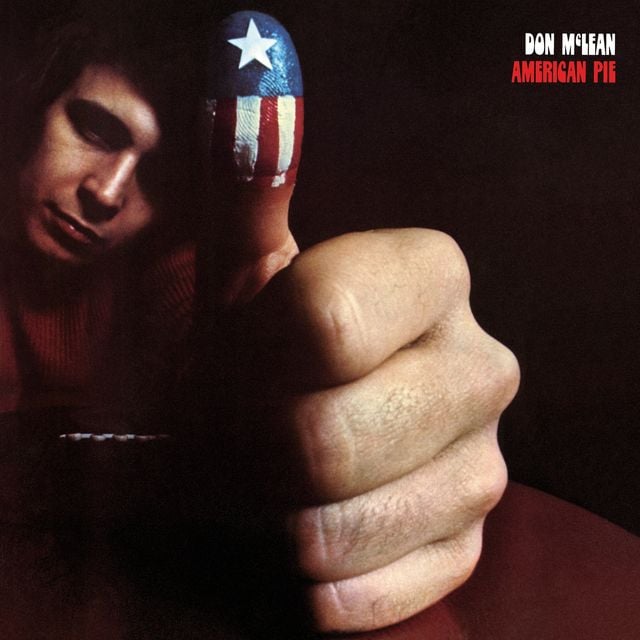

On the morning of February 4, 1959, a thirteen-year-old in New Rochelle, New York, cut the string on his bundle of newspapers and read the front page before he delivered it. A chartered plane had come down in an Iowa field the previous night, killing Buddy Holly, Ritchie Valens and J.P. Richardson. Twelve years later that boy walked into Studio A at the Record Plant on West 44th Street and cut an eight-and-a-half-minute song about it — too long for radio, too long for a 45, and structurally nothing like a hit. United Artists released it by splitting it across both sides of the single, because there was no other way to put it out. It went to number one for four weeks, took the album with it, and set a record for the longest song ever to top the American chart that stood for roughly half a century.
“I first found out about the plane crash because I was a 13-year-old newspaper delivery boy.”
Seventy-Two Rejections
Nothing about Don McLean's career to that point suggested this was coming. He had spent the late sixties playing the Hudson Valley folk circuit, doing a stint as a travelling troubadour for the New York State Council on the Arts, and accumulating rejection letters. His debut, Tapestry, was turned down repeatedly before finding a home at Mediarts, a label that had not existed when he began looking for one.
What changed his prospects was corporate rather than artistic. United Artists absorbed Mediarts, and McLean's second album inherited the promotional muscle of a major label almost by accident. Without that takeover, the most-discussed song in American popular music would have been released by a boutique imprint with no radio department.
He was twenty-five, his first marriage was coming apart, and the decade that had shaped him had just ended in a way nobody involved had planned for. That combination — personal collapse running alongside a broader one — is audible across the whole record, not just the famous parts. American Pie is dedicated to Buddy Holly, and the dedication is not decorative.
Studio A, May 26, 1971
The album was cut across May and June 1971 in the Record Plant's Studio A, a room roughly thirty-five by fifty-five feet with a twenty-five-foot ceiling, a Spectra Sonics console and a sixteen-track Ampex. Producing was Ed Freeman, who made two decisions that shaped everything.
The first was personnel. Rather than book the most efficient session players available, Freeman assembled musicians he thought would behave like a band — Paul Griffin and Warren Bernhardt on pianos, David Spinozza on electric guitar, Mike Mainieri on vibes and marimba, Bob Rothstein on bass, Roy Markowitz on drums. Engineer Tom Flye remembered Freeman having definite ideas about how everything should sound and working unusually well with players.
The second was to track McLean live, singing and playing at once. He was never comfortable doing one without the other, so Flye built a Plexiglas panel that sat between McLean's chin and his guitar, isolating the vocal from the acoustic so the two could be treated separately without losing the performance. Rhythm tracks generally went down in a single take; McLean's phrasing varied so much between passes that some vocal parts ran to twenty-four.
The title track was recorded on May 26, 1971, and it nearly did not work. Two weeks of rehearsal had produced an arrangement nobody was happy with. Griffin was added at the last moment, and his piano — which drives the acceleration from the funereal opening verse into the singalong — is what finally made the thing move. The apparent simplicity of that first verse is an illusion: Flye recalled eight separate edits in the section that is nothing but piano and voice.
Eight and a half minutes, recorded live in one room on May 26, 1971 — and released as a 45 split across both sides because no shorter version was ever an option.
A Single With Two Sides
Then United Artists had to sell it. An eight-and-a-half-minute song could not go on a 45, and the obvious solution — an edit — was refused. As Flye put it, several versions were made, but a short version was never on the table.
What shipped instead was one song across two sides: roughly the first four minutes on the A-side, fading out, and the remaining four and a half on the B, fading in. Radio stations initially played only side one. Listeners would not stand for it, and programmers quickly switched to the full album version — which meant that in the winter of 1971 into 1972, American Top 40 radio was regularly surrendering eight and a half minutes of airtime to a folk singer.
It entered the Hot 100 at No. 69 and reached No. 1 on January 15, 1972, staying four weeks. It topped the charts in Canada, Australia and New Zealand and reached No. 2 in Britain. For nearly fifty years it held the record as the longest song ever to reach No. 1 in the United States, until Taylor Swift's ten-minute version of “All Too Well” displaced it in 2021.
Essential Tracks
“American Pie”
It opens as a slow, almost hymnal recollection of a boy learning that the musicians he loved are dead, and then it does something no hit single had really attempted: it speeds up and stays sped up for six minutes, cycling through verse after verse of allusive, deliberately unstable imagery, with a chorus built to be shouted by a room full of people who have no idea what the verses mean.
The construction is what carries it. McLean plays a Martin D-28 as the spine; Griffin's piano supplies the lift; the tempo change roughly ninety seconds in functions as a hinge between private grief and public spectacle. By the final chorus a large uncredited choir has joined — billed on the sleeve as the West Forty Fourth Street Rhythm and Noise Choir. Freeman later claimed it included Pete Seeger, James Taylor, Livingston Taylor and Carly Simon, though no membership list was ever published.
What it accomplished beyond the charts is rarer. McLean coined a phrase for February 3, 1959, that has since become the standard English name for that date, used by people who have never heard the record. The Library of Congress added the recording to the National Recording Registry in 2017, and the RIAA placed it fifth in its Songs of the Century project.
“Vincent”
McLean wrote it in 1970 after reading a biography of Van Gogh, and it is the exact opposite of its famous neighbour: four minutes, no allusions to decode, one subject, stated plainly. Where the title track hides its meaning behind a wall of imagery, “Vincent” simply describes a man whose work nobody understood while he was alive.
The arrangement is close to bare — fingerpicked acoustic guitar, a restrained string chart from Freeman, and a vocal delivered barely above conversational volume. That restraint is a deliberate risk. The song has no dynamic build at all, which in 1972 was close to commercial suicide and is precisely why it works: the flatness of the delivery is the sympathy.
Released as the follow-up single in February 1972, it went to No. 1 in Britain for two weeks and No. 12 in the United States, where it also reached No. 2 on the Easy Listening chart. It has since outgrown its own album, played daily at the Van Gogh Museum in Amsterdam and covered several hundred times.
“Empty Chairs”
The album's quietest song and the one that explains the mood of everything around it. Written as McLean's first marriage was disintegrating, it is a three-and-a-half-minute inventory of a room after somebody has left it, sung with the same unhurried delivery as “Vincent” and even less musical decoration.
It is here, rather than in the two hits, that the influence of the era's confessional singer-songwriters is most obvious — this could sit on Tapestry or Blue without adjustment. The sparseness Freeman imposed across the record pays off best on tracks like this one, where a fuller arrangement would have flattened the intimacy.
Its afterlife is the strangest on the album. Hearing it is what moved Lori Lieberman to write the lyric that became “Killing Me Softly with His Song” — a hit for Roberta Flack in 1973 and again for the Fugees in 1996. An obscure McLean album cut is, at two removes, the reason one of the most covered songs in pop exists.
Four minutes, no allusions, no dynamic build — the follow-up single that went to No. 1 in Britain and is still played daily at the Van Gogh Museum.
The Song That Refuses to Be Solved
Almost immediately, listeners set about decoding the title track, and McLean declined to help. His early position was that the words were beyond analysis because they were poetry. His more durable position was a joke: asked what “American Pie” meant, he answered that it meant he never had to work again if he did not want to.
It means I don't ever have to work again if I don't want to.
The silence held for over four decades, and it was strategic. A song that will not resolve stays in circulation; every classroom, radio phone-in and pub argument that tried to crack it was free promotion. McLean later put the principle plainly: songwriters should make their statements and move on, maintaining a dignified silence.
The seal broke, partially, in 2015. McLean consigned the original manuscript to Christie's — sixteen pages, 237 handwritten lines and twenty-six typed, including verses that never made the record — and it sold on April 7 for $1.2 million. The sale catalogue carried his own gloss: that things in the song are heading in the wrong direction, and that it is, in a sense, a morality song. That is a long way from a line-by-line key, but it is a genuine statement of intent.
Then, in a 2022 documentary, he did something better than explaining: he dismantled the standard decoder ring. Elvis Presley was not the king. Janis Joplin was not the girl who sang the blues. Bob Dylan was not the jester. Half a century of confident annotation, wrong on its three most cited points. He did offer a few real keys — the marching band as the military-industrial complex, the sweet perfume as tear gas — and insisted the method was impressionistic rather than literal all along.
Number One and a C−
The album went to No. 1 on the Billboard 200 and topped the charts in Canada and Australia, reaching No. 2 in Britain. It was certified gold within six months of release and is now two-times platinum in the United States. For a folk record with an eight-minute lead single, that is an extraordinary set of numbers.
Critics were more divided than the sales suggest, and the sharpest dissent came from Robert Christgau, who graded it C− in the Village Voice. He conceded the title cut was a great novelty song that might be about the death of rock and roll or might be about its refusal to die — and then argued that the rest of the album indicated McLean could not have written it, before advising readers to just buy the single. It is unfair, and it identifies something real: the gap in ambition between the two famous songs and the eight that surround them.
Retrospective opinion has settled somewhere in between. AllMusic gives it four stars; it was included in 1001 Albums You Must Hear Before You Die; and the title track sits in the National Recording Registry. The fairest reading is that American Pie is a very good singer-songwriter album carrying two songs of an entirely different order, and that the album's reputation is doing work the deep cuts were never built to do.
Those deep cuts are better than their reputation, though. “The Grave,” a stark anti-war narrative, was covered by George Michael in 2003 as an Iraq protest. “Babylon,” a ninety-second round adapted from Psalm 137 with an assist from Lee Hays of the Weavers, closes the record and later turned up in Mad Men. This is not filler; it is simply a different, smaller kind of songwriting sharing a sleeve with a monument.
Why It Still Matters
Fifty-five years on, the album's durability rests on a paradox worth stating plainly: the most successful piece of American songwriting about the 1960s is one that nobody can reliably explain, written by a man who spent forty years refusing to explain it, and whose eventual explanation was mostly a list of things it did not mean.
That is not a failure of craft. It is the craft. McLean built a song with enough specific texture to feel like it must be about identifiable people, and enough ambiguity that it never closes. Every generation gets to re-solve it and re-fail, which is why a record about a plane crash in 1959, released in 1971, is still being argued over by people born fifty years after the fact.
And underneath the puzzle there is a real feeling that has nothing to do with codes. A thirteen-year-old boy read a front page he was supposed to be delivering and understood, for the first time, that things end. The rest of the song — the jesters and kings, the marching band, the whole allusive parade — is scaffolding around that one plain fact. The riddle is why people keep coming back. The grief is why it works.
“You will find many interpretations of my lyrics but none of them by me... songwriters should make their statements and move on, maintaining a dignified silence.”