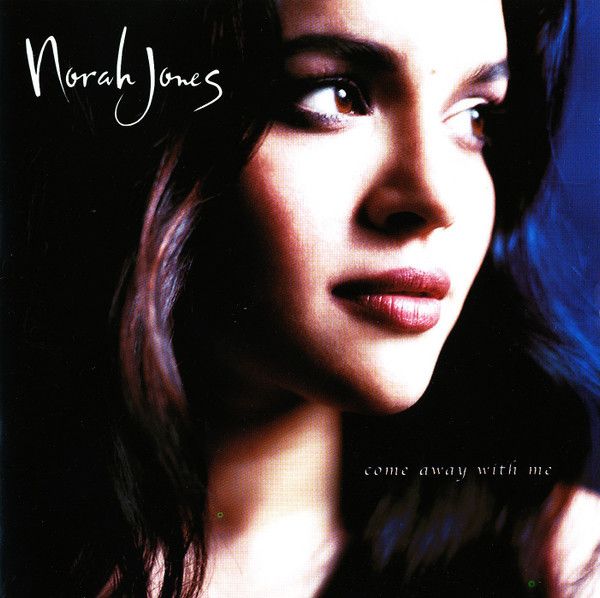

In the spring of 2001, Norah Jones recorded 21 songs in five days with producer Craig Street and some of New York's best jazz musicians. Blue Note Records had signed her a few months earlier. A week after the label received the tapes, her manager called to say it had rejected the album.
Jones went back into the studio that summer with Arif Mardin, who had produced Aretha Franklin. They remade most of the record in less than a week and kept two of her early demos. Come Away With Me came out on February 26, 2002, and sold 10,000 copies in its first week.
Most of the industry expected it to sell fewer than 100,000 copies. It went on to sell more than 27 million and win eight Grammys, including Album of the Year. It turns 25 in February 2027.
“Debut albums rarely achieve such a timeless, breathtaking quality, but Norah Jones' new album is worthy of Horace's epithet.”
A Jazz Brunch on Her 21st Birthday
Jones grew up in Texas, the daughter of the concert producer Sue Jones and the sitar player Ravi Shankar. She listened to her mother's records: Ray Charles, Aretha Franklin, Dolly Parton and Willie Nelson. In high school she fell for Bill Evans and Miles Davis, and twice won DownBeat's student award for best jazz vocalist. She went on to study jazz piano at the University of North Texas.
In 1999 she moved to New York to play music with Jesse Harris, a guitarist and songwriter she had met in Texas. “One day I heard her sing a song of mine,” Harris told NPR. “I thought it sounded great and I started teaching her songs, writing charts of them.” She waitressed by day and sang in clubs at night.
The downtown songwriters' club the Living Room changed her direction. “When I started going to singer/songwriter clubs, like the Living Room, I was inspired to start writing songs again,” she told Salon in 2022. “Also, in New York, I started missing country music. I was longing for my Texas roots.”
On her 21st birthday, she played a jazz brunch with a trio at a club called the Garage. Someone from EMI's publishing company was impressed and arranged a meeting with Bruce Lundvall, the president of Blue Note. Jones brought a three-song demo: two jazz standards and one of Harris's songs, “World of Trouble.”
Lundvall liked the standards and was puzzled by the third. “[Bruce] was like, ‘Well this is not really a jazz song. What do you want to be, a jazz singer or a pop singer?’” Jones told NPR. “And I was like, ‘Uhhh, jazz singer!’ I didn't know what to say.” Lundvall asked to hear more.
Thirteen Songs in Two Days
Blue Note did not send her straight into a big studio. In October 2000, the label's A&R man Brian Bacchus asked the engineer Jay Newland, who had worked with Etta James and Charlie Haden, to record demos with her. “We went in and cut 13 songs in two days, rough mixed them, and sent them off to the record company,” Newland told Berklee's alumni magazine.
Newland knew what he had. “I played Norah's demo at my sessions in Memphis, New Orleans, and Paris. People loved it everywhere,” he said. “My parents loved it, and so did my niece who is in college. That usually doesn't happen.” Four of the demos came out on a 2001 sampler EP, First Sessions.
The demos were played by Jones's own band from the Living Room: Harris on guitar and Lee Alexander on bass. They were simple and built around her piano. One of them was Harris's “Don't Know Why.” “We never beat the demo version,” Jones said later. “So, that's the version that made it on the record.”
The Album Blue Note Turned Down
For the album itself, Jones wanted something more ambitious. She loved Cassandra Wilson's 1995 album New Moon Daughter and asked to work with its producer, Craig Street. He took her to Allaire Studios near Woodstock, New York. The band included Brian Blade on drums and Bill Frisell and Kevin Breit on guitar. “We recorded 21 songs over five days,” Jones said.
She was not happy with the mixes. “I didn't love the way I sounded on them, and there was a ton of guitar,” she told NPR. “With two guitar players, at times it was just not balanced for what I wanted.” Blue Note agreed. Mardin later summed it up for Sound on Sound: “It was more of a folky, guitar-orientated approach.”
The rejection came as a phone call. “Bruce was given the 21 songs with these funky mixes, and after a week I didn't even hear from him,” Jones said. “My manager at the time, Shell, called me and said that they rejected the record.” She felt two things at once. “I was kind of relieved because I also knew that it wasn't quite right. I was also just scared that I was going to lose the deal and it was over.”
Twenty years later, she defended Street's version. “It definitely was never a failed experiment,” she said. A remix with less reverb and quieter guitars would have fixed it, she thinks, but Street never got the chance. “I think there were some politics at play behind the scenes that I don't really know much about.”
The song on the album is the original 2000 demo. It won Record of the Year and Song of the Year at the 2003 Grammys.
Jones felt pulled in several directions at once. “I felt a little pulled in different (musical) directions by people in my life – some friends, some (record company) executives, producers, whatever,” she told George Varga of the San Diego Union-Tribune. “The last thing I wanted to do, after getting a record deal, was to make an album I didn't want to make.”
Remade in Less Than a Week
Blue Note turned to Mardin, a Turkish-born producer then in his late sixties. He had made records with Aretha Franklin, Dusty Springfield, the Bee Gees and Barbra Streisand. The plan was to go back to the sound of the demos. “Both Norah and the Blue Note people thought that it should actually go back and capture the original piano-flavoured demos,” Mardin said.
This time Newland was brought back to engineer. In the summer of 2001, at Sorcerer Sound in New York, they recorded new tracks with the band that had played on the demos. “The band knew the tunes and we went in and I produced about 80 percent of the album,” Mardin said. “It was actually very quick. I think we did it in less than a week.”
The finished album was put together from all three sessions. The demos of “Don't Know Why” and “Turn Me On” stayed. “The Long Day Is Over,” “Feelin' the Same Way” and “Seven Years” came from Street's Allaire sessions. The rest was new. “Arif and I worked side by side on the tracks and the mixes,” Newland said. “It was a thrill and an honor to work with him.”
“We were hoping for some modest sales, and then look out for the next album, build the artist.”
Jones knew what she wanted it to sound like. “I like stuff that's understated, and I've always been drawn to ballads,” she said in early 2002. “I can't scat-sing … and I can't sing like Mariah Carey. But I don't want to. It's not what I enjoy listening to, so I went in the other direction.”
The result was quiet and spacious. Most of the 14 songs are built on Jones's piano, bass, light drums and a guitar or two. Jones wrote or co-wrote only three of them, and Harris wrote five. The covers include Hank Williams's “Cold, Cold Heart,” the standard “The Nearness of You” and “Turn Me On,” first released by Mark Dinning in 1961 and later sung by Nina Simone.
Essential Tracks
“Don't Know Why”
Harris wrote “Don't Know Why” and first released it with his band on the 1999 album Jesse Harris & the Ferdinandos. Jones made it a quiet piano ballad, and Harris played guitar on it, as he did across the album.
The label wanted a version for pop radio. “I do remember that the record company wanted a remix of ‘Don't Know Why’ that they could sell to pop radio,” Jones told Salon. “At the time, I was horrified by the idea.” She refused. “So, we didn't do it, but we got on pop radio anyway, and to this day, I don't know how.” It peaked at No. 30 on the Billboard Hot 100. Stereogum notes it is still her only single to reach the Top 40.
At the 2003 Grammys it won Record of the Year, Best Female Pop Vocal Performance and Song of the Year, which goes to the writer. Harris beat Bruce Springsteen for Song of the Year. “I felt a little bit guilty that night,” he told NPR. “I felt that I had robbed a bank or something.”
“Come Away With Me”
The title track is the only song on the album credited to Jones alone. She wrote it late one night after a show at the Living Room, on an old electric guitar, using the few chords she knew. “It felt more country than jazz,” she told American Songwriter. “I wrote it down with enough clues to remember the melody and luckily was able to make sense of it the next morning.”
It is a simple invitation song, sung slowly over a few chords, with the band barely moving behind her. Jones was so new to songwriting that she had stopped for years because her high-school songs embarrassed her. She was just happy, she said, to have one that didn't.
She hears it differently now. “How innocent that is, how pure that feeling is,” she said in 2022. “I don't know if I could write a song like that now.”
“Cold, Cold Heart”
Hank Williams's country heartbreak song shows how the album mixes genres. Jones turns it into a slow jazz ballad, with the bass carrying the line that Williams's rhythm guitar once played.
PopMatters loved it. Her version, the review said, “makes it seem like Hank Williams wrote the song over a few carafes of red wine in a smoky corner of the Five Spot,” the New York jazz club.
Jones has said she did not fully understand the song at the time. “I always felt like it was playful the way I did it,” she told American Songwriter. “It's a sad song about longing but there's a lightness to it.”
The title track, written late one night on an old electric guitar after a show at New York's Living Room.
10,000 Copies, Then 621,000 in a Week
The album started slowly and kept growing. It sold 10,000 copies in its first week and kept selling through 2002. It eventually reached No. 1 on the Billboard 200.
The 2003 Grammys, held on February 23, made it enormous. Jones won all five awards she was nominated for: Best New Artist, Album of the Year, Record of the Year, Best Female Pop Vocal Performance and Best Pop Vocal Album. With Harris's Song of the Year and awards for Mardin and Newland, including Producer of the Year, the album took eight Grammys. Aretha Franklin presented one of them to her.
Jones remembers the night mostly as a blur. “I definitely thought Bruce Springsteen was gonna win everything,” she told The Daily Beast in 2023. “I just felt like an imposter.” Franklin and Bonnie Raitt handed her Record of the Year, and she kept going back to the stage until she felt embarrassed. “I was starving the whole time,” she said. At four in the morning she ate “the best cheeseburger of my life” at a 24-hour bistro. “A hangry blur!”
The week after the show, it sold 621,000 copies in the US, up from about 144,000. EMI called it the biggest post-Grammy sales spike ever, and it put the album back at No. 1 above R. Kelly and 50 Cent. By then it had sold 4.2 million copies in America.
Jones found it hard to take in. “I thought there was no way the record could get any bigger after the first jump in sales, but then the Grammys happened, and it was just insane,” she said. The RIAA certified it Diamond, for 10 million US sales, in 2005.
“My First Record Is Not a Jazz Record”
The album's label caused confusion. Blue Note was the home of Art Blakey, John Coltrane and Herbie Hancock, and had never released anything as close to pop. Critics struggled to file it. PopMatters said that calling it jazz “would only be half of the story. Jones defies easy classification.”
Mardin thought it belonged to jazz anyway. Asked by All About Jazz if Jones was a jazz artist, he said: “Yes, especially in spirit.” Jones herself disagrees. “I'm the first to say that my first record is not a jazz record,” she told Salon. “It certainly leans that way, but I have too much respect for the artform of jazz to say that it was a jazz record.”
Some writers linked its success to its timing, five months after the September 11 attacks. Mardin was one of them. “This heartfelt music reached so many people, especially after 9-11,” he said. Jones rejected the idea at the time, but has since told The Guardian that “that could have been part of it.”
Looking back in 2022, Varga heard an album “dominated by hushed ballads” that still sounded unlike the other big records of 2002. “Like very few artists in their early 20s,” he wrote, “she caressed each note she sang and savored the silences between them.”
Mardin also noticed who was buying it. “When I go to Norah Jones concerts, you have 10-, 12-year-old, young people to 80-year-old grandmas,” he said. “It's just an incredible phenomenon.”
The Rejected Album, Finished at Last
The album changed Blue Note. Stereogum's Rachel Brodsky notes that the label went on to release records by Rosanne Cash, Annie Lennox, Elvis Costello and the Roots. Every Jones album since has come out on Blue Note.
It also helped open the door for the soul-influenced singers who followed, including Amy Winehouse, whose Back to Black arrived four years later, and Adele. Jones has played down the comparisons. “When people would put me in the same category as someone else, I wouldn't agree,” she told The Guardian. “The truth is some great artists came out of that and that's awesome.”
For the 20th anniversary in 2022, Blue Note put out a super deluxe edition with 22 unreleased tracks, including Jones's original demos and the rejected Allaire album. Street remixed his sessions with Tony Maserati, finishing the album he had started. “It was healing,” Jones said. “For Craig, it was a bummer to have the record taken away from him. I'm sure of it.”
Hearing the old tapes changed how she felt about her own singing. “I just never thought I sounded good on them at the time,” she said. With proper mixes, she realized, “these are actually great, and I sound great. I'm really proud of myself.”
“It was just like the whole world is ahead of us, so let's make it beautiful.”