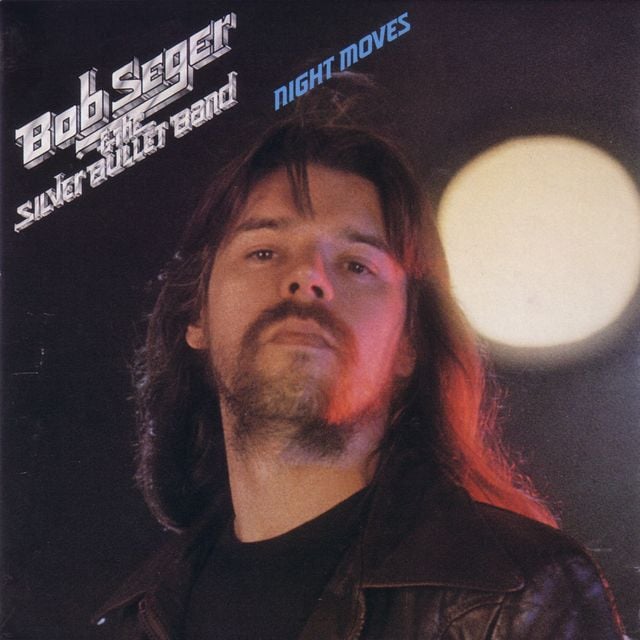

The best-known song Bob Seger ever wrote was very nearly never heard. It was cut on the last day of a three-day session in Toronto, with most of his band already gone home, by a producer his manager had hired to make him something more commercial. When the tapes came back, the manager was unhappy with them. Capitol Records was unhappy with them. Seger and his manager did not submit the song to the label at all. The producer, Jack Richardson, sent it in himself, on his own initiative and without their involvement — whereupon Capitol listened, made it the lead single, and put its title on the front of the album. It became Seger's first top-ten hit in eight years, Rolling Stone's single of the year, and one of the few American rock records of the 1970s that gets sadder the older you are when you play it.
“I came out of the theater thinking, ‘Hey, I've got a story to tell, too!’”
Nine Albums and a Michigan Ceiling
By 1976 Bob Seger had been making records for a decade and had precisely one national hit to show for it: “Ramblin' Gamblin' Man,” in 1969. Everything since had sold in Michigan and almost nowhere else. He could fill Cobo Arena in Detroit and struggle to fill a club in Ohio. Inside the state he was a rock star; three hundred miles away he was a booking agent's problem.
What finally cracked it was not a studio album. In April 1976 Seger and his manager Punch Andrews put out Live Bullet, a double album recorded at Cobo, partly as a stopgap while the next record was being written. It did what a decade of studio releases had not: it captured what the live show actually sounded like, and it travelled. By the autumn, radio programmers outside the Midwest knew who he was for the first time.
That is the position Night Moves was made from — not obscurity, exactly, but a career that had spent ten years hitting the same ceiling and had just, at thirty-one, found a crack in it. It changes how you hear the record. This is not a young man's album about being young. It is a man at the far end of his twenties writing about being seventeen, with the specific clarity of someone who has had a long time to think about it.
Three Studios, Two Different Bands
Night Moves is the first Seger studio album to credit the Silver Bullet Band on the sleeve, which makes it slightly awkward that they only play on about half of it. The nine tracks were cut across three studios with two entirely separate rhythm sections and four production credits, and the record ought by rights to sound like a compilation.
Four songs — “Rock and Roll Never Forgets,” “The Fire Down Below,” “Sunburst” and “Mary Lou” — were done at Pampa Studios in Warren, Michigan with the Silver Bullet Band: Drew Abbott on guitar, Robyn Robbins on keys, Alto Reed on saxophone, Chris Campbell on bass and Charlie Allen Martin on drums. Four more — “Sunspot Baby,” “Mainstreet,” “Come to Poppa” and “Ship of Fools” — were cut at Muscle Shoals Sound Studio in Sheffield, Alabama, with the house rhythm section, who also took a production credit: Pete Carr and Jimmy Johnson on guitars, Barry Beckett on keyboards, David Hood on bass and Roger Hawkins on drums.
The split is audible and, unusually, works in the record's favour. The Michigan tracks are louder and looser, built on Abbott's guitar and Reed's saxophone, and they swing the way a bar band swings. The Muscle Shoals tracks sit deeper in the pocket, with Hawkins and Hood doing the thing they had already done on a hundred soul records — playing slightly behind the beat so that everything feels unhurried. “Mainstreet” in particular could not have been made in Warren; Pete Carr's clean, liquid guitar figure is a Muscle Shoals sound, not a Detroit one.
And then there is track two, recorded in a third country.
Six months to write, fewer than ten takes to record, and submitted to the record label by a producer acting without the artist's knowledge.
The Song Nobody Wanted to Send
Punch Andrews wanted a hit, and went looking for someone who could make one. He hired Jack Richardson, the Toronto producer behind the Guess Who's run of North American singles, and booked three days at Nimbus Nine. Most of the Silver Bullet Band had gone home; only Campbell and Martin made the trip, and Richardson filled the room with local players — Joe Miquelon on electric guitar, Doug Riley on organ, and a trio of Toronto session singers behind Seger's vocal.
The first two days produced two Seger originals and a Motown cover. On the last day, with time left, Seger brought in a fourth song — the one he had been picking at for more than six months. It went down in fewer than ten takes. Paul Cotton of Poco added a guitar solo that was later edited out, though you can still hear a faint trace of it just before the final verse if you know to listen. They worked until half past two in the morning.
Then everyone involved on the artist's side decided it had not worked. Andrews was dissatisfied with the Toronto tapes. Capitol, hearing what did get sent, was unenthusiastic. “Night Moves” was not among the material Seger and Andrews submitted. Richardson submitted it independently — and Capitol, to its lasting credit, immediately recognised what it had, named the album after it and pushed it as the lead single. The most celebrated song in a fifty-year career reached the public because its producer went over the artist's head.
Six Months and Two Bridges
The song began in a cinema. Seger saw American Graffiti in 1973 and came out convinced that his own adolescence — Michigan, cars, summer, a girl a year older than him who eventually married a soldier — was material nobody had put on a record. He wrote the ending first, working in the basement of a house he had just bought, and then stalled badly. Two verses existed. The song did not.
What unlocked it was Bruce Springsteen. Hearing “Jungleland” showed Seger that a rock song could carry more than one bridge, and could change tempo and register in the middle without falling apart. That structural permission is what let him fuse the two halves he had — the hormonal comedy of the verses and the older man's reflection that closes it — into one piece. The whole thing took over six months.
What he had found by the end was a title that means two different things depending on which verse you are in. Early on, the phrase describes what teenagers get up to in the back of a car. By the coda it describes what time does to a memory — the way the past moves on you in the middle of the night, decades later, unbidden. Seger has said the duality was exactly why he liked it. Timothy White identified the same thing as the song's central trick: the meaning of the phrase changes underneath you while the words stay the same.
One of rock's most moving exercises in elegy.
Essential Tracks
“Night Moves”
Five and a half minutes that begin almost apologetically — a single acoustic guitar, Seger's voice close to the microphone, bass and drums arriving so gradually you do not notice them join. For a record whose other tracks open at full volume, it is a startling piece of restraint, and Richardson's production keeps everything spare for a remarkably long time.
The architecture is the achievement. The verses are comic and specific, remembering teenage fumbling with an adult's amusement; then the song executes a false ending and opens into a coda in which the whole thing is reframed as a man lying awake decades later. The backing vocals from Sharon Lee Williams, Rhonda Silver and Laurel Ward do most of the emotional work in that last section, turning what could have been maudlin into something closer to gospel.
It entered the Hot 100 at No. 85 on December 11, 1976 and took three months to reach No. 4, where it sat for two weeks — Seger's first top ten since 1969. Rolling Stone named it the best single of 1977 and later placed it at No. 301 on its 500 Greatest Songs; the Rock and Roll Hall of Fame included it among the 500 Songs That Shaped Rock and Roll, the only Seger record to make that list. He has called it his favourite of everything he wrote, and spent years trying to do it again.
“Mainstreet”
The album's other great song, and the clearest evidence for what Muscle Shoals brought to the record. It opens on Pete Carr's guitar figure — clean, unhurried, played with almost no distortion — which does more scene-setting in eight bars than most songwriters manage in a verse.
Where “Night Moves” remembers a specific summer, “Mainstreet” remembers a specific street: a teenage boy loitering outside a bar in downtown Ann Arbor, too young to go in, watching a dancer he will never speak to. Nothing happens. That is the point. It is a song about proximity to an adult world you are not yet allowed to enter, and Seger sings it without a trace of the swagger he uses elsewhere on the record.
Released as the second single in April 1977, it reached the top 40 and has since become the deep cut Seger devotees reach for first. Roger Hawkins and David Hood hold the tempo down to something close to a walking pace throughout, which is why the track feels like memory rather than anecdote.
“Rock and Roll Never Forgets”
The album opens with the Silver Bullet Band at full tilt in Warren, Michigan, and with a thesis statement disguised as a party record. Its subject is not teenage rebellion; it is being thirty-one, tired, and finding that the music still does what it always did.
Musically it is unabashed Chuck Berry lineage — a riff any bar band in America could play, Alto Reed's saxophone answering the vocal, Drew Abbott keeping it moving. Christgau made the connection explicitly, comparing the riffs here to Berry and the Rolling Stones. That is a compliment about craft, not originality, and it is accurate.
Its significance is what it announced. In 1976, rock albums were still overwhelmingly addressed to people under twenty-five. Opening a record by telling listeners who had aged out of the target demographic that the music was still theirs was a genuinely new commercial idea, and it built the audience that carried Seger through the next decade.
The Silver Bullet Band at Pampa Studios in Warren, Michigan — the loose, saxophone-driven side of an album half-made in Alabama.
Rock and Roll for People Who Are Not Teenagers
The thing that separates Night Moves from the enormous number of 1976 rock albums nobody plays is its audience. Seger worked out, apparently by accident and certainly ahead of almost everyone, that the first rock and roll generation was now in its thirties, still buying records, and had nothing addressed to it.
Christgau saw it immediately, grading the album A− in the Village Voice and putting his finger on exactly what it was: rock and roll for people who were no longer in their teens. That sounds obvious now because Seger, Springsteen, Petty and Mellencamp spent the following decade building an entire commercial category on it. In 1976 it was close to a market discovery.
The record achieves it by never once condescending to the boy it remembers. The teenager in these songs is neither idealised nor mocked. He is broke, horny, bored and standing outside a bar he cannot get into, and the man singing about him has enough distance to find it funny and enough honesty to admit he misses it. That balance is very hard, and it is why the album has outlived nearly all of its 1976 competition.
From No. 85 to Six Million
Commercially it did everything Live Bullet had promised. The album reached No. 8 on the Billboard 200 and No. 12 in Canada, finished ninth on the American year-end album chart for 1977, and became the first Bob Seger record the RIAA ever certified. It is now six-times platinum in the United States and three-times platinum in Canada.
The reviews were strong and reached for the same two names. Kit Rachlis, writing in Rolling Stone, called it one of the best albums to come out of 1976 and 1977 and observed that Seger sounded like Rod Stewart while writing lyrics like Bruce Springsteen — his only real complaint being that the production was not strong enough, which is a defensible objection to a record cut in three studios by four production teams. Cash Box singled out “Ship of Fools” as a likely classic. AllMusic's Stephen Thomas Erlewine has since given it five stars, noting how much harder it hits than 1975's Beautiful Loser while covering a far wider stylistic range.
The Springsteen comparison was fair and slightly unfair at once. Born to Run had arrived a year earlier, and Seger had openly taken a structural lesson from it. But the two men were writing about different things. Springsteen's characters are trying to escape; Seger's already left, made it, and are looking back at what they left with more affection than they expected. That is a smaller subject and, on this record, a more durable one.
Why It Still Matters
Fifty years on, Night Moves is the album that established heartland rock as a commercial proposition rather than a regional accent. Everything the genre would come to rely on is here: the specificity of place, the refusal of irony, the mid-tempo, the saxophone, and above all the assumption that the listener has a past worth being reminded of.
It is also a useful corrective to how these stories usually get told. Nothing about this record was a confident artistic vision executed cleanly. It was assembled in three cities by two bands, with a hired producer brought in to make the artist more commercial, and its defining song was written over six months, recorded almost as an afterthought, dismissed by the artist's own camp, and rescued by a producer who submitted it behind their backs. Records are often better than the process that produced them.
And the song keeps doing the thing it was built to do. Play “Night Moves” at seventeen and it is about sex. Play it at forty and it is about time. Seger wrote a coming-of-age record that quietly reveals itself to be a song about ageing, and then had to be talked into releasing it. Fifty years later it is still the one that gets people.
“The genius of the song is the way Seger changes the meaning of the phrase ‘night moves’ — from a reference to making out, to a comment on the passage of time.”