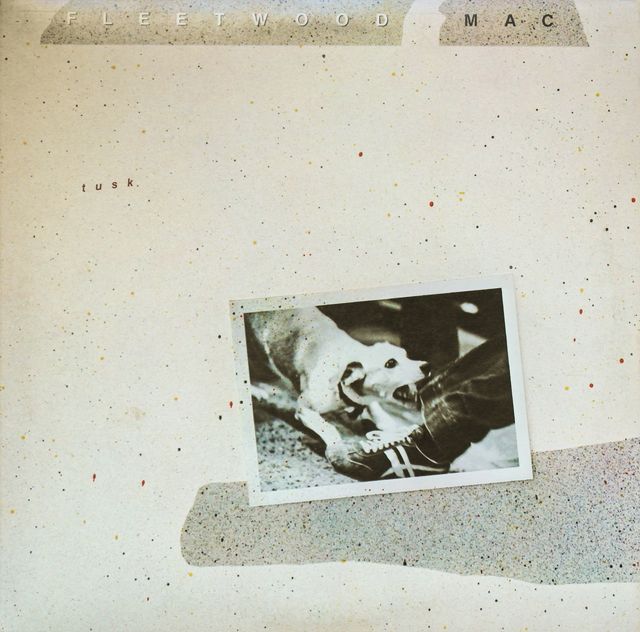

In 1978, Fleetwood Mac had to follow Rumours, one of the best-selling albums ever made. Their record company expected more of the same. Instead, Lindsey Buckingham taped a microphone to a tile floor and sang into it while doing push-ups. Mick Fleetwood hired a university marching band.
The result was Tusk, a 20-song double album released on October 12, 1979. It cost more than $1 million to make, a record at the time.
It reached No. 1 in Britain and No. 4 in America, and sold about four million copies. After Rumours, that counted as a failure. Today many fans and critics rank it among the band's best work. Mick Fleetwood calls it his favorite.
“At a cost of two years and well over a million dollars, Fleetwood Mac's Tusk represents both the last word in lavish California studio pop and a brave but tentative lurch forward.”
“Poised to Make Rumours 2”
Rumours came out in February 1977 and sold more than 10 million copies in its first year. Our review of Rumours tells how the band made it while two couples inside the group were breaking up. By 1978 the obvious next step was another record just like it.
The music around them had changed, though. “The explosion of the punk movement had changed the musical landscape,” Mick Fleetwood wrote in his 2014 autobiography. Bands like Fleetwood Mac were being called dinosaurs. Buckingham, the band's guitarist and producer, had been listening to the Clash and Talking Heads, and he wanted to follow them.
“We were really poised to make Rumours 2,” Buckingham later told Billboard. “That could've been the beginning of kind of painting yourself into a corner.” He described himself as “the culprit behind that particular album.” He said it was made deliberately to undermine “the formula of doing Rumours 2 and Rumours 3.”
The rest of the band went along partly to keep him. “He had already decided that he wanted to make a solo record,” Christine McVie told GQ in 2020. “In order to keep him within the fold we all said, ‘Well, look, let him do his experimenting and incorporate it in the album somehow.’ That's how in essence it came to be a double album.”
Champagne and Shrunken Heads in Studio D
The band tried to save money at first. Rather than pay hourly rates, they used part of their royalty advance to build their own room, Studio D, at the Village Recorder in West Los Angeles. The building had once been a Masonic temple. It did not save them anything.
The studio filled up with decorations. Stevie Nicks remembered “shrunken heads and leis and Polaroids and velvet pillows and saris and sitars,” with tusks on the mixing desk, “like living in an African burial ground.” Christine McVie later called the spending absurd. “The studio contract rider for refreshments was like a telephone directory,” she told Uncut in 2015. “Exotic food delivered to the studio, crates of champagne. Stupid. Really stupid.”
The sessions ran from mid-1978 into 1979. The final bill passed $1 million, which made Tusk the first album to cost that much. The title's meaning is still argued about. Some band members joked it was slang for male anatomy. Engineer Ken Caillat and co-producer Richard Dashut both said that was not the source. The photographer Peter Beard, whose pictures fill the inner sleeve, said the album was named after “all my photographs with tusks in them.”
A Microphone on the Bathroom Floor
Buckingham made many of his songs at home first, and he no longer wanted the smooth, perfect sound of Rumours. Caillat noticed the change on day one. “He was a maniac,” Caillat told Classic Rock. “The first day, I set the studio up as usual. Then he said, ‘Turn every knob 180 degrees from where it is now and see what happens.’” Caillat also remembered Buckingham cutting off his own hair with nail scissors.
For “Not That Funny,” Buckingham had a microphone taped to the tile floor and sang into it from a push-up position. He also asked for the studio to build a copy of his bathroom at home, because he liked how his voice and drums sounded in it. “1927 bathrooms, believe me — they're rock & roll all the way,” he said in footage filmed during the sessions.
He played with tape speed and detuned his guitars. On the title track, he and Fleetwood used lamb chops and a Kleenex box as percussion. Buckingham later admitted he was losing his balance. “I was losing a great deal of myself,” he told Mojo.
My thought was, let's subvert the norm. Let's slow the tape machine down, or speed it up, or put the mike on the bathroom floor and sing and beat on, uh, a Kleenex box!
His model was Brian Wilson of the Beach Boys, who had long since abandoned his ambitious Smile album. According to Domenic Priore's book on Smile, Buckingham listened to the unreleased Smile tapes during the Tusk sessions. He wrote nine of the album's 20 songs and oversaw much of the production. His own songs are deliberately short and rough. The Quietus noted that none runs longer than 3:32, and that on some Fleetwood “sounds as though he were drumming with a set of cardboard boxes.”
Nicks and McVie Keep the Melodies
Christine McVie wrote six songs and Stevie Nicks five. Theirs were closer to the old sound, which made the album feel like three records in one. Stephen Holden of Rolling Stone compared it to the Beatles' White Album, “less a collection of finished songs than a mosaic of pop-rock fragments by individual performers.”
McVie's “Over & Over” opens the album as a slow, gentle ballad. Buckingham said they left it “in a fairly raw state, not too glossy in the production.” The Beach Boys' Dennis Wilson, who was dating McVie, was in the studio that day and sang suggestions to her through the talkback microphone. Then the second track, Buckingham's “The Ledge,” crashes in.
Their best songs here are some of their finest. McVie's “Think About Me” is a tight, upbeat rocker. Nicks wrote “Beautiful Child” about her affair with Derek Taylor, the Beatles' former publicist, and in 1979 she called it her “most special song.” Holden thought Nicks sounded “more than ever like a West Coast Patti Smith,” with a hoarser voice than on Rumours. He was less sure about “Sara” and “Sisters of the Moon,” calling their imagery “a near-impenetrable murk.” He singled out McVie's “Brown Eyes,” where the layered voices build “a mere scrap of a song into a magnificent castle in the air.”
One old friend dropped by. Peter Green, who co-founded Fleetwood Mac and had left nine years earlier, played on McVie's “Brown Eyes.” Only a few of his notes survived, in the fade-out. “It's great that he's on here, because it's Peter and it's his band,” Fleetwood said. A longer version with his full part came out on the 2015 reissue.
Stevie Nicks's “Sara,” cut down from a 16-minute demo. Mick Fleetwood spent about 24 hours fitting his brush drumming around her timing.
112 Musicians at Dodger Stadium
The idea for the title track's marching band came from a hangover. Fleetwood was staying in Barfleur, a fishing village in France, when a local brass band woke him by marching round the square all day. “As the day went on, they got drunker and drunker,” he told British GQ. “But one thing was apparent. Everyone followed the brass band around the town, and I thought, ‘What a good idea!’”
On June 4, 1979, the University of Southern California's Trojan Marching Band, 112 players strong, recorded their part at an empty Dodger Stadium. Their director, Arthur C. Bartner, and his staff arranged the music, and he conducted from the stage. A mobile studio was set up inside the stadium, and Caillat used shotgun microphones to follow the players as they marched. A film crew shot the day for a promotional video. “When I said I wanted to record the USC Marching Band at Dodger Stadium they were sure I'd gone round the twist, so I paid for it myself,” Fleetwood told Mojo in 1995.
It was not easy. Trumpet player Gretchen Heffler remembered the band struggling to get the take, and the director and Fleetwood getting frustrated. According to the 33⅓ series book on Tusk, each student was paid one dollar. The video later became one of the first shown on MTV when it launched in 1981. “Tusk” became the USC band's unofficial fight song.
Essential Tracks
“Tusk”
“Tusk” is built around a loud, repetitive tom-tom beat from Fleetwood, with very few words and whispered vocals mixed lower than the drums. Then the marching band breaks in. Buckingham and Fleetwood added more percussion with whatever was to hand, including the lamb chops and Kleenex box.
Holden called it “an aural collage that pits African tribal drums, the USC Trojan Marching Band and some incantatory group vocals against a backdrop of what sounds like thousands of wild dogs barking.” His verdict was blunt: “‘Tusk’ is Fleetwood Mac's ‘Revolution 9.’”
Released as the lead single in September 1979, it was a strange choice for a band that had just ruled pop radio. It still went into the US Top 10. Paul Lester of Classic Rock came round to it decades later. “Suddenly, the title track does seem like the obvious single, for all its background hubbub and off-kilter tribal beats,” he wrote.
“Sara”
“Sara” is one of Stevie Nicks's most personal songs. It touches on love, friendship and a child she never had. She told Billboard that had she married the Eagles' Don Henley and had a daughter, “I would have named her Sara.” She added that another Sara in her life soon became Mick Fleetwood's wife.
Her home demo ran about 16 minutes. Henley and J.D. Souther told her it was good at full length, but she knew she had to cut it. “I found it hard to get below seven minutes,” she said. The album version runs 6:22, and the single 4:37.
The drums were a problem because Nicks's guide vocal and piano could not be separated and the timing wandered. Fleetwood solved it with brushes. “I spent about 24 hours — a long, long time — dropping in phrases, schmoozing my way around her timing,” he said. The shortened version was released as a single.
“The Ledge”
“The Ledge” is Buckingham at his most stripped-down. The band tried it together on June 24, 1978, with Fleetwood's snare tuned so high it sounded like a trash can lid. After seven takes Buckingham stopped the session and remade it at home.
On the finished version his guitar and bass are tuned down an octave, which gives the song its trashy, rubbery twang. Classic Rock's Paul Lester called it “weird rockabilly with a guitar that sounds like the twang of an elastic band.” The New York Times later described it as “a noisy, bouncing fuzz-monster that makes no kind of sense in the universe of mainstream ’70s radio pop.” Holden heard Buddy Holly in Buckingham's short rock songs, which he said had “the sound and spontaneity of beautifully engineered basement tapes.”
Placed right after “Over & Over,” it tells listeners within the first five minutes that this is not Rumours. Holden thought these rough songs helped the album. He wrote that their “calculated crudeness” both “undercuts and improves” the polished tracks around them.
Filmed at Dodger Stadium on June 4, 1979, with 112 members of the USC Trojan Marching Band.
A Million-Dollar Disappointment
Expectations were enormous. As Dylan Jones put it in GQ, “the consensus seemed to be that Tusk was going to single-handedly rescue the record business.” Warner Bros. had not heard the album until it was finished. “I would've loved to have been a fly on the wall when Warner Brothers first put that album on in the boardroom,” Buckingham told Billboard. “From a marketing point of view, it was not what they wanted or what they expected.” He later joked that people at the label “saw their Christmas bonuses flying out the window when they heard it.”
The label also made a strange marketing decision. The day before release, it played the entire double album on network radio, so anyone with a tape recorder could copy it. “To me it was like a milestone of stupidity,” Fleetwood said in 2004. The album's list price was just under $16, which was steep for 1979.
Tusk still reached No. 4 in America and No. 1 in Britain. It sold about four million copies, far short of Rumours. “We'd made this record that was so far to the left of Rumours,” Buckingham said in 2006. “And when it didn't sell 16 million copies, that was hard. There was a lot of anxiety among the people at Warners.”
The disappointment reached the band too. Buckingham told GQ that nobody judged the album until it was clear it would not sell like Rumours. Then, on tour, Fleetwood turned on him. “Mick would say to me, ‘Well, we went too far. You blew it,’” Buckingham said. “And it was very hurtful.”
From Career Sabotage to Cult Favorite
Early reviews were mixed. Holden admired Buckingham, calling him Tusk's “artistic linchpin,” but thought some of the production went too far. Robert Christgau gave it a B-plus. “A million bucks is what I call obsessive production, but for once it means something,” he wrote. He compared Buckingham's spacious mixes to reggae and Brian Eno.
Later verdicts swung both ways. Mojo called it “one of the greatest career sabotage albums of all time.” The Irish Times said that “it remains a stretch to say it's a great record.” Paul Lester of Classic Rock called it “the strangest rock album ever made by a mainstream pop behemoth.” He argued it now sits comfortably next to Talking Heads' Fear of Music.
Over time, the reputation turned. Reviewing the 2015 deluxe reissue for Pitchfork, Amanda Petrusich called Tusk “a beautiful and terrifically strange album.” Kris Needs of Record Collector called it “a classic statement of excess to bring down the curtain on the ’70s with a roar rather than a whisper.” Younger bands took it up too. Camper Van Beethoven recorded a full cover of the album, and The Quietus counts it as a formative influence on Carl Newman of the New Pornographers.
The band members came to defend it. “I think Tusk is a spectacular record,” Nicks said in the 2015 reissue notes. “We were all down with getting heavy, but Lindsey was really trying to make it weirder and heavier than any of us were able to comprehend. But we went along. We followed him up that mountain!” Buckingham called it “a very good career move” that showed “there's a good deal more than meets the eye.”
Fleetwood re-recorded Buckingham's “Walk a Thin Line” for his 1981 solo album, with George Harrison on slide guitar. Buckingham eventually left the band after Tango in the Night in 1987. Fleetwood has kept championing Tusk. He told Rolling Stone in 2016 that, along with 1969's Then Play On, it is probably his favorite Fleetwood Mac album.
“Tusk stands as a great body of work. A creative milestone. And a lesson learned is that if you want to keep creatively stimulated, you have to take risks. It truly is my favorite album.”