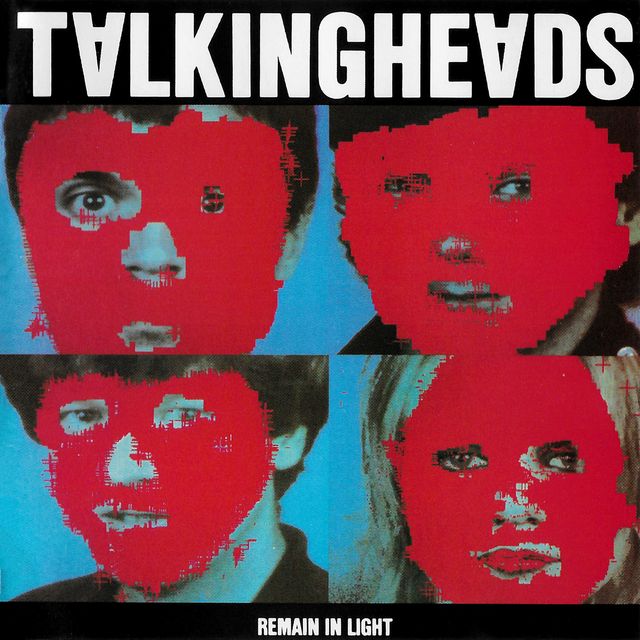

Talking Heads arrived at Compass Point Studios in Nassau in July 1980 with no finished songs. Next door, AC/DC were making Back in Black.
With producer Brian Eno, the four band members built the album one looped groove at a time. Remain in Light was assembled from studio jams rather than written in advance. Its rhythms came from African polyrhythms the band borrowed from Fela Kuti's Afrobeat records. It closes with David Byrne singing like a radio preacher on “Once in a Lifetime,” a song that flopped as a single and then became one of the most recognizable tracks of the era.
The album came out on October 8, 1980. The fight over who deserved songwriting credit nearly split the band. It is still cited as a founding text for everything from Afrobeat-influenced indie rock to sample-based production.
“‘Once in a Lifetime,’ the greatest song Byrne will ever write… it's about the secret of life, which even a woman's hips can't encompass.”
A Dead End, and an Escape Route from Fela Kuti
By 1980, Talking Heads had released three albums in three years, and their fourth, 1979's Fear of Music, already contained the seed of what would become Remain in Light: “I Zimbra,” a track built from African polyrhythmic drumming laid over a disco bassline, produced with Eno. Rather than treat that song as a one-off experiment, the band and Eno decided to build an entire album on the same premise. Before the sessions began, Eno introduced the group to Fela Kuti's 1973 record Afrodisiac, which became, in effect, the record's structural blueprint.
Drummer Chris Frantz described the ambition behind the shift plainly: “We were interested in creating sounds that would take us deeper and far beyond what people had come to expect from us.” That meant abandoning the band's usual method of arriving at a studio with finished songs. Byrne later explained the approach to the Library of Congress in stark terms: “We deconstructed everything and then as the music evolved, we began to realise we were in effect reinventing the wheel.”
The reinvention started with rhythm, not melody or lyrics. Frantz and bassist Tina Weymouth built cyclical rhythm parts that functioned like live loops, repeating patterns the rest of the band could layer indefinitely, while keyboardist Jerry Harrison and Byrne added parts on top once a groove felt right. No lyrics existed yet for most of the material; Byrne would spend weeks afterward fitting words to tracks that were, structurally, already finished.
A Preacher's Cadence, Borrowed from the Radio
Byrne's vocal on “Once in a Lifetime” came out of the same deconstructive process as the music beneath it. Rather than write a conventional lyric, he built the words from an arbitrary collage of phonetic speech patterns and quotes lifted from American radio, gravitating toward the rhythm of evangelical preachers he'd heard broadcasting across the country. He later explained the connection in purely musical terms: exciting preaching, to his ear, shared an aesthetic with music itself, call-and-response included.
The technique extended across the album. For “Crosseyed and Painless,” Frantz pushed the band toward a stream-of-consciousness, rap-influenced delivery after playing the group Kurtis Blow's “The Breaks” — an early hip-hop record whose cadence fed directly into Byrne's vocal approach, months before hip-hop had any real visibility outside New York clubs. The album's eventual closing track, “The Overload,” carried its own strange footnote: the band built it as a deliberate homage to Joy Division's gloomier, more atmospheric side, based entirely on descriptions they'd read in the music press. None of them had actually heard Joy Division's records yet, and when they finally did, they were mildly disappointed to find the real thing sounded more conventional than the version they'd imagined.
Sessions moved to Sigma Sound Studios in New York in August 1980 to finish overdubs and vocals, and it was there that the album's collaborative spirit began to curdle. Frantz recalled the atmosphere souring as Byrne and Eno took a more central role in decision-making: “It seemed as if [Byrne and Eno] thought of us as sidemen who were no longer useful to them.” Eno, according to Frantz, went so far as to complain there were “too many people in the control room” — a striking remark about the rhythm section that had built the album's entire foundation.
Directed by Byrne with choreographer Toni Basil, the video's jerking, seizure-like movements were drawn from footage of religious possession rituals Byrne had studied.
Essential Tracks
“Born Under Punches (The Heat Goes On)”
The album's opener sets its method in plain view: a looped, interlocking rhythm bed built by Frantz and Weymouth, over which guitars, keyboards, and Byrne's voice arrive in layers rather than a conventional verse-chorus arrangement. It sounds less like a song that was written than one that was assembled, piece by piece, in real time.
Byrne's lyric, delivered in his best impression of a functionary reciting official language, introduces the album's recurring character: an anonymous figure adrift inside systems — corporate, political, technological — too large to see the edges of. It's a theme that runs through nearly every track that follows.
As a statement of purpose, the track told listeners immediately that this would not be another Fear of Music: the anxious, guitar-driven post-punk of the band's earlier records had been replaced by something built from groove outward, with anxiety now folded into the rhythm itself rather than announced over it. Live, the expanded nine-piece touring band would stretch the arrangement even further, giving Bernie Worrell's keyboards and the additional percussion room to push the loop past anything captured on tape.
“Once in a Lifetime”
The album's best-known song began, like most of the record, as a jam without lyrics. Byrne's eventual vocal — half sermon, half interior monologue, asking “How did I get here?” over a hypnotic bassline and Eno's looping synthesizer — turned a middle-class existential crisis into something closer to religious ecstasy.
Released as a single in early 1981, it initially underperformed commercially, a modest showing that had nothing to do with the song's eventual reputation. What changed its fortunes was the video: Byrne's twitching, possessed-looking choreography, directed with Toni Basil, became inescapable on the still-new MTV and later resurfaced in the band's 1984 concert film Stop Making Sense.
Decades on, it's the song most cited as the album's single greatest achievement — Christgau called it flatly “the greatest song Byrne will ever write” — proof that a track built with no fixed lyric and no conventional structure could still become one of the era's most enduring singles.
“Houses in Motion”
The album's second and final single leaned furthest into its outside contributors: Jon Hassell's processed, avant-garde trumpet lines wind through the track like a fifth vocal part, while Adrian Belew's guitar work adds a layer of controlled chaos against the rhythm section's discipline.
Byrne's lyric returns to the album's central image of a man moving through life without agency, “a dark and empty room” standing in for both a literal house and a life lived on autopilot — the same anxious drift that runs through “Born Under Punches” and “Once in a Lifetime,” here set against the album's most overtly jazz-inflected arrangement.
It reached only No. 50 on the UK singles chart, a modest showing that undersells how directly it previewed the horn-heavy, expanded-band sound the group would tour with the following year — the same sound that eventually filled the stage in Stop Making Sense. Of the album's eight tracks, it's the one that most clearly points forward rather than back, a hint of the horn-driven arrangements the touring band would lean on for years afterward.
The album's second single, built around Jon Hassell's processed trumpet and Adrian Belew's guitar work.
A Credit Dispute That Nearly Broke the Band
The album's most lasting internal wound had nothing to do with music and everything to do with paperwork. The band had agreed the songs would be credited alphabetically to all five contributors: “Byrne, Eno, Frantz, Harrison, Weymouth.” Advance copies of the LP instead listed “David Byrne, Brian Eno, Talking Heads” on the cover, and the inner sleeve went further still, crediting most individual tracks to only Byrne and Eno, with Harrison named on just two songs and Frantz and Weymouth left off entirely.
For a rhythm section that had built the album's foundational loops before a single lyric existed, the omission read as a direct erasure of their contribution to a record they considered as much theirs as anyone's. The dispute was eventually corrected on later pressings, but the damage to the band's internal trust proved durable — a tension that would resurface repeatedly across the band's remaining years together.
Warner Bros., for its part, had its own reservations about the finished record, described at the time as having “prolonged qualms” about an album built almost entirely from studio experimentation rather than conventional songs. The label released it anyway, under its original working title Melody Attack discarded in favor of a phrase Byrne pulled from the lyrics themselves.
A Cover Built on a Mainframe
The album's artwork matched its studio methods: rather than commission a conventional photograph or illustration, the band digitally altered portrait photos of themselves using MIT's mainframe computer, breaking the images into blocky, pixelated red masks laid over blue backgrounds. It was a strikingly early use of digital image processing for a record sleeve, executed years before consumer computing made that kind of manipulation routine, and it gave the album a visual identity as disorienting and technologically forward-looking as the music inside.
Critical response on release leaned strongly positive, if occasionally cautious about how far the band had strayed from anything resembling a conventional rock record. Robert Christgau graded it an A in The Village Voice, singling out the album's second side for evoking, in his words, John Cale “in his spookiest pregeopolitical mode.” UK critics went further still: the album topped both Sounds and Melody Maker's year-end polls for 1980, and placed sixth in NME's.
This is one of the best rock albums ever made.
Retrospective assessment has, if anything, hardened that verdict into consensus. Huey's AllMusic review credits the record with carrying more words than any previous Talking Heads album while making them count for less in the overall sweep of the music — a paradox that captures how thoroughly the band had subordinated lyric-writing to groove-building. Commercially, the album reached only No. 19 on the Billboard 200 and went no further than Gold in the US, modest numbers next to its reputation, but consistent with a record built to reward repeated listening rather than deliver immediate hits.
From a Quartet to a Nine-Piece Band
Eno believed the finished album was too dense to reproduce with the band's standard four-piece lineup, so for the 1980–81 tour, Talking Heads expanded to nine musicians, adding guitarist Adrian Belew, keyboardist Bernie Worrell (formerly of Parliament-Funkadelic), bassist Busta Jones, percussionist Steven Scales, and backing vocalist Dolette McDonald to the core quartet. That expanded configuration proved durable enough to carry the band through its next several years, eventually forming the backbone of the nine-piece ensemble captured in the 1984 concert film Stop Making Sense.
After four albums in four years and an increasingly exhausting touring schedule, the band took a three-year hiatus following the Remain in Light tour. Frantz and Weymouth used the break to form Tom Tom Club, scoring hits of their own with “Wordy Rappinghood” and “Genius of Love” — a direct continuation of the rhythm-first approach they'd helped originate on this record, now credited entirely in their own names.
The album's influence has proven unusually durable and specific: its fusion of African polyrhythm with Western pop structure is now cited as a direct forerunner of everything from Vampire Weekend's debut to decades of dance-punk and Afrobeat-influenced indie rock, and its groove-first, lyrics-added-later studio method anticipated sample-based production techniques that wouldn't become standard practice for another decade. Few albums built from so little advance planning have proven so foundational to what came after.
“We deconstructed everything and then as the music evolved, we began to realise we were in effect reinventing the wheel.”