
On October 9, 1981, a twenty-three-year-old in thigh-high boots and a trench coat walked out in front of ninety-four thousand people at the Los Angeles Memorial Coliseum, opening for the Rolling Stones, and was met with fruit, fried chicken, bottles and slurs. He lasted barely a quarter of an hour before leaving the stage and flying home to Minneapolis, telling anyone who asked that he was finished with the whole idea. Mick Jagger got him back on the phone and talked him into returning for the second date on October 11, where the crowd did it again and he played five songs anyway. Three days after that, Warner Bros. released Controversy. It is an album made by someone who had just been told, at enormous volume, exactly what a rock audience thought he was — and who responded by opening his record with a list of the questions and refusing, across eight tracks and thirty-seven minutes, to answer a single one.
“Prince's first three records were so erotically self-absorbed that they suggested the reveries of a licentious young libertine.”
The Man Nobody Could Place
By the autumn of 1981 Prince Rogers Nelson had made four albums in four years and still could not be filed. For You and Prince had established him as a prodigy who played everything himself. Dirty Mind, in 1980, had thrown out the smooth soul entirely for something scratchier and far more alarming — punk tempos, new wave keyboards, and lyrics that got the record banned from a good deal of radio. Critics loved it. Black radio was wary of the guitars. Rock radio was wary of him.
That ambiguity was the commercial problem and the artistic point. He was a Black artist from Minneapolis making music with synthesizers and power chords, dressed in a way that read as neither straight nor obviously anything else, and refusing to clarify. The industry had no shelf for him. Neither, as the Coliseum demonstrated, did the audience the industry kept trying to sell him to.
The Stones dates were meant to fix that. Jagger was a genuine early admirer and had asked for him personally. What happened instead was a public verdict, and Prince took the obvious lesson from it: stop waiting to be let in. Within a year he would be building his own institutions — his own bands, his own protégés, his own sound with his own name on it. Controversy is where that decision becomes audible.
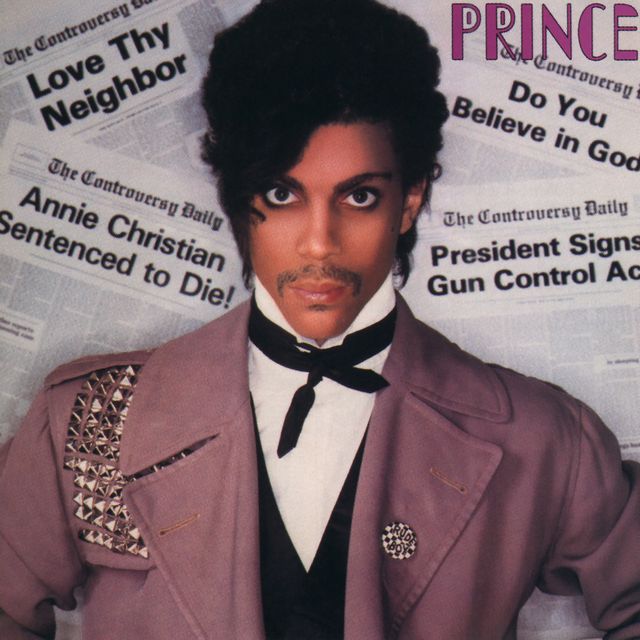
It is also, in the most literal sense, where the purple starts. The sleeve photograph by Allen Beaulieu shows him in a mauve studded trench coat against a wall of mocked-up newspaper front pages, and it is the first Prince record to attach him to the colour that would eventually become a brand, a film, a stage set and an entire posthumous estate.
Kiowa Trail to Sunset Sound
The album was made fast, in two bursts, and mostly alone. “Do Me, Baby” was cut in June 1981; everything else was recorded between August 14 and 23. The sessions moved between Prince's home studio on Kiowa Trail in Chanhassen, Minnesota, and two Hollywood rooms, Hollywood Sound and Sunset Sound. Eight finished songs in roughly ten days of studio time, with one man playing almost all of it.
The instrument list is the story of the Minneapolis sound in miniature: Oberheim OB-X and OB-SX synthesizers, an ARP Omni, a Yamaha CP-70 electric grand, Pearl Syncussion and Korg Mini Pops for percussion, and — decisively — the Linn LM-1, one of the first drum machines to use digital samples of real drums. Prince had got hold of one early and worked out what nobody else had yet: that you could tune the samples, gate them, drench them in reverb and end up with a rhythm section that sounded like nothing on earth rather than like a bad drummer.
The few outside contributions are telling for how small they are. Lisa Coleman sings backing vocals on the title track and “Ronnie, Talk to Russia” and plays an Oberheim; Doctor Fink adds keyboards; Bobby Z. turns up on drums and Syncussion. Only on the closing “Jack U Off” do three of them appear at once, which is as close as this record gets to a band performance.
In the Hollywood rooms the sessions ran through a small group of engineers — Bob Mockler, Mick Guzauski, Ross Pallone and, most consequentially, Peggy McCreary. A former Roxy waitress who had become the first woman on staff at Sunset Sound, McCreary was assigned to a client who mumbled instructions from behind his hair until she told him to face her so she could hear him. He started requesting her by name, and she went on to engineer the run of records that made him famous. When equipment trouble at Hollywood Sound scuppered a session on August 16, the work simply moved down the road to Sunset Sound, where “Private Joy” — the last song recorded for the album — was finished the same day.
The title track's promo video, directed by Bruce Gowers: seven minutes of questions, a chain-link set, and the first sustained look at the persona Purple Rain would make global.
A Seven-Minute Question
Most albums open with their best hook. Controversy opens with an interrogation. The title track runs seven minutes and fifteen seconds and spends them cataloguing what people had been saying about him — his race, his sexuality, his religion, whether any of it was sincere — over a groove built from a stiff LM-1 pattern, a bass line that barely moves, and a two-note synth stab that functions like a flashing light.
The genius is structural. He does not rebut the rumours; he recites them, in the second person, as though reading his own press. The music underneath refuses to resolve, sitting on one chord for minutes at a time, which turns a pop song into something closer to a stand-off. And then, at the midpoint, he stops singing and recites the Lord's Prayer over the beat — not as parody, and not quite as devotion, but as a third thing that made programmers extremely uncomfortable and has been unsettling listeners ever since.
“Sexuality” follows at speed, closer to new wave than funk, with guitars that could sit on a Cars record and a lyric arguing for sexual freedom as a political position rather than a private one. “Let's Work” came out of a dance Minneapolis kids were doing called the Rock; Prince had written a version called “Let's Rock,” had it rejected, and rebuilt it into one of the most durable dance tracks of his early catalogue. Three songs in, the album has covered identity, ideology and the floor of a club, and has not repeated a tempo.
The Headlines on the Cover
Look closely at Beaulieu's sleeve and the mocked-up newspapers behind him are not decoration. “The Controversy Daily” carries four front pages: Love Thy Neighbor, Do You Believe in God, Annie Christian Sentenced to Die! and President Signs Gun Control Act. It is a table of contents for side two, and it tells you that the man usually filed under sex was, in 1981, thinking about something else.
He had reason to. The preceding twelve months in America had produced John Lennon's murder outside the Dakota in December 1980, the shooting of a sitting president in March 1981, and the ongoing horror of the Atlanta child murders. Reagan had taken office in January promising a harder line with Moscow, and the nuclear anxiety that would define the decade's pop culture was just beginning to gather.
“Ronnie, Talk to Russia” addresses this head-on and lasts one minute and fifty-eight seconds, a burst of frantic rockabilly with gunshot sound effects that essentially amounts to shouting at the president to pick up the phone before everyone dies. It is the least sophisticated thing on the record and the most immediate; Christgau, reviewing for the Village Voice, thought the socially conscious songs were catchy enough but sprang from the mind of a rather confused young fellow, and he was not entirely wrong. Confusion was the point. Nobody in 1981 had a coherent position on any of this.
Seven Minutes of Seduction
Side one closes with the record's other long track and its most influential. “Do Me, Baby” runs seven minutes and forty-three seconds and is the moment Prince perfects the slow jam — not the suggestive soul ballad of the previous decade, but something explicit, unhurried and eventually wordless, ending in gasps and whispers that go on well past the point of comfort.
Its history is complicated. Prince took sole writing credit, but his childhood friend and former bassist André Cymone has always maintained that he wrote it; a demo version dating back to April 1979 exists, cut at a studio in Burbank. Whoever originated it, the released recording is entirely Prince — Yamaha electric grand, ARP Omni, Oberheim, bass and drums, all of it played by one person alone in a room, which makes the intimacy of the performance faintly surreal.
The influence was enormous and largely uncredited at the time. Meli'sa Morgan took a cover of it to No. 1 on the R&B chart in 1986, and the template — extended running time, whispered second half, no fade to safety — became standard equipment for quiet-storm radio and, eventually, for a generation of R&B singers who had never heard the original.
Prince's first attempt to get you to love him for his mind, not just his body.
Essential Tracks
“Controversy”
Written in the immediate aftermath of Dirty Mind's notoriety, the song takes the least promising possible subject — gossip about the artist — and makes it universal by never conceding a single fact. The questions arrive in a flat, almost bored delivery, as if he has been asked them too many times to perform surprise.
Musically it is a masterclass in restraint. The LM-1 pattern is deliberately mechanical, the bass sits on a single figure, and almost all the movement comes from small changes in the synthesizer voicings and from Prince's own vocal, which slides between a conversational baritone and the Smokey Robinson falsetto that would become his signature. Nothing builds. The groove simply refuses to stop, which is why it works on a dancefloor and why it feels like a siege.
It reached only No. 70 on the Hot 100 but went top three on the R&B chart and became a permanent fixture of his live show for the next thirty-five years. More importantly, it established the method he would use for the rest of his career: state the accusation yourself, first, louder than anyone else, and give away nothing.
“Annie Christian”
The strangest song Prince had recorded to that point, and still one of the strangest in his catalogue. Over a skeletal, deliberately ugly arrangement — a drum machine, a bass pulse, and a guitar that sounds like it is being scraped rather than played — he invents a figure named Annie Christian and holds her responsible for the era's violence.
The verses move through the murder of Black children in Atlanta and the killing of John Lennon, delivered in a strangled monotone that owes more to gothic post-punk than to anything on Black radio in 1981. The name is the joke and the thesis at once: an antichrist, but also an ordinary-sounding American woman, which is to say the violence is domestic and not supernatural.
It is not a pleasant listen and was never going to be a single. What it demonstrates is range — that the same artist who had just spent seven minutes on a groove could also make something this austere and this frightened — and it points directly at the darker, more paranoid Prince who would surface on Sign o' the Times six years later.
“Private Joy”
The last thing recorded for the album, finished at Sunset Sound on August 16, 1981, after equipment trouble at Hollywood Sound down the road killed the session he had booked. It is also the lightest thing on a record otherwise preoccupied with gossip, God and nuclear war — a piece of pure bubblegum pop-funk that lasts four and a half minutes and apologises for nothing.
The Linn LM-1 is right at the front of the mix, unusually crisp for 1981, with a handclap pattern and a synth line that could pass for a children's television theme if the vocal were not sung in a helium falsetto and addressed to a lover kept deliberately secret. Prince tracked every part himself in a matter of hours, which is much of the point: the speed is audible, and it is what gives the song its unbothered charm.
Buried as an album cut and later a B-side, it has become one of the record's most quietly influential tracks — a demonstration that the machine-made drum sound could carry sweetness as easily as menace. Everything cheerful in the Minneapolis sound over the following five years, from the Time's lighter singles to a good deal of 1999, works the way this does.
New wave tempo, rock guitars, and an argument for sexual freedom as politics — the clearest evidence that Controversy was not a soul record.
No. 21, and Eighth Place
Commercially, Controversy was a step rather than a leap. It reached No. 21 on the Billboard 200 and No. 3 on the R&B albums chart, and of its three singles only the title track troubled the Hot 100, at No. 70. The RIAA did not certify it platinum until January 1985, by which point Purple Rain had sent buyers backwards through the catalogue looking for whatever they had missed.
Critically it did much better. It finished eighth in the Village Voice Pazz & Jop poll for 1981, with Christgau grading it A− despite his reservations about the politics. Stephen Holden, writing in Rolling Stone that January, framed it as the record where an artist previously lost in erotic self-absorption turned outward, and found the new direction refreshingly relevant. Later assessments have been kinder still: AllMusic's Stephen Thomas Erlewine placed it as a continuation of Dirty Mind's new wave-tinged funk with a deepening fascination with synthesizers, and Pitchfork, revisiting it decades on, scored it 9.0.
The gap between the chart position and the critical standing is the whole story of Prince in 1981. He had the reviews, the songs and the machinery. What he did not yet have was a way past the format barriers — the Black stations that heard too much guitar, the rock stations that heard too much funk, and an MTV, launched that August, that had not yet worked out it was going to have to play Black artists at all.
Building the Empire
What makes Controversy pivotal is less what happened to it than what was happening around it. In the same stretch of months, Prince was assembling a second band out of Minneapolis musicians, writing and producing their debut himself, and hiding behind a pseudonym — Jamie Starr — so that the Time could be presented as a rival rather than a subsidiary. It was the beginning of a habit that would eventually produce Vanity 6, Sheila E., the Family and a good portion of the decade's pop.
The Controversy Tour opened at the Stanley Theatre in Pittsburgh on November 20, 1981, with the Time as support, and ran until mid-March 1982. Two acts, one songwriter, an intra-company rivalry stoked deliberately for the audience's benefit — the structure of the Purple Rain film was rehearsed on that tour three years before anyone wrote a screenplay.
Thirteen months after Controversy, the same one-man method and the same Linn LM-1 produced 1999, a double album that finally broke the format barriers and put him on MTV. Our review of Prince: “1999” picks up the story from there, and the “Purple Rain” review covers where it ended up. For how the sound itself was engineered, our story on the birth of the Minneapolis sound goes into the home-studio techniques underneath all three records.
Why It Still Matters
Forty-five years on, Controversy is the Prince album that most rewards being played rather than remembered. It has no anthem on the scale of “When Doves Cry” and no cultural moment attached to it. What it has is the sound of a young artist working out, in public and at speed, that he was never going to be given permission — and deciding, three days after a stadium full of people threw things at him, to stop asking for it.
Its methods are now so standard that they are invisible. The tuned and gated drum machine, the one-man multitrack production, the refusal to pick a genre lane, the artist who answers speculation by putting it in the first verse himself: all of that is ordinary practice in 2026, and almost none of it was ordinary in 1981. Every bedroom producer who tracks an entire record alone is working in a tradition that runs through Kiowa Trail.
And the central question the title track asks — why an audience needs to file an artist before it can hear one — has aged into something closer to a documentary. Prince spent his whole career declining to answer it. This is the record where he decided the declining was the answer.
“It refines the propulsive funk of previous albums and adds treatises on religion, work and nuclear war.”