
On September 9, 1986, at Yokohama Stadium in Japan, Prince smashed two guitars at the end of “Purple Rain” and walked off stage. It was the last show of his Parade tour. Only he knew it was also his last concert with the Revolution, the band that had made him a superstar.
Over the next few months he recorded almost nonstop. He finished and then shelved three albums: a band record called Dream Factory, an album credited to a female alter ego called Camille, and a three-LP set called Crystal Ball. Warner Bros. refused to release a triple album.
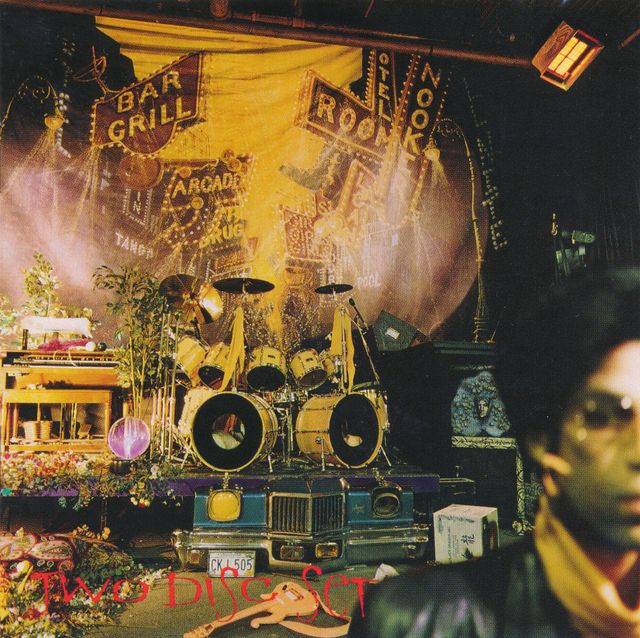
What came out in March 1987 was a double album, Sign o' the Times. It reached No. 6 in the US and No. 4 in Britain, and it won the Village Voice's Pazz & Jop critics' poll by the biggest margin in its history. It turns 40 in March 2027.
“Sign ‘O’ the Times is Prince's recorded apex, the summation and greatest articulation of all the musical fusions he'd alchemized up to that point.”
Two Smashed Guitars in Yokohama
In 1986 Prince was at the top. “Kiss” was the No. 1 song in America that April, and the Bangles' version of his “Manic Monday” was No. 2. But his film Under the Cherry Moon had flopped, and his band was coming apart.
Guitarist Wendy Melvoin and keyboardist Lisa Coleman wanted to work on their own. Prince was engaged to Wendy's twin sister, Susannah, and that relationship was going badly. “Wendy, Lisa, and Bobby Z. were the heart of the Revolution,” his engineer Susan Rogers told Wax Poetics. “Wendy and Lisa were aching to get out there on their own.”
Prince disbanded the Revolution in October 1986. Wendy, Lisa and drummer Bobby Z left; Sheila E. took over on drums, and only keyboardist Matt Fink stayed. Rogers felt the loss in the studio. “The sorrow of their absence was also felt in the room,” she said. “Sign ‘O’ the Times represented Prince soldiering through a tough time, personally and professionally.”
Dream Factory and a New Home Studio
Much of the music had started earlier. In December 1985, as Parade was being finished, Prince began a double album with the Revolution called Dream Factory. In March 1986 he opened a new home studio in Chanhassen, Minnesota, with a song that came to him in a dream, “The Ballad of Dorothy Parker.”
“He came downstairs and told me, ‘Let's go. Let's record,’” Rogers told Rolling Stone. The new console had not been tested and had no high end. “I'm thinking, ‘God, this is awful,’” she said. “Typical of Prince, our session lasted roughly 24 hours.” He liked the muffled result and kept it, because the song had come from a dream.
The songs piled up. He wrote “Starfish and Coffee” with Susannah Melvoin. On the European leg of the tour, a soundcheck jam in Paris became “It's Gonna Be a Beautiful Night,” recorded live with the Revolution. By July, Dream Factory had grown to 18 songs. But with the band gone, Prince scrapped it.
Two of its new songs survived. “Sign o' the Times” was recorded in a ten-hour sprint. “The Cross,” a meditation on the Christian symbol with layered guitars and sitar-like colours, was made entirely alone on a Sunday at Sunset Sound in Los Angeles. “[The drumming] speeds up, but he wasn't using a metronome,” Rogers recalled. “I thought he was actually going to scrap it. But he was happy with it.”
Camille, the Album With No Prince on It
The next idea came from a vocal trick. The day after the Revolution's breakup was announced, Prince started “Housequake,” a hard-funk party track sung in a sped-up, pitched-up voice. The altered voice gave him a new character: Camille, a female alter ego reportedly named after the 19th-century memoirist Herculine Barbin, who was intersex and known by that name.
Prince decided Camille should have an album of her own, released without his name on it. He recorded five songs in under two weeks, and by November 1986 the record had been test-pressed. Then he pulled it, weeks before its planned release.
Camille's best song was “If I Was Your Girlfriend,” a slow jam in which the singer wishes he could be closer to his lover than a boyfriend can. Rolling Stone's Will Hermes called it “a gender-jumping slow-jam head trip,” and found it hard not to read it as a letter to Susannah Melvoin.
Crystal Ball and the Warner Meeting
Prince then combined the best of Dream Factory and Camille with new songs into a three-LP, 22-track set called Crystal Ball. Warner Bros. said no. A triple album would be expensive, and his recent records had not sold as well as Purple Rain.
“It was one of those rare meetings where the label executives actually came to the studio,” Rogers recalled. Prince was forced to cut it to two records. “He was upset about it,” she said. “Then he accepted it and we moved on.” He came out of it with a new direction, she said, darker than anything he had made before, “because this time he was talking about world affairs.”
He added songs even as he cut. “Adore,” a falsetto ballad aimed at R&B radio, was one of the last recorded. “I Could Never Take the Place of Your Man,” a song he had first taped in 1979, came out of the vault. “U Got the Look” featured Sheena Easton, who happened to be passing through the studio in Los Angeles.
“Each side was like an act in a play: It had to have a beginning, middle and an end.”
The double album was sequenced at Sunset Sound and finished in January 1987. “Sequencing a record with him was really extraordinary,” Rogers said. “He put so much value in the sequence.” Prince himself was later frank about what he kept back. “I didn't always give the record companies the best songs,” he told Rolling Stone in 2014.
The title track, recorded in a ten-hour sprint, reached No. 3 in the US and topped the 1987 Pazz & Jop singles poll.
Essential Tracks
“Sign o' the Times”
The opening song is a bleak news report set to a beat. It touches on AIDS, gang violence, drugs, poverty and the Challenger space shuttle disaster. Rogers said it was about how things were changing in America and the world.
The sound is sparse: a fat bass line, sharp funk-guitar bursts and programmed drums. Rogers said the Fairlight CMI, an expensive early sampling synthesizer, was “the sound for the Sign ‘O’ the Times record,” alongside Prince's old Linn LM-1 drum machine. Hermes heard it as Prince remaking hip-hop's new minimalism in his own image.
It was a brave lead single. James Hall of The Telegraph calls it “a maudlin lead single” for such a crowded year. It still reached No. 3 in the US and topped the Pazz & Jop singles poll.
“If I Was Your Girlfriend”
This was a Camille song, sung in the pitched-up voice he made for the alter ego. The singer imagines being his lover's girlfriend, so they could share things a boyfriend never could.
It is one of Prince's strangest and most tender songs. The groove is slow and unsettled, and the sped-up voice makes the singer sound neither male nor female. Rogers named it as one of the album's core songs, alongside the title track, “Housequake,” “The Cross” and “Adore.”
As a single it reached only No. 67 in the US. It was never a hit, but it is the clearest sign of where the Camille project might have gone if Prince had released it.
“U Got the Look”
The album's brashest pop song took longer than almost anything else. “‘U Got the Look’ went through a lot of different permutations,” Rogers said. “He tried it at different tempos and tried it with different feels. It was unusual for him, but he really liked the track.”
Easton's part was not planned. “I don't believe for a minute that it was planned from the beginning,” Rogers said. “It was just that she was around at the time. We spent three or four days on ‘U Got the Look,’ which was unusual for him.” She remembers working so long that she could not tell whether it was morning or night.
Christgau called it “galvanic,” the hottest groove on the album. It became the album's biggest hit, reaching No. 2 on the Billboard Hot 100.
Sheena Easton joined because she happened to be in the studio. The song reached No. 2 in the US.
Studio 3 at Sunset Sound
Prince split the work between his home studio and Studio 3 at Sunset Sound, which Rogers called “his favorite studio in the world.” The room was big enough to keep everything set up at once: piano, Hammond organ, drum kit, and his keyboards, bass and guitars. At home he recorded songs like “Hot Thing” and “Forever in My Life.”
He played most of the instruments himself and often sang alone, with Rogers and her assistant out of the room. The hours were extreme. “I could expect an eighteen, twenty, or twenty-four hour workday,” Rogers said. “It was fairly common to work a forty-eight hour session.”
The album mixes brand-new songs with old ones. “Slow Love” and “I Could Never Take the Place of Your Man” were years old. “Play in the Sunshine” was written near the end, just to link the title track to “Housequake.” “It was like a tomato on a sandwich,” Rogers said. “It complemented the meat and cheese.”
No Demos, and the Accidents He Kept
Prince rarely made demos. “Prince worked so fast that he wouldn't waste his time demoing,” Rogers said. The exception was “Strange Relationship,” an older song the band had worked through many times at rehearsal before he recorded it.
He often kept mistakes. On “Forever in My Life,” recorded in the basement studio of his house on Galpin Boulevard, he came in on the wrong bar while singing his backing vocals, so they run ahead of the lead like a round. “He was happy with it, even though it was an accident,” Rogers said. “He was excited by it.” “Starfish and Coffee,” based on a story Susannah Melvoin told him about a girl from her school, used drums recorded with the tape running backwards.
His vocal arranging was quick and rooted in church music. “He really loved those gospel chords. He loved sevenths, ninths, and thirteenths,” Rogers said. “He'd always say, ‘We're going to go to church on this one.’” Some old songs were brought in simply to finish the record. “I don't feel like writing another ballad,” she remembers him saying. “I have an old song. Let's put ‘Slow Love’ on there.”
He kept an eye on one rival. During the same busy year he turned down Michael Jackson's invitation to duet on “Bad.” Rogers said Jackson was the only artist Prince talked about as direct competition. “Michael Jackson was considered the kid next door that you would love to have as your neighbor,” she said. “Prince was kind of the scary guy.”
The Biggest Winner in Pazz & Jop History
Critics loved it. In the Village Voice's 1987 Pazz & Jop poll, it scored 1,491 points from 118 critics. Bruce Springsteen's Tunnel of Love came second with 912. The title track also won the singles poll.
The Voice's own review was by Greg Tate. “Never has Prince's mastery of modern pop instrumental and production techniques seemed as total and assured as they do on Sign,” he wrote. “Instrumentally, there isn't a failed cut.” He heard it leap “from gutbucket bottom to baroque fusion to Frippertronic guitar noise.”
Robert Christgau, who ran the poll, gave it an A-plus. He called it “merely the most gifted pop musician of his generation” showing what he could do “for two discs start to finish,” with vocal chops “that make Stevie Wonder sound like a struggling ventriloquist.” Working alone had not made the record cold, he thought: “the voices put over real emotions.”
In his poll essay he called it “easily the biggest winner in Pazz & Jop history.” Its 579-point margin, he noted, was 40 per cent wider than London Calling's in 1980. He added a caveat. The album, he wrote, “doesn't right Prince's chronic shortcomings as lyricist-icon-conceptmaster.”
Swamped in a Crowded Year
Sales were good but not Purple Rain. The album peaked at No. 6 on the Billboard 200 and No. 4 in the UK. “It went Platinum after four months and the singles did nicely,” said Michael Pagnotta, Prince's publicist in the 1990s. “But it was not Purple Rain. And that failure to follow up to his own standard was something that haunted him.”
The competition was fierce. Hall lists the albums released between spring 1986 and the end of 1987: Bad, The Joshua Tree, Faith, Graceland, Appetite for Destruction and many more. Hip-hop was also breaking through to white audiences, as Prince's funk had five years earlier. Rogers saw it too. “Funk dance music was getting the elbow from hip-hop,” she said. She thought Prince knew it. “James Brown's style went out of favor, the Beatles' style went out of favor, and the big arena rock of Led Zeppelin went out of favor, so you can kind of predict that it's going to happen to you too,” she said. “This is what helped give Sign ‘O’ the Times its somber tone.”
Prince did not tour America. The 1987 tour played 34 dates in Europe. He filmed some shows for a concert film, but the sound was so poor that he reshot most of it at Paisley Park and mimed many songs.
The Peak Before the Vault
The pattern continued. Later in 1987 Prince withdrew another finished album, the so-called Black Album, just before release. Pagnotta thinks the period set habits that defined the rest of his career: label fights, more songs than any album could hold, and a growing vault. “He found a lot of inspiration in chaos,” Pagnotta said. “And he created a lot of that chaos.”
After his death in 2016, the vault opened. In September 2020 his estate released a super deluxe edition with dozens of unreleased songs from the Dream Factory, Camille and Crystal Ball sessions. Archivist Michael Howe said the team found a version of “I Could Never Take the Place of Your Man” from 1979. “It was kind of jaw-dropping to think that he had the song in his pocket for six or seven years before he reimagined it,” he said.
Later critics have heard something else in it: restraint. Writing for The A.V. Club in 2017, Alex McLevy noted that for all its pomp, the title track “is basically a five-minute drum machine and Prince's sing-speak vocal performance.” His colleague Erik Adams called it “one of the weirdest albums to ever top the Village Voice's Pazz And Jop poll.”
It remains the album many critics rank as his best, ahead of Purple Rain and 1999. Hall calls it “the closest Prince got to his own White Album.”
“That can go either way—it can yield some of the best work you'll ever do, or it can yield work that is self-indulgent, dispirited, and apathetic. In this case, it yielded some of his very best work.”