The Riff Lost Over Dinner
David Bowie dropped in on Queen in Switzerland in 1981. They jammed, ate, drank, argued over a bassline, and came out with a No. 1 single nobody had planned to write.
 Trevor Fortune•🎵 Queen and David Bowie - Hot Space•6 min read•November 5, 2026
In 1981 Queen were recording at Mountain Studios in Montreux, Switzerland, a studio they liked so much they had bought it. David Bowie lived nearby and came down to say hello. Within a day, the five of them had written “Under Pressure.” It went to No. 1 in Britain that November.
Nobody had planned it. Bowie and Queen barely knew each other. The song came out of a jam, a long dinner, an argument about a bassline, and a way of writing that Bowie brought with him. Then it nearly came apart again in the mixing room in New York.
A Neighbour Drops In
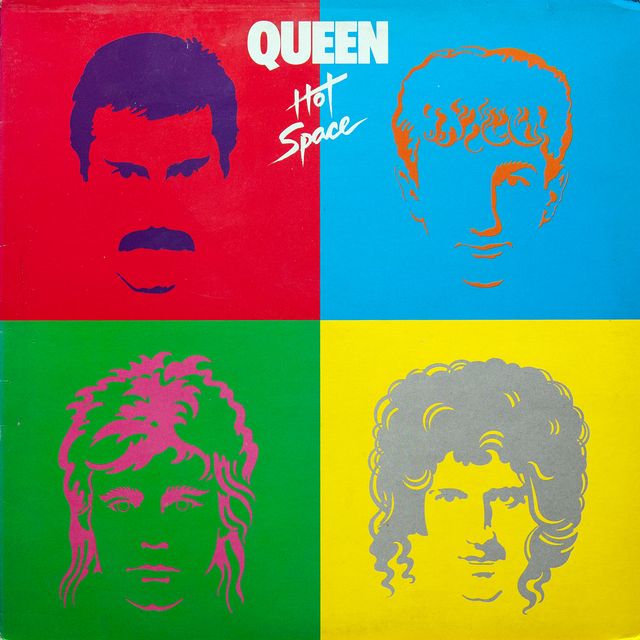
Queen were making the album that became Hot Space. Bowie had recorded his 1979 album Lodger at Mountain and had settled close by. He knew Roger Taylor a little and the others hardly at all. “I didn't know Queen very well,” he said on Top of the Pops 2 in 1999. “I knew Roger the drummer quite well, but I didn't really know Freddie.”
In a 1983 video interview, Bowie said the studio's engineer, David Richards, had rung him and asked if he would like to come down and see what was happening. Part of the reason was a Queen track called “Cool Cat,” written by Freddie Mercury and John Deacon, which Bowie was due to sing backing vocals on. He did, and later asked for his vocal to be taken off before Hot Space came out.
Brian May remembered the visit turning into a jam almost at once. “We all very quickly decided that the best way to get to know each other was to play together,” he wrote in 2016. They started on fragments of songs they all knew. Then they decided to make something new on the spot.
Six Notes and a Long Dinner
Everyone brought something. May had a heavy riff in D. Queen also had an unfinished track called “Feel Like” that was going nowhere, and its verse chords would be reused. But what caught the room was a bass figure Deacon started playing. May described it as six notes the same, then one note a fourth down.
Then they got hungry. The five of them went to a local restaurant for food and, in May's words, “a fair amount of drink.” They came back to the studio two or three hours later, and Bowie asked Deacon to play the riff again. Deacon played it. Bowie said that wasn't it.
"I can just see DB going over and putting his hand on John's fretting hand and stopping him. It was also a tense moment because it could have gone either way. Deacy did not take kindly to being told what to do, especially by physical interferences while he was playing!"
Deacon let it go, and the riff that survived is the one Bowie remembered. That may be why the two men later credited each other. “David wrote the bassline, he's responsible for it,” Deacon told the Japanese magazine Viva Rock in 1983. Bowie, answering a fan in 2004, said the opposite: “I believe the riff had already been written by Freddie and the others.”
Five Singers, One Booth
Left to themselves, May said, Queen would have gone away and planned out a song structure. Bowie told them to keep going on instinct. May added a light guitar figure over the bass, which Bowie later insisted be redone on a 12-string. The track grew a verse, a quiet section, and a loud climax where May finally got his heavy riff in. When May said it sounded like the Who, Bowie frowned. “It won't sound like The Who by the time we're finished!” he said.
There were still no words and no tune. Bowie's solution was a method he had used with other musicians. Each of them went into the vocal booth in turn, without hearing what the others had sung, and improvised whatever came into their heads over the track. Mercury's wordless scatting from that pass made it all the way to the finished record. The best fragments were cut together into one guide vocal.
They went home that night with a rough mix, provisionally titled “People on Streets.” The next day Bowie got to the studio first and said he wanted to take the song over, because he knew what it should be about. The band stepped back, and he built the lyric around the phrase “under pressure” from the improvised vocals. “It was unusual for us all to relinquish control like that,” May wrote, “but really David was having a genius moment.”
"I still cannot believe that we had the whole thing written and recorded in one evening flat. Quite a feat for what is actually a fairly complicated song."
The Fight Over the Mix
The Montreux session ran for about 24 hours. Producer Reinhold Mack later remembered that there was “so much blow” in the room. A few weeks later Mercury, Bowie, Taylor and Mack met again at the Power Station in New York to finish the vocals and mix the track. That session lasted another 18 hours.
May stayed away on purpose. “I think it's probably the only time in my career I bowed out, because I knew it was going to be a fight,” he told Total Guitar. “So basically it was Freddie and David fighting it out in the studio with the mix. And what happened in the mix was that most of that heavy guitar was lost.”
Mercury and Bowie never fully agreed, so what came out was, in May's description, a compromise: a quick rough monitor mix. It is the version everyone knows. May still isn't a fan. “I never liked it, to be honest, the way it was mixed,” he has said. “But I do recognise that it works.”
Two Weeks at No. 1
“Under Pressure” came out on October 26, 1981, credited to Queen and David Bowie, with a Queen song, “Soul Brother,” on the B-side. It entered the UK chart at No. 8 and went to No. 1 the following week, replacing the Police's “Every Little Thing She Does Is Magic.” It stayed there for two weeks. It was Queen's second British No. 1, after “Bohemian Rhapsody.” In America it peaked at No. 29.
Neither act made a video. Director David Mallet assembled one from newsreel and silent-film footage of crowds, traffic, riots and explosions instead. The BBC refused to show it because it included footage of IRA bombings in Belfast. The song turned up again the next spring as the closing track of Hot Space, sounding nothing like the disco-leaning record in front of it.
It did not make the British edition of Queen's Greatest Hits, released the same week as the single. The story of that compilation is told in our review of Queen's Greatest Hits.
Wembley, and a Lawsuit
Queen played the song at every concert from 1982 until their last tour with Mercury in 1986. Bowie never sang it with them. His first live performance came at the Freddie Mercury Tribute Concert at Wembley Stadium on April 20, 1992, five months after Mercury died, when he sang it with Annie Lennox. From the mid-1990s he made it part of his own shows, with his bassist Gail Ann Dorsey singing Mercury's part while playing Deacon's line.
By then the riff had a second life. In 1990 Vanilla Ice built “Ice Ice Baby” on it without permission. The publishers sued and the case was settled out of court, with Bowie and Mercury added to the songwriting credits. “We didn't go to war for it, but the publishers did,” May said later. “They came to a settlement, which was that he pays us most of the money he's ever generated with that song.”
Bowie looked back on the whole thing with mild surprise. “Somehow or other we ended up writing this thing together, as usually happens when musicians get together,” he said in 1999. “I'm very pleased I did it.” Mercury put it more simply: the song “came about by pure chance.”
Related Review
Read our comprehensive analysis of Queen and David Bowie's Hot Space
Hot Space Review →