Two Thousand Records
Rolling Stone called their debut the work of career session players, meant as an insult. Then the same session players turned up on Thriller.
 Trevor Fortune•🎵 Toto - Toto IV•9 min read•September 9, 2026
Steve Lukather likes to joke that he played guitar on about two thousand records before anyone outside the music business knew his name. Nobody actually counted. What is certain is that four members of his band, Toto, played on Michael Jackson's Thriller, the best-selling album ever made. They did it when Toto already had platinum records of its own, and when critics were still dismissing the band as faceless session players.
Grant High School to the Sonny & Cher Band
David Paich, Jeff Porcaro and Steve Lukather all came up through Grant High School in the San Fernando Valley, but Paich had a head start most teenagers didn't: his father was Marty Paich, the jazz arranger who worked with Ray Charles and Ella Fitzgerald, and David spent his childhood around professional sessions before he ever played on one. Porcaro turned professional before he finished school at all. At seventeen, in lieu of a normal senior year, he took the drum chair on the Sonny & Cher Comedy Hour, then sat in on a big-band session alongside Hal Blaine, Jim Gordon and Jim Keltner — the very session players whose place in the Los Angeles studio hierarchy he and his friends were about to inherit.
Boz Scaggs Made Them a Rhythm Section
The record that turned a group of individually busy session players into a recognizable unit was Boz Scaggs' Silk Degrees (1976). Paich played keyboards and co-wrote five songs, including “Lowdown” and “Lido Shuffle”; Porcaro played drums; David Hungate played bass. Scaggs later described his own role in what followed with more modesty than the nickname the story earned him: “I think I was to some degree” the father of Toto, he said. “By recording with me and having the success that we had on that album and then touring with me, I think that it really solidified them. It gave them a clear path to what was to follow, recording as Toto.”
Hungate has told the same story from inside the rhythm section: “We worked together on a lot of projects, culminating with Boz Scaggs' Silk Degrees, which put us on the map as a happening rhythm section. After Silk Degrees, record companies became interested in us forming a band. Jeff, Paich and I had been working together.” Columbia Records — Scaggs' own label — signed the new group on the strength of exactly that reputation, before it had a name that meant anything to a record buyer.
“You Guys Don't Have a Sound”
What the label had trouble understanding was exactly what made the players valuable in the first place: they could do anything, which meant they didn't sound like any one thing. Paich has recalled the pushback directly: “A lot of the comments were, ‘There's no thread [to the music]. You guys don't have a sound.’” Executives wanted to know what genre they were selling — R&B, rock, adult contemporary. Paich's answer became the closest thing the band had to a mission statement: “We just said, ‘This is it. This is what we are. We do all this stuff.’”
Vocalist Bobby Kimball, poached from a band called S.S. Fools, was recruited to front the group in 1976, and Toto released its self-titled debut in 1978. Rolling Stone's Don Shewey delivered the review that would define how serious critics talked about the band for the next several years: “Toto is the kind of dull debut you'd expect from a bunch of career session players,” he wrote, arguing the group lacked “a singer and a writer” and calling it “a band of skilled craftsmen without a mesmerizing mastermind: pros, but no poetry.” It was a real hit record — “Hold the Line” reached the Top 5 — reviewed as if the band should apologize for its own competence.
The Piano Bench Paul McCartney Was Sitting In
By 1982, with three more Toto albums behind them, Paich, Lukather, Jeff Porcaro and Steve Porcaro found themselves working sessions for Quincy Jones on Michael Jackson's Thriller — the album that would go on to outsell every other record in history. Paich has described walking into the session for “The Girl Is Mine” and finding Paul McCartney already at the piano: “The hardest part about that one was walking in and seeing Paul McCartney playing the piano, before Quincy has him get up and let me play his part for him! Even while you're sitting there and there's George Martin and Quincy Jones and Paul McCartney and Michael Jackson and they're all gathered around the piano and I'm playing — I had to mentally pinch myself.”
Lukather's guitar work anchors “Beat It,” including the parts built around Eddie Van Halen's guest solo. Lukather has described the mechanics of stitching Van Halen's contribution into the track: “Quincy Jones and Michael took a skeleton version of it up to Eddie Van Halen's place as they wanted him to solo over the verse section. However, he played over a section that had more chord changes. So to fit his solo to where it went in the song, they had to cut the tape which took a lot of time to synchronise together.” Jeff Porcaro played drums on multiple album tracks alongside him. What had been, four years earlier, a punchline about session musicians with no personality of their own was now the rhythm section on the biggest pop record ever made.
A Conversation With His Daughter
The most unlikely Toto contribution to Thriller almost didn't happen at all. Steve Porcaro wrote the music for “Human Nature” after something happened to his young daughter Heather at school. “I had written the song for my daughter Heather,” he later explained. “Something had happened at school and it just inspired me.” He wrote it, by his own account, almost by accident, tinkering at a piano while the band was mixing “Africa” for Toto IV — “like most of my songs it was an unfinished song” — and never expected it to go anywhere. He sent a cassette to Quincy Jones with other material attached for an unrelated purpose, and the demo happened to run on past the songs it was meant to carry. “I never thought Quincy would ever hear it,” Porcaro said. “He just happened to let the cassette play a roll.”
"All of a sudden, at the end, there was all this silence, there was: ‘why, why, dah dah da-dum dah dah, why, why.’ Just a dummy lyric and a very skeletal thing – I get goosebumps talking about it. I said, ‘This is where we wanna go, because it's got such a wonderful flavour.’"
Jones brought in lyricist John Bettis to finish the words Porcaro had left unresolved, and “Human Nature” became one of the album's most enduring tracks — later covered by Miles Davis, a musician Porcaro had grown up listening to through his own father. A song written in a spare moment for a daughter who'd had a bad day at school ended up on the best-selling album in history because an engineer forgot to stop the tape.
Pros, But No Poetry
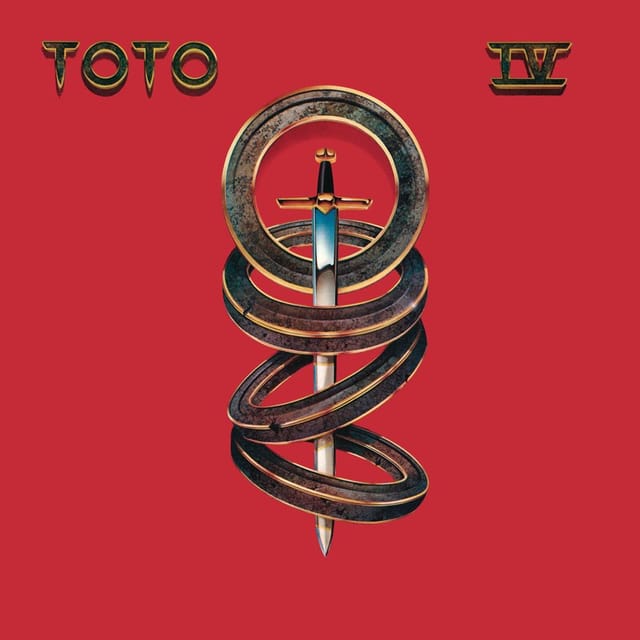
None of the Thriller credits changed how the rock press talked about Toto's own records. Toto IV, released the same year the band was working Jackson's sessions, earned Robert Christgau a backhanded B− in the Village Voice: “The fattest of all studio bands is almost as hooky as Shoes or the Ramones, and their production excesses at times betray verve, delight, even (though I must be mistaken) a sense of humor.” The Los Angeles Times's Robert Hilburn was harsher, faulting the record for what he called a “disheartening lack of depth or daring.”
Then Toto IV won six Grammy Awards at the February 1983 ceremony, including Album of the Year and Record of the Year for “Rosanna” — a sweep so complete that the band, accepting one of the awards, made a point of thanking Hilburn from the stage, a dig at a critic who had spent years insisting they had none of what the Grammys had just rewarded.
Lukather never fully let go of the argument, and decades later was still making the case that reading music off a chart and playing something worth hiring were not the same skill: “People don't even know what we did. They think we sat in a chair and read the notes that were on the paper. We're not the third viola player. We're creating our parts, and that's why we got hired.” It is, in its way, the same argument David Paich made to a skeptical record executive years earlier, when asked what kind of band Toto actually was, and gave the only honest answer available to four musicians who had spent their whole careers being whatever a session required: this is it, this is what we are, we do all this stuff.