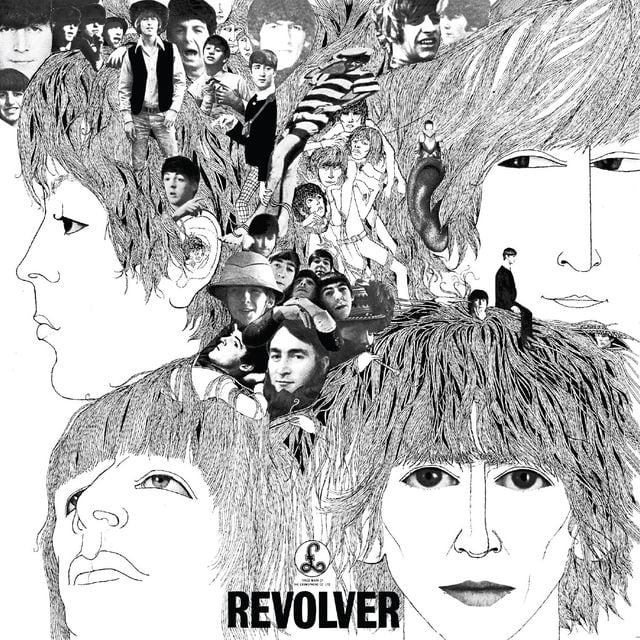
Studio Three, April 6, 1966
The first song the Beatles recorded for Revolver had one chord, a working title of 'Mark I', and an engineer who had never run a Beatles session. Three days of work on it changed what a recording studio was for.
 Trevor Fortune•🎵 The Beatles - Revolver•6 min read•October 6, 2026
At 2:30 in the afternoon on Wednesday, April 6, 1966, the Beatles walked into Studio Three at EMI's Abbey Road studios to begin their seventh album. The first song on the list was called “Mark I.” It had one chord. Behind the glass sat Geoff Emerick, 20 years old, running a Beatles session as their engineer for the first time.
“Mark I” became “Tomorrow Never Knows,” the last track on Revolver. It took three sessions to finish. Along the way it broke EMI's rules about microphones, turned an organ speaker into a vocal effect, and used the mixing desk itself as an instrument. Emerick later put it simply: “The very first thing I recorded was ‘Tomorrow Never Knows’.”
A Book From the Indica Shelf
The song started five days earlier, on April 1, at the Indica bookshop in London's Mason's Yard. McCartney had helped fund the shop, and he and John Lennon stopped by. According to co-owner Barry Miles, Lennon came in asking for Nietzsche. While browsing he found something else: The Psychedelic Experience, Timothy Leary's LSD guide based on the Tibetan Book of the Dead.
Lennon settled onto the shop's settee with it. A line in Leary's introduction, about switching off the mind and drifting, became the opening of the new song. The rest of the lyric followed the book's ideas about dissolving the ego. Lennon gave it a light title on purpose. “That's me in my Tibetan Book of the Dead period,” he said in 1980. “I took one of Ringo's malapropisms as the title, to sort of take the edge off the heavy philosophical lyrics.”
Musically the song barely moved. It sat on a single drone, an idea the band had picked up from Indian records. “Indian music doesn't modulate; it just stays,” George Harrison said. When Lennon first played it to George Martin on one chord, McCartney remembered, the producer did not flinch. “He just said, ‘Hmmm, I see, yes. Hmm hmm.’”
Two Inches From the Bass Drum
Emerick had inherited the job from Norman Smith, the band's engineer since their first sessions. He arrived with ideas that EMI's rulebook didn't allow. The first was Ringo Starr's drums. “I moved the bass drum microphone much closer to the drum than had been done before,” he said. He stuffed a sweater inside the drum to deaden it and ran the kit through Fairchild 660 valve limiters. “Drums had never been heard like that before.”
Someone reported the close miking to EMI management. The rule, Emerick recalled, was “you put it two feet away, not two inches away,” because the pressure could damage the microphone. After a meeting EMI reached a compromise: he could keep doing it, but only on Beatles sessions. “I've got a letter that actually says that,” he said.
Three takes were recorded that first day. Take three became the backing track: Starr's drums, McCartney's bass, and Harrison's tambura. Take one, released decades later on Anthology 2, shows how strange the song was from the start.
Breaking Into the Leslie
Lennon's brief for his voice was famously vague. He wanted it to sound distant and otherworldly, like a holy man chanting from a mountain. Martin knew normal studio tools would not get there. “I knew perfectly well that ordinary echo or reverb wouldn't work, because it would just put a very distant voice on,” he said. “We needed to have something a bit weird and metallic.”
The answer was a Leslie speaker, the rotating cabinet built for Hammond organs. Feeding a voice into it meant rewiring the equipment. Emerick described the moment it worked: “It meant actually breaking into the circuitry. I remember the surprise on our faces when the voice came out of the speaker. It was just one of sheer amazement.”
"After that they wanted everything shoved through the Leslie: pianos, guitars, drums, vocals, you name it!"
Lennon's vocal goes through the Leslie for the second half of the song. The effect is a wavering, underwater quality that makes the voice sound as though it is coming from somewhere else. Martin called it “a kind of intermittent vibrato effect,” and added: “I don't think anyone had done that before.”
Pencils, Loops, and Faders
The next afternoon, April 7, the band arrived with homework. Each Beatle had been making tape loops at home on a Brenell recorder. McCartney had found that removing the machine's erase head let him pile sound onto the same short strip of tape. “People tend to credit John with the backwards recordings, the loops and the weird sound effects,” he said, “but the tape loops were my thing.” Starr made his own as well. “I'd sit there for hours making those noises,” he said.
Five loops were threaded onto separate tape machines around the building. Because a loop only stays tight under tension, studio staff stood beside the machines holding the tape taut with pencils. In the control room, the loops came up on faders, and the band and engineers played them like keys. “Just before you could tell it was a loop, before it began to repeat a lot, I'd pull in one of the other faders,” McCartney said. The result was recorded live, straight onto the master tape.
The best-known sound in the mix is a high squawk that most listeners hear as seagulls. McCartney's own description: “a speeded-up shout, hah ha, goes squawk squawk.” Strings, a sustained orchestral chord, Mellotron, and a rubbed wine glass filled out the rest. Martin understood that this mix could never be made again.
"It is the one track, of all the songs The Beatles did, that could never be reproduced: it would be impossible to go back now and mix exactly the same thing."
The Studio as the Instrument
The song was finished on April 22 with more vocals, organ, tambourine, piano, and a reversed guitar solo. It closed Revolver when the album came out in August 1966. That same month the Beatles played their last paying concert. Their records no longer needed to be playable on stage, and from then on the studio was where the band lived.
Lennon was never fully satisfied. He had imagined “thousands of monks chanting” behind him. “That was impractical of course and we did something different,” he said. “I should have tried to get near my original idea.” The compromise he regretted is the version that set the template: when an ordinary recording couldn't make the sound in a songwriter's head, the engineers built a new way to make it.
For Emerick, the first session settled his place in the band's work. “‘Geoff gets the sounds’ and that was just accepted as the way things were,” he said. He went on to engineer Sgt. Pepper's Lonely Hearts Club Band and Abbey Road.
The close-miked drums, the Leslie vocal, and the loops played on faders are all standard studio practice now. On April 6, 1966, each of them was the first attempt, made on a song with one chord by an engineer on his first day.