The “We’re Almost Finished” T-Shirt
Motown printed the joke on cotton and handed it out while Stevie Wonder kept recording. Inside the two years, 130 musicians and roughly 200 songs behind his masterpiece
 Trevor Fortune•🎵 Stevie Wonder - Songs in the Key of Life•8 min read•August 18, 2026
At some point during the long wait, somebody at Crystal Sound in Hollywood made a T-shirt as a joke. It read “We're Almost Finished.” One of the engineers has always claimed authorship and complained, entirely reasonably, that Motown took the credit — because the label looked at the gag, recognised a marketing asset when it saw one, and printed a few thousand of them. This is the position a record company had been reduced to by 1976: it had paid the largest advance in the history of the business for an album it could not obtain, and its remaining strategy was to sell the delay as anticipation. Stevie Wonder, meanwhile, was in the room writing another four songs.
The Threat to Leave for Ghana
The label had almost lost him outright. Wonder's contract was due to expire in 1975, and rather than negotiate he began talking publicly about walking away from music altogether — moving to Ghana, where he believed his ancestry led, and giving his time to disabled children and humanitarian work. At a Los Angeles press conference that March he floated a farewell tour for the end of the year, proceeds to Ghanaian charities. He was twenty-five, and he had just made Talking Book, Innervisions and Fulfillingness' First Finale in under three years.
Berry Gordy could not let that happen, and the negotiation that followed is one he later described in his memoirs as the most grueling and nerve-racking Motown ever had. On August 5, 1975, Wonder signed: seven years, a $13 million advance, a ceiling of some $37 million if he delivered above the minimum, twenty percent royalties and control of his own publishing. TIME observed that it exceeded the contracts of Elton John and Neil Diamond combined. It was, at that moment, the biggest deal anyone in the record business had ever signed.
Having secured total creative freedom and an enormous sum of money, Wonder did the thing that terrifies every label that grants both. He went into the studio and stayed there.
Two Hundred Songs in the Vault
The sessions ran across Crystal Sound in Hollywood, the Record Plant in both Hollywood and Sausalito, and the Hit Factory in New York. They produced twenty-one released songs. They also produced a great deal else: engineer John Fischbach has put the total at something like two hundred pieces of music in varying states of completion, nearly all of which remain unheard. Michael Sembello, one of the guitarists, described a man writing three, four or five new songs a day, indefinitely.
The engineers adapted by simply never stopping. Gary Olazabal, the principal engineer alongside Fischbach, explained the working method as pure defensive readiness — everything committed to multitrack, always, because Wonder would sit at a piano for hours and amazing songs would arrive one after another. Nothing was a rehearsal. There was no way to know in advance which hour would matter.
The Musicians Who Waited
For the band, this was a job with no edges. The drummer Raymond Pounds remembered Wonderlove rehearsing Monday to Friday from ten in the morning until five in the afternoon, at which point Wonder might suggest everybody come to the studio. Pounds went every night. For all of it, he ended up playing on three finished tracks, because Wonder frequently replaced what the band had done with parts he played himself.
Pounds tells one story that explains the whole atmosphere. Arriving at the studio for what he assumed was a drum session for “Another Star,” he met Wonder coming out of the live room, drenched in sweat, having already played the drums himself. He was, in his own account, simply too late.
The bassist Nathan Watts got the opposite version of the same problem: not being replaced, but being summoned. “I Wish” was written in a day. Watts was at the studio until one in the morning, got a phone call at half past three, and found himself back behind a bass. The song was finished inside three or four days. Sessions like that are why the album employed something in the region of 130 musicians before it was done — Herbie Hancock, George Benson, Minnie Riperton and the pedal steel player “Sneaky Pete” Kleinow among them.
Forty-Five Minutes for “Sir Duke”
The counter-argument to every complaint about the delay is how fast Wonder could work when the idea was already whole. Duke Ellington had died in May 1974, and the tribute Wonder wrote for him was composed and taught to the band during a single break in rehearsals — the horn line, that impossible unison run, parts distributed by ear, in about forty-five minutes.
"We went to the Sizzler and had some dinner. We went to the studio at a quarter of seven and started recording “Sir Duke.” We played it once or twice, and then they turned on the red light to record."
A steakhouse dinner, and then one of the most recognisable horn figures in twentieth-century pop. The two years were not spent struggling. They were spent choosing, out of an abundance nobody else had.
A Baby, a Synthesizer, and Fifty Chanting Devotees
The album's most famous sounds were mostly logistical problems first. “Isn't She Lovely,” written for his daughter Aisha, incorporates recordings of the baby herself — and because there were not enough tracks left to accommodate them, the material had to be held on a separate two-track machine and flown in by hand at precisely the right moment, every time.
“Village Ghetto Land” sounds like a string quartet playing a chamber piece under a description of poverty. There is no quartet. As Watts pointed out, Wonder played everything, synthesizing the strings on a Yamaha keyboard in the studio — the same instrument that gives “Pastime Paradise” its unearthly sustained tone, and the reason both tracks still sound like nothing else on the record.
“Pastime Paradise” also required people. Olazabal arranged for roughly fifty practitioners from the Self-Realization Fellowship temple on Sunset Boulevard to provide the chanting and cymbals that close the song, and they walked to Crystal Sound in single file to do it. Two decades later Coolio built “Gangsta's Paradise” on that track, and a generation met Wonder's synthetic strings without knowing whose they were. On “As,” Herbie Hancock sat down at the piano and played in the key of B without visible difficulty, which Watts has never entirely got over.
What the Waiting Bought
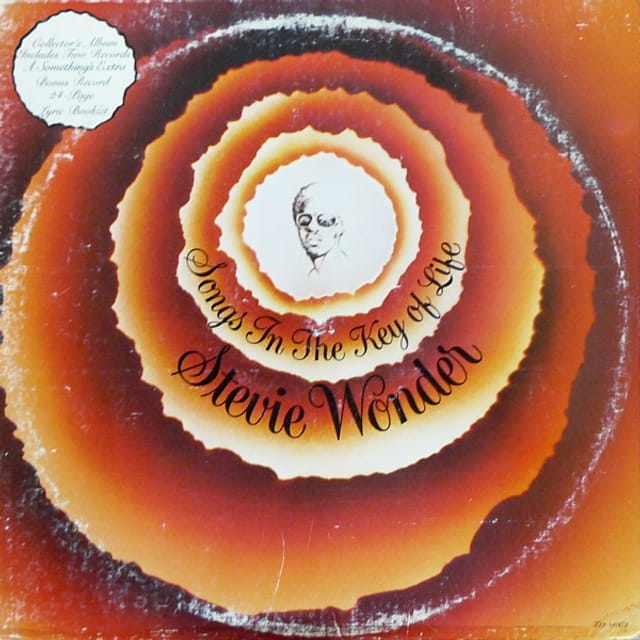
It arrived on September 28, 1976: a double album so overfull that four more songs had to be attached as a bonus seven-inch EP, twenty-one in total, running over an hour and three quarters. It entered the Billboard chart at number one and stayed there fourteen weeks — longer than any Motown album before or since. The following year it took the Grammy for Album of the Year, Wonder's third in four years. The album itself is covered in full in our review; what the sessions explain is why it feels less like a record than a catalogue of everything one man could do.
The best commentary on the delay had already been delivered, by accident, at the Grammy ceremony the year before. Wonder had won Album of the Year twice running, in 1974 and 1975. In 1976 the award went to Paul Simon for Still Crazy After All These Years, and Simon, accepting it, thanked Stevie Wonder for not making an album that year.
It was funnier than Simon knew. Wonder had not stopped making an album; he had been making this one the entire time, somewhere around the hundredth song, with a room full of musicians on permanent call and a label reduced to printing T-shirts about its own helplessness. When he finally handed it over, Motown got twenty-one songs and one hundred and thirty musicians' worth of work for a $13 million advance, and the joke on the shirts turned out to have been true all along. They were almost finished.
Related Review
Read our comprehensive analysis of Stevie Wonder's Songs in the Key of Life
Songs in the Key of Life Review →