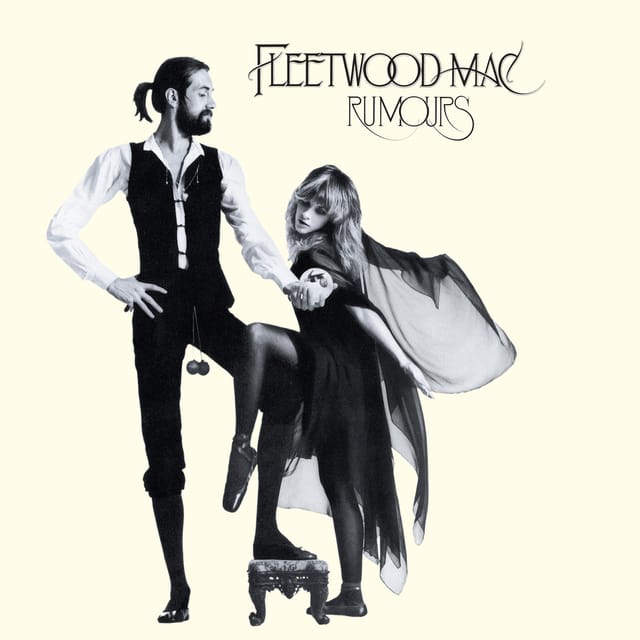
The Song About Her Dog
Almost every song on Rumours was about someone else in Fleetwood Mac. One was hidden behind a pet, one was called a lie, and one was cut in a parking lot.
 Trevor Fortune•🎵 Fleetwood Mac - Rumours•6 min read•November 18, 2026
In 1976, Christine McVie wrote a love song for Fleetwood Mac's next album. It was about Curry Grant, the band's lighting director, with whom she was having an affair. Her husband, John McVie, played bass on it. According to the book Making Rumours, she told the band the song was about her dog.
The song was “You Make Loving Fun,” and it became a Top 10 hit. It is the gentlest example of something that runs through the whole of Rumours. The band's two couples were splitting up while they made it, and nearly every song was written about someone else in the room.
Stevie Nicks said so at the time. In 1977 she told Cameron Crowe of Rolling Stone that “all the songs that I wrote except maybe ‘Gold Dust Woman’” were “definitely about the people in the band.” The others were in the same position. What made it strange was that they then had to record each other's songs, and sing them on stage for years.
Christine, John and a Dog Called Duster
Christine and John McVie were both in the band, and married. By the start of the Rumours sessions in early 1976 the marriage was over, but both were still in the band. Ken Caillat, who engineered and co-produced the album, remembered one of the first days in the studio. He heard yelling and saw Christine “throw a glass of champagne in [former husband's] John's face,” he told MOJO.
Her new relationship was with Curry Grant, who ran the lights on the band's tours. “You Make Loving Fun” was about him. Caillat's book Making Rumours says that, to keep the peace, Christine told the band it was about her dog, Duster. John McVie eventually found out.
The song itself was one of the happiest moments on the record. Caillat ran Christine's Clavinet keyboard through a wah-wah pedal. She could not play and work the pedal at once, so, he said, “Mick got down on his hands and knees and worked the pedal while Christine played.”
Mick Fleetwood believes another of her songs is about him. In a documentary about the album, he said of “Oh Daddy,” “I believe it is about me.” His reasoning was simple: “I was the only father in the band at that point.” His own marriage was ending during the sessions too.
A Lyric Stevie Nicks Called Untrue
Lindsey Buckingham and Stevie Nicks had been a couple since before they joined Fleetwood Mac. During the Rumours sessions they split up, and Buckingham wrote “Go Your Own Way” about it.
One line in the song suggests she was leaving him to move in with other men. Nicks hated it. She said she had been the one to end the relationship. “I was the one who broke up with him,” she told Rolling Stone in 1980.
Twenty years later she was still angry about it. “He knew it wasn't true. It was just an angry thing that he said,” she told Rolling Stone in 1997. Singing the song live made it worse. “Every time those words would come out onstage, I wanted to go over and kill him.”
The song was hard on the people who recorded it in other ways too. Buckingham was so particular about the guitar solo that when Caillat erased a take on his instructions, Buckingham grabbed him by the throat. The full story of the sessions is in our review of Rumours at 50.
Stevie's Answer
Nicks wrote her reply in a spare room at the Record Plant in Sausalito, a small space with a piano known as Sly Stone's Pit. The song was “Dreams.” Where Buckingham's song accuses, hers is calm. It describes a storm passing, and leaves him to deal with what he has lost.
“Dreams” became Fleetwood Mac's only No. 1 single in America. “Go Your Own Way” reached the Top 10. Both songs were hits, so radio listeners were hearing two sides of the same breakup, mostly without knowing it.
"When we're up there singing songs to each other, we probably say more to each other than we ever would in real life."
The Song Cut in the Parking Lot
Nicks wrote a second song about Buckingham, and she thought it was her best. She named it after Silver Spring, a town she had passed through on tour. “It sounded like a pretty fabulous place to me,” she said. The song, “Silver Springs,” was about the life she had imagined with him.
Near the end of the sessions, Fleetwood asked her to step outside into the Record Plant's parking lot. “I knew it was really serious ‘cause Mick never asks you to go out to the parking lot for anything,” she said in a 1991 BBC interview. He told her “Silver Springs” was off the album. It was too long to fit on the record.
Nicks did not take it quietly. “I started to scream bloody murder and probably said every horribly mean thing that you could possibly say,” she recalled. Caillat said the band offered her other options, such as cutting a different track, but “she wanted to keep all of the other songs more than ‘Silver Springs.’” In its place she recorded a shorter song she and Buckingham had been playing live. “With a gun to my head, I went out and sang ‘I Don't Want to Know,’” she said.
There was money involved too. Nicks had given the song's publishing rights to her mother, Barbara, as a thank-you. Off the album, it earned far less. “Stevie was devastated for a number of reasons,” Caillat said. The band put “Silver Springs” on the B-side of a single as a peace offering.
Twenty Years Later, on a Soundstage
The song caused trouble again in the early 1990s. Fleetwood wanted it on the band's box set 25 Years – The Chain, and Nicks wanted the tapes back. She told his manager that if she did not have the tapes by Monday, she was “no longer a member of Fleetwood Mac.” Fleetwood kept the song, and Nicks left the band.
In 1997 the Rumours lineup reunited for a live concert film, The Dance. They played “Silver Springs,” and near the end Nicks turned and sang it straight at Buckingham. She said it was deliberate. “I wanted people to stand back and really watch and understand what [the relationship with Lindsey] was.”
The performance was nominated for a Grammy, for Best Pop Performance by a Duo or Group With Vocals. It lost to Jamiroquai's “Virtual Insanity.” Buckingham admitted the song still got to him. “Now it's all irony, you know, but there is no way you can't get drawn into the end of that song,” he said.
That same year, Rolling Stone asked them about getting back together. Buckingham said they had not, then added, “Not yet, anyway. You never know.” Nicks answered: “Over my dead body.”
For Nicks, getting “Silver Springs” heard properly twenty years after it was cut mattered more than the award. “For it to come back around like this has really been special to me,” she said.