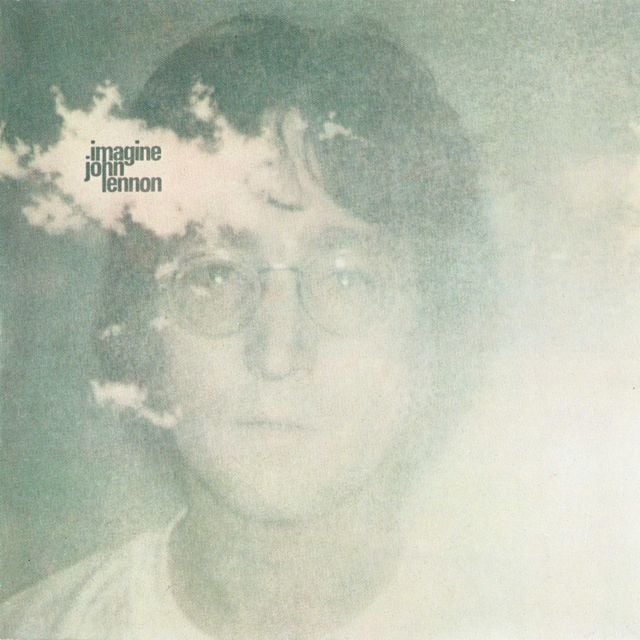
Cloud Piece
John Lennon admitted that much of 'Imagine' came from Yoko Ono's book Grapefruit. Her name did not reach the song's credits until 2017.
 Trevor Fortune•🎵 John Lennon - Imagine•4 min read•October 7, 2026
On July 20, 1971, a film crew set up in the white room at Tittenhurst Park. John Lennon sat at a white grand piano and mimed to “Imagine.” Yoko Ono walked along the windows, opening the shutters one by one until the room filled with light. Then she sat down beside him.
The piano was hers. Lennon had given it to her that February for her 38th birthday. The song, in a sense, was partly hers too. But when Imagine came out that September, it was credited to Lennon alone, and it stayed that way for 46 years.
A Book of Instructions
Ono published Grapefruit in Japan in 1964, in an edition of 500 copies. It was a book of “instruction pieces,” short texts that asked the reader to carry out an artwork, often only in their head. Ono called them paintings “meant for others to do.” Lennon received a copy in 1966, the year they met.
Many of the pieces asked the reader to imagine something. One, dated spring 1963, was called “Cloud Piece”: “Imagine the clouds dripping. Dig a hole in your garden to put them in.”
The finished lyric of “Imagine” only loosely resembles any single piece in the book. What Lennon took was the method: ask the listener to picture something, and let the picturing do the work. He later tied it to another gift, a book of prayers from the comedian and activist Dick Gregory. “It is the concept of positive prayer,” he said. “If you want to get a car, get the car keys. Get it? ‘Imagine’ is saying that.”
The White Room
Lennon wrote the words on whatever paper was nearby, including a hotel bill from Majorca and stationery from the New York Hilton. In May 1971 he brought the song to the eight-track studio at Tittenhurst. He first played it to the musicians on an upright piano.
Bassist Klaus Voormann suggested moving to Ono's white baby grand in the white room. The band tried a few takes there, but Phil Spector disliked the room's acoustics, and they went back to the studio. The master was the tenth take, recorded on May 27.
Ono's influence was not hidden. Lennon printed “Cloud Piece” on the back cover of the album. But the songwriting credit, the line that decides who is the author, read only “Lennon.”
“I Wasn't Man Enough”
Lennon said so himself in 1980, the last year of his life. Speaking to David Sheff for Playboy, he described how the song grew out of Grapefruit, “a lot of pieces saying, Imagine this, imagine that.”
"Yoko actually helped a lot with the lyrics, but I wasn't man enough to let her have credit for it. I was still selfish enough and unaware enough to sort of take her contribution without acknowledging it."
He gave a reason, too. “I was still full of wanting my own space after being in a room with the guys all the time, having to share everything.” He had just spent a decade as half of Lennon–McCartney, sharing credit on every song.
He said it again on December 6, 1980, in a three-hour interview with Andy Peebles of BBC Radio 1 at the Hit Factory in New York. The song, he said, “should be credited as a Lennon-Ono song, because a lot of it, the lyric and the concept, came from Yoko.” He added: “Those days, I was a bit more selfish, a bit more macho, and I sort of omitted to mention her contribution.” Two days later he was shot dead outside the Dakota.
Correcting the Record
The admission was public, but the credit did not change. It took another 36 years. In June 2017, the National Music Publishers' Association gave “Imagine” its Centennial Song award at a ceremony in New York. Ono, then 84, attended in a wheelchair with her son, Sean.
The association's chief executive, David Israelite, played the BBC recording to the room. Then he announced that he was there to “correct the record” and recognize Ono as a co-writer. Patti Smith sang the song, with her daughter at the piano. “This is the best time of my life,” Ono said as she accepted the award.
Sean Lennon said the announcement surprised him. “When they officially acknowledged – through my father's account – that my mother co-wrote Imagine, the song of the century, it may have been the happiest day of mine and [my] mother's life,” he told Billboard.
The change had a legal side as well. In the United States, a song co-written by two people stays in copyright until 70 years after the death of the last surviving writer. With Ono added, the term runs on her life, not only Lennon's. Ono was already a beneficiary of Lennon's estate, so little changed about who was paid. What changed was the name on the song. It now reads Lennon and Ono, as Lennon had said it should in 1980.