The Devil on the Balcony
Where the devil-worship rumors around “Hotel California” came from, and the meaning Don Henley has spent fifty years repeating
 Trevor Fortune•🎵 Eagles - Hotel California•9 min read•July 30, 2026
Open the gatefold of Hotel California and look at the lobby photograph: a crowd of people milling about a Spanish-style courtyard, and above them, on a balcony, a shadowy figure with arms spread wide. For decades, believers have squinted at that blur and seen Anton LaVey, founder of the Church of Satan, welcoming the unsuspecting crowd below into his trap. The figure is a woman — one of the models hired for the photo shoot — and the “sinister inn” is a Hollywood building called the Lido, photographed with friends of the band standing in for hotel guests. But the truth never had a chance. “Hotel California” is that rare hit so evocative, and so deliberately ambiguous, that millions of listeners have simply refused to accept it means what its authors say it means.
A Hit Built to Be Misread
The song itself began with no meaning at all. Don Felder wrote the music in a rented Malibu beach house, taping a demo with a twelve-string acoustic, bass, and a drum machine ticking out a reggae-inflected beat — one of more than a dozen instrumental “musical beds” he submitted for the album. Don Henley picked it out of the pile by its feel, calling it the one that sounded like “Mexican reggae,” which became its working title. Glenn Frey supplied the concept — a hotel as a stage for a strange, cinematic night — and Henley wrote the words, driving around Los Angeles with the cassette playing.
What they built was a masterpiece of implication: a weary traveler, a seductive establishment, luxury curdling into menace, and an ending that snaps shut like a trap. The full story of the album that surrounds it is told in our review; what matters here is what the song withholds. It names no crime, no captor, no explanation. It hit No. 1 in May 1977 and won the Grammy for Record of the Year, and almost immediately, listeners began filling its empty rooms with their own furniture.
The Satanic Panic Checks In
The darkest reading arrived with the satanic-panic era. Preachers told congregations that the Hotel California was a real place: in the telling of the Reverend Paul Risley of Cornerstone Church in Burlington, Wisconsin, it was an old San Francisco inn taken over by Anton LaVey as the Church of Satan's headquarters. Rumor connected the dots with the song's reference to the year 1969 — the year, believers noted meaningfully, that LaVey published The Satanic Bible. Others claimed the Eagles had hidden a confession in the grooves themselves: play the record backward, the story went, and you could hear a voice declare that Satan had organized his own religion.
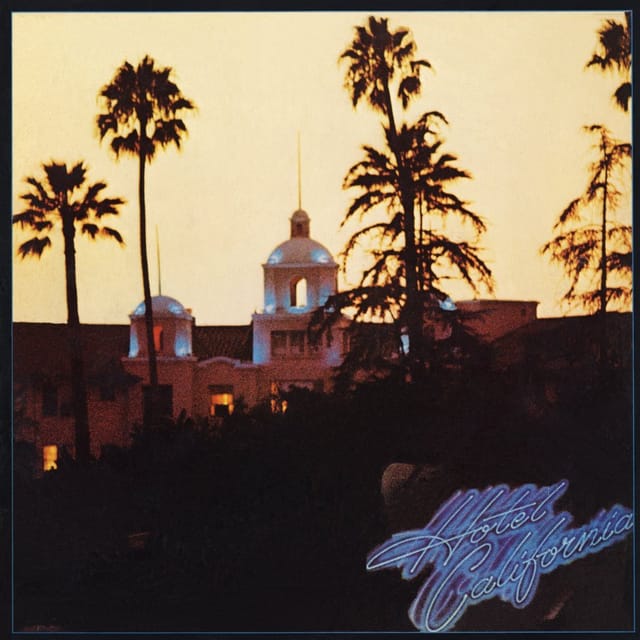
Every plank of it collapses on inspection. The cover photograph is the Beverly Hills Hotel — the “Pink Palace” where the industry the song skewers actually did its deal-making — shot at sunset by David Alexander from a lift sixty feet above Sunset Boulevard, with art direction by John Kosh. The interior shots came from the Lido in Hollywood, populated by the band's friends. The balcony ghoul was a hired model whose face blurred in the long exposure. The backward message exists only in the way all such messages exist: play any record in reverse and the mush invites you to hear whatever you were told to listen for. The satanic reading required no evidence, though — only the song's atmosphere, which supplied the dread all by itself.
The Other Wrong Answers
Satanism was merely the loudest theory. Over the decades the song has been confidently explained as a portrait of heroin addiction, with the hotel as the drug and the checkout line as withdrawal; as a night in a psychiatric hospital; as an inn run by cannibals who feast on their guests; as Aleister Crowley's mansion in Scotland; and as the Playboy Mansion. Band members have flatly rejected all of them. The interpretations tell you more about their inventors than the song — each one takes the lyric's engineered unease and assigns it the most vivid villain its era had available.
The most durable spin-off wasn't sinister at all — it was commercial. An eleven-room hotel in Todos Santos, on Mexico's Baja peninsula, spent years letting guests believe it was the song's namesake, piping Eagles records through its sound system and selling “legendary” T-shirts. The band had never set foot in it. In May 2017 the Eagles sued, and the matter settled in early 2018 after the hotel withdrew its U.S. trademark application — a quiet legal end to the only Hotel California rumor with a gift shop.
What the Lyric Actually Hides
The real Easter eggs in “Hotel California” are jokes, not confessions. The “steely knives” that appear late in the song are a tip of the hat to Steely Dan, who shared manager Irving Azoff with the Eagles and had needled them the previous year with a line on The Royal Scam's “Everything You Did” instructing someone to turn up the Eagles because the neighbors were listening. And “colitas,” the word that perfumes the opening verse, is Spanish slang — Felder described it as a desert plant that blooms at night with a “pungent, almost funky smell,” and most translators land, less botanically, on marijuana buds.
"It's basically a song about the dark underbelly of the American dream, and about excess in America, which is something we knew a lot about."
Henley has been giving the same answer, in different words, since the Carter administration. The hotel is not a building; it is Southern California as the Eagles found it in the mid-seventies — the seduction of fame, money, and pleasure, and the discovery that the life you checked into cannot be checked out of. “It's a song about a journey from innocence to experience,” he said in the 2013 documentary History of the Eagles. “It's not really about California; it's about America.” They were, he has pointed out, middle-class kids from Texas, Michigan, Minnesota, and Florida, writing down what the high life looked like from the inside.
Henley vs. the Literalists
The misreadings clearly wear on him. In 2009, John Soeder of Cleveland's Plain Dealer tried a gotcha of the pedantic variety, pointing out that the song's wordplay about wine and spirits fails as chemistry, since wine is fermented rather than distilled. Did Henley regret the line?
"Thanks for the tutorial and, no, you're not the first to bring this to my attention — and you're not the first to completely misinterpret the lyric and miss the metaphor."
The line, Henley went on, had little to do with beverages at all — it was a sociopolitical statement, the spirit in question being the one that vanished from American life at the end of the sixties. “My only regret,” he closed, “would be having to explain it in detail to you, which would defeat the purpose of using literary devices in songwriting and lower the discussion to some silly and irrelevant argument about chemical processes.” It is as close as he has come to stating the method outright: the song is built from metaphors, and a metaphor explained is a metaphor destroyed.
The Rumor That Can Never Leave
Which is why the rumors will outlive everyone involved. Henley and Frey wrote a song specifically designed to feel like it means more than it says — a noir with the last page torn out — and an audience given that much room will wander into devil worship, heroin, and cannibal innkeepers sooner than accept an allegory about narcissism and the music business. Felder, whose Malibu demo started it all, thought the six-and-a-half-minute track was too long to be a single and said he'd never been so delighted to be proved wrong. The satanists, the literalists, and the conspiracy hunters have all been proved wrong too. Unlike Felder, they never seem to check out.