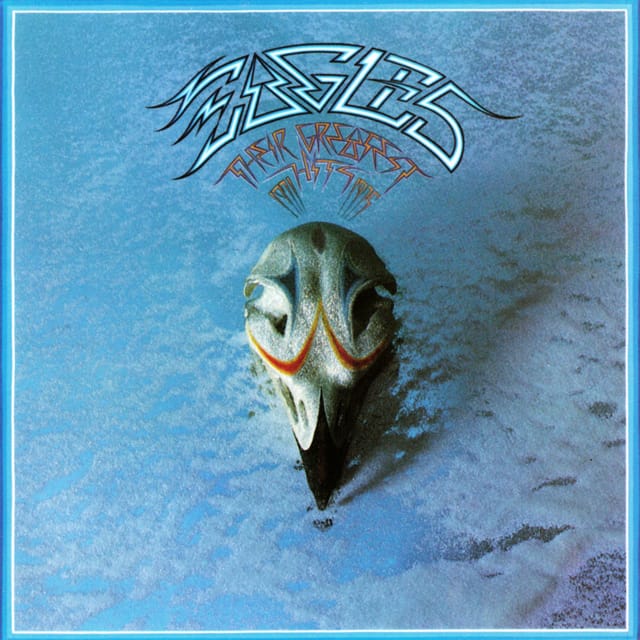
The Quiet Record
The band didn't want to release it, didn't play on any new track, and grumbled about it at the time. Fifty years later it's the first Quadruple Diamond album in RIAA history — ahead of Thriller.
 Trevor Fortune•🎵 Eagles - Their Greatest Hits (1971-1975)•9 min read•September 22, 2026
Don Henley has spent fifty years being polite about an album he never wanted released. “It wasn't really their idea; it was basically pushed on them by the record company,” he said of Their Greatest Hits (1971–1975), which Asylum Records put out on February 17, 1976, while the Eagles were still buried in the studio finishing Hotel California. Asked whether the band objected at the time, Henley didn't soften it: “We complained. Oh, yeah. It's documented.” Ten previously released songs, no new material, no say in the timing — and by January 2026, RIAA-certified Quadruple Diamond, more than 40 million units, the best-selling album in American history. It passed Michael Jackson's Thriller for the title not once, but twice, and neither time did anyone throw the record-industry equivalent of a parade.
A Record the Band Didn't Ask For
Compiled from the Eagles' first four studio albums — Eagles (1972), Desperado (1973), On the Border (1974), and One of These Nights (1975) — Their Greatest Hits was, by industry standards of the time, exactly the kind of release nobody expected to matter much. Compilations were a label's low-risk, low-effort move between real albums. Contemporary critic Henry Edwards, writing in The New York Times, summed up why labels loved them: they “cost almost nothing to produce; they sell with a minimum of advertising.” Asylum needed revenue while the band dragged its feet on Hotel California, and a hits package was the fastest way to get there.
The album debuted at No. 4, hit No. 1 within a month, and held the top spot for five weeks — a strong showing, but nothing that suggested it would still be selling half a century later. One week after release, on February 24, 1976, it became the very first album ever awarded RIAA Platinum certification, a tier the organization had only just introduced. It was a historic footnote at the time, not yet a harbinger of anything larger.
"“Greatest Hits” is kind of a misnomer… every song on that album was not a great hit."
The Slow Climb Nobody Was Watching
What happened over the following decades wasn't a marketing campaign — it was pure, grinding, unglamorous consistency. Carl Mello, a senior buyer at the record chain Newbury Comics, described the pattern bluntly: “It was never the biggest thing ever… but each year it just sold tons and tons.” Part of the reason traces back to timing nobody planned: the compilation reached stores roughly ten months before Hotel California, meaning new fans discovering the band through that album's title track and singles often went back and bought both records on the same trip, a pattern Rolling Stone's Steve Knopper has argued repeated itself “for decades” as each new generation found the band.
The album became less a phenomenon than a fixture — the default entry point for a band whose catalog was otherwise scattered across individual LPs, a constant presence on classic rock radio, and, according to chart-analytics research from ChartMasters, “the biggest anomaly ever of the music industry” by the sheer scale of its sustained sales. By 1999 it was already being named the best-selling album of the 20th century in the US. It just never stopped selling long enough for anyone to declare it finished.
Trading the Lead With Thriller
The two albums have leapfrogged each other for decades under RIAA's certification math, and the story of that leapfrogging is stranger than a simple sales record. Thriller took the 20x Platinum milestone first, in 1984 — a deliberately engineered, seven-singles, MTV-era blockbuster built from day one to be the biggest album ever made. The Eagles compilation, with no equivalent campaign behind it, kept quietly climbing anyway: 26 to 27 times platinum by 1999, 29x by 2006.
Then, in August 2018, the RIAA recertified the Eagles collection from 29x to 38x platinum in a single jump — a leap large enough that reporters asked how it happened. Behind it was a genuine forensic audit: Warner Music Group's data team reportedly went into the Iron Mountain document-storage archive and interviewed former label financial executives to reconstruct decades of sales and royalty records that had never been formally counted toward certification. RIAA Chairman and CEO Cary Sherman framed the milestone diplomatically at the time: “Both of these transcendent albums have impressively stood the test of time, only gaining more currency and popularity as the years have passed.”
That 2018 recertification pushed the Eagles ahead of Thriller's then-33x platinum mark for the first time since Michael Jackson's 2009 death had driven a wave of new Thriller sales and certifications. Thriller has been stuck at 34x platinum since August 2021 — nobody re-auditing its decades of catalog sales the way Warner did for the Eagles. The Eagles collection, meanwhile, kept grinding upward without any comparable fanfare, until January 2026, when the RIAA certified it Quadruple Diamond — more than 40 million units, the first album in RIAA history to reach that tier, and roughly 6 million units ahead of Thriller.
Fifty Years Later, Still Correcting the Record
When the band marked the album's 50th anniversary in 2026, with a crystal-clear vinyl reissue timed four days ahead of the actual date, Henley used the press cycle to quietly needle the record's own branding one more time — pointing out that the title itself oversells what's on it, since Desperado, among other tracks, was never even released as a single. It is a strange kind of legacy: a founding member still gently correcting the marketing of an album he didn't choose to release, fifty years after the fact, even as that same album keeps setting sales records no one at Asylum could have imagined in 1976.
The contrast with Thriller is really the whole point of the story. Jackson, Quincy Jones, and Epic built Thriller from the ground up to be the biggest album ever made, and for a long stretch, by every measure, it was. The Eagles collection never tried to be anything but a stopgap between two real albums — and quietly outsold it anyway, not once but in two separate decades, through nothing more dramatic than five decades of people continuing to buy it.
Nobody engineered that outcome. Nobody at Asylum Records in February 1976 was thinking about RIAA certification tiers that wouldn't exist for another decade, let alone a Quadruple Diamond tier that wouldn't exist for fifty years. A label needed cash before a fiscal quarter closed, a band that didn't want the album out complained about it and lost, and the result quietly became the best-selling album in American history — the record nobody was trying to set.
Related Review
Read our comprehensive analysis of Eagles's Their Greatest Hits (1971-1975)
Their Greatest Hits (1971-1975) Review →