The No. 9 Single
Journey's second single from Escape was a solid hit in 1981 and an oldie by 1990. Then a lounge singer, a baseball team, a TV finale, and a high-school glee club gave it a second career bigger than the first.
 Trevor Fortune•🎵 Journey - Escape•6 min read•October 6, 2026
On a summer weekend in 2005, three Chicago White Sox players walked into a hotel bar in Baltimore. A.J. Pierzynski, Joe Crede, and Aaron Rowand called themselves “the Three Stooges.” There was a lounge singer working the room, and Crede shouted the request: “Play some Journey!” The singer picked “Don't Stop Believin'.” Three months later, Steve Perry was singing it with them in a World Series clubhouse.
That is one of four accidents that turned a modest 1981 hit into one of the best-selling songs ever recorded. None of them were planned by Journey. Each one came from somebody outside the band who heard the song differently than the radio had.
A Respectable Hit, Then Nothing Special
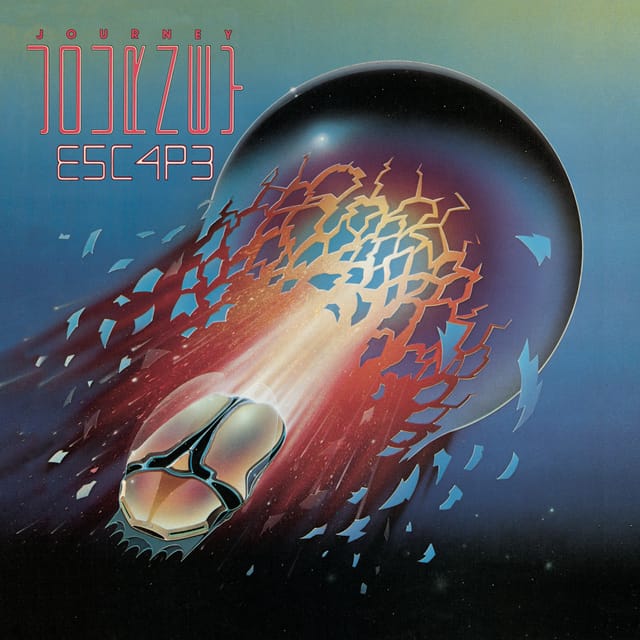
“Don't Stop Believin'” was the second single from Escape, the 1981 album that gave Journey its only No. 1 record. It peaked at No. 9 on the Billboard pop chart and No. 8 on the Mainstream Rock chart. That was a good result, but not the band's biggest of the era. “Who's Crying Now” and “Open Arms” both charted higher.
Jonathan Cain, who wrote it with Perry and guitarist Neal Schon, had aimed it at a specific kind of listener. “With ‘Don't Stop Believin'’ we wanted to reach anybody that had a dream, anybody that felt like they were stuck someplace,” he said. For two decades it did that quietly, as one classic-rock radio staple among many.
Perry left the band in the late 1990s. Journey kept touring with other singers. The song went on to Apple's iTunes Store on April 28, 2003, where it sat waiting like the rest of the 1980s catalog.
The Three Stooges and Steve Perry
The first signs came in 2005. Placements on Family Guy and MTV's Laguna Beach pushed it into iTunes' list of the year's ten most downloaded singles. Then the White Sox adopted it. After that Baltimore series in late July, the song became the clubhouse anthem for the rest of the season.
When Chicago reached the World Series, Pierzynski made it his mission to get Perry there. He succeeded. Perry turned up for Game One in Chicago and for the Game Four clincher in Houston, where the Sox completed a sweep of the Astros for their first championship since 1917. He sang the song with the players in the visitors' clubhouse. At the downtown victory parade he sang it again, with Crede, Pierzynski, and Rowand as backup singers.
“Hanging out with Steve Perry, always makes me laugh,” Crede said years later. “It was a great time in my life.” For a singer who had largely stayed out of public view since leaving Journey, it was a strange and very public return. It also showed that the song worked as something other than a radio single. It was something people sang together.
Cut to Black
David Chase wanted the song for the final scene of The Sopranos, which aired on Sunday, June 10, 2007. In the scene Tony Soprano chooses it from a diner jukebox while his family arrives. Schon and Cain approved the use quickly. Perry held out. He feared Chase was planning to end the series by “mowing down” the entire Soprano family. He did not want his song attached to a massacre.
His answer stayed no until the show agreed to tell him how it ended. The message reached him through his licensing agent on the Thursday afternoon before the broadcast. The producers explained almost everything, but held back the last seconds: the abrupt cut to black that would start years of arguments. “They didn't tell me that,” Perry said later. “That's okay. At least nobody got whacked.”
"I loved the way it was used. I really did."
The effect was immediate and measurable. Sony reported that on a typical day the song sold roughly 1,000 downloads on iTunes. On the Sunday of the finale it sold 2,491. On Monday it sold 6,531. Across June 9 to 12, downloads were up 482 percent, and by Wednesday it was No. 1 on the iTunes rock chart.
Schon called it “probably the highest compliment ever for that song.” Cain later put the impact more modestly: “The Sopranos created a buzz for Journey and the song for about two or three months afterwards.” The buzz did not fade, though. In November 2008 “Don't Stop Believin'” became the first catalog track ever to pass 2 million digital sales.
A Singer From YouTube
The band was being reshaped by the internet too. That year Schon was without a lead singer and out of patience with auditions. “I was frustrated about not having a singer,” he said. “So I went on YouTube for a couple of days and just sat on it for hours.” He found clips of a Manila cover band called The Zoo and its singer, Arnel Pineda.
“After watching the videos over and over again, I had to walk away from the computer and let what I heard sink in because it sounded too good to be true,” Schon said. He messaged Pineda through YouTube. Pineda assumed it was a hoax at first. In December 2007, Journey announced him as their new lead singer. The song had a new crowd and the band had a new voice, both found online within a few months of each other.
Higher Than the Original
The last accident came in May 2009, when Fox aired the pilot of Glee. The episode ended with its high-school glee club performing “Don't Stop Believin'.” The cast recording debuted at No. 4 on the Billboard Hot 100, five places higher than Journey's original ever reached. A song that had once been a hit for teenagers in 1981 was now a hit for their children.
Each of these placements fed the next. The White Sox made it a sing-along. The Sopranos made it a cultural reference. Glee made it a song teenagers performed themselves. By 2024 the RIAA had certified the original 18-times platinum.
Cain no longer treats it as one hit among several. The band moved it from the end of the set to the start, he said, because closing with it had become “very predictable.” His summary is simple. “With ‘Don't Stop Believin'’, every band wishes they had one, and that's ours. It's the song that defines our band.”
In 1981 it was Journey's No. 9 single. By 2009 it was the song a lounge singer, a ballclub, a TV writer, and a glee club had each chosen for themselves.