Twenty Seconds of Leader Tape
How sixteen minutes of unfinished scraps, a drum solo nobody wanted and one engineer’s refusal to throw anything away became the Beatles’ goodbye
 Trevor Fortune•🎵 The Beatles - Abbey Road•9 min read•August 18, 2026
At the end of July 1969, a twenty-year-old tape operator named John Kurlander was standing at an editing bench in Abbey Road with a razor blade and a problem. Paul McCartney had just listened to a rough assembly of the album's second side, decided that one twenty-three-second fragment sitting between two other songs was ruining the flow, and told him to cut it and throw it away. Kurlander had also been told, by everyone above him at EMI, that no piece of Beatles tape was ever to be discarded. So he obeyed both instructions: he sliced the fragment out, spooled roughly twenty seconds of red leader tape onto the end of the reel, and stuck the offcut on after it, where nobody would ever hear it. Six weeks later it was the last thing on the last album the Beatles ever recorded, and popular music had its first hidden track. It is the perfect origin story for the medley it fell out of, because almost nothing about side two of Abbey Road was planned either.
A Band That Had Already Ended
By the summer of 1969 the Beatles were, functionally, over. The January sessions that became Let It Be had been filmed, abandoned and shelved. Allen Klein had been installed as business manager over McCartney's objections, and the four of them were no longer meaningfully on the same side of anything. George Martin, who had barely been in the room for the White Album, agreed to come back only on the condition that they work the way they used to — which is to say, with a producer.
Lennon arrived late and damaged. On July 1 he had crashed a car on a single-track road near Durness in the Scottish Highlands with Yoko Ono, his son Julian and Ono's daughter Kyoko in it, swerving to avoid an oncoming vehicle and putting the car in a ditch. Three of them needed stitches; Ono, who was pregnant, came off worst. Lennon rejoined the sessions on July 9 and had Harrods deliver a double bed to the studio so that Ono could recuperate in the room where the band were working, with a microphone suspended above it so she could contribute her thoughts. This is the atmosphere in which the most sustained, most technically ambitious sixteen minutes in the Beatles' catalogue were assembled.
Paul's Symphony, John's Objection
The medley was McCartney's idea, and George Martin's instinct. Martin had been pushing the pair of them to think symphonically — to stop treating an album as a container for singles and start treating a side as a movement. McCartney, who had a drawer full of song fragments that were never going to become songs, saw the way out: stop trying to finish them and start sequencing them. Eight pieces, cross-faded and key-matched, running continuously from a bitter piano ballad to a drum solo to a Shakespearean couplet.
Lennon wanted the opposite. His preference was for a straight split — his songs on one side, McCartney's on the other — and he never came round to the suite, even after contributing three of its eight parts. Eleven years later, in his final long interview, he was still filing a dissent.
"I liked the A side, but I never liked that sort of pop opera on the other side. I think it's junk. It was just bits of song thrown together."
The complaint is accurate as description and wrong as criticism. The pieces genuinely have nothing to do with each other — no thread, as Lennon said, beyond the fact that they were stuck together. What he was declining to notice is that the sticking together is the composition, and that a band with nothing left to say to one another had accidentally found the only form that suited them.
Assembled From Leftovers
Look at where the eight pieces came from and the joins stop being a weakness. The suite opens with “You Never Give Me Your Money,” which is a song about the accountancy that was destroying the band. McCartney later said flatly that it was him directly lambasting Allen Klein's attitude to the group — no money, just funny paper, all promises that never worked out. Rock's most romantic farewell begins with a complaint about a manager's balance sheets.
Then come the orphans. “Sun King” was cut back-to-back with “Mean Mr Mustard” as a single performance on July 24, under the working title “Here Comes The Sun-King” until its resemblance to Harrison's song forced a trim; Lennon cheerfully admitted the band were chasing the drifting, tremolo feel of Fleetwood Mac's “Albatross,” and capped it with a verse of mock-Romance gibberish that means nothing in any language. “Mean Mr Mustard” had been written in Rishikesh in the spring of 1968, sparked by a Daily Mirror item about a sixty-five-year-old Scottish miser whose marriage was annulled because he would not spend money on his wife. “Polythene Pam” was another leftover from the same fallow period. “She Came In Through the Bathroom Window” came from life: fans who kept permanent vigil outside McCartney's London house had once got a ladder up to the bathroom window and let themselves in.
The most revealing origin is “Golden Slumbers.” McCartney found the words on a piano at his father's house in Liverpool, in a songbook belonging to his stepsister Ruth — a lullaby lifted from Thomas Dekker's Patient Grissil, printed around 1603. He could not read music, so he could not play the tune on the page.
"I can't read music and I couldn't remember the old tune, so I just started playing my own tune to it."
A four-hundred-year-old lullaby, rewritten because the man holding it was unable to read the notes. The medley is full of that: every limitation converted into a decision.
The Solo Ringo Did Not Want
“The End” contains the only drum solo Ringo Starr ever played on a Beatles record, and he played it under protest. Starr disliked drum solos on principle, as did the rest of the band — McCartney has said they all hated drummers who went in for lengthy ones. He gave in because the arrangement had a hole in it that nothing else would fill. What he produced is barely a solo at all: a short, melodic, tom-heavy figure that works as a bridge rather than a showcase, over in seconds.
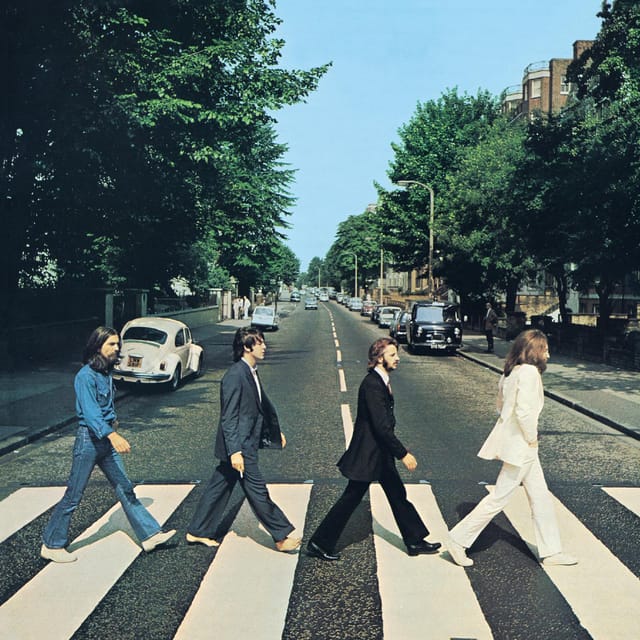
Then, on August 7, 1969 — the day before the four of them walked across the zebra crossing outside for Iain Macmillan's camera — McCartney, Harrison and Lennon stood together and traded lead guitar, live, two bars each, rotating in that order three times over. It is the only place on any Beatles record where the three of them solo in sequence, and the personalities are unmistakable: McCartney bluesy and slightly showy, Harrison singing and precise, Lennon deliberately dirty and ragged. They had been fighting for eighteen months. Given twenty-eight bars and one amplifier each, they sound like teenagers again.
McCartney closed it with a rhyming couplet, written to order, that balances what a person receives against what a person gives. He has said he wanted a meaningful couplet at the end and so followed the Bard. Lennon, who spent that 1980 interview dismantling most of McCartney's catalogue and had just called the entire side junk, stopped to make an exception for it — conceding that his partner had landed a line that was, in his words, very cosmic and philosophical. It is the last thing either of them said about the other's work while both were alive to say it.
The Last Night in the Room
On August 20, 1969, all four Beatles were together in a recording studio for the final time. Fittingly, no music was made. They spent the afternoon mixing “I Want You (She's So Heavy)” from two different masters at Lennon's instruction, and then, from six in the evening until quarter past one the following morning, sat in the control room of Studio Two deciding what order the album went in. Kurlander spliced as they argued. At that point they still believed the medley would open the record rather than close it.
Which is how the accident became the ending. When a lacquer was cut from the reel, the person doing the cutting saw Kurlander's discarded fragment sitting after the leader tape, applied the same institutional rule — never throw anything away — and included it. McCartney heard the playback: “The End” resolving, fourteen seconds of silence, and then, out of nowhere, twenty-three seconds of solo acoustic guitar and voice that begins on a crashing chord belonging to a different song and stops dead mid-phrase, because its final note is still sitting at the top of “Polythene Pam” where the razor blade left it. He decided he liked it.
"It was typical Beatles — an accident."
The full story of the album that side belongs to is told in our review; what the medley itself is worth remembering for is the method. Four men who could no longer write together, produced by a man they had frozen out and then recalled, salvaged sixteen minutes from things none of them had been able to finish, and arranged them into the most convincing ending any band has ever managed. Lennon was right that it was bits of song thrown together. He simply underestimated what the throwing was worth. The Beatles could not agree on a manager, a business, a producer, or which side of the record their songs belonged on. They agreed on twenty-eight bars of guitar, one couplet, and an offcut nobody meant to keep.