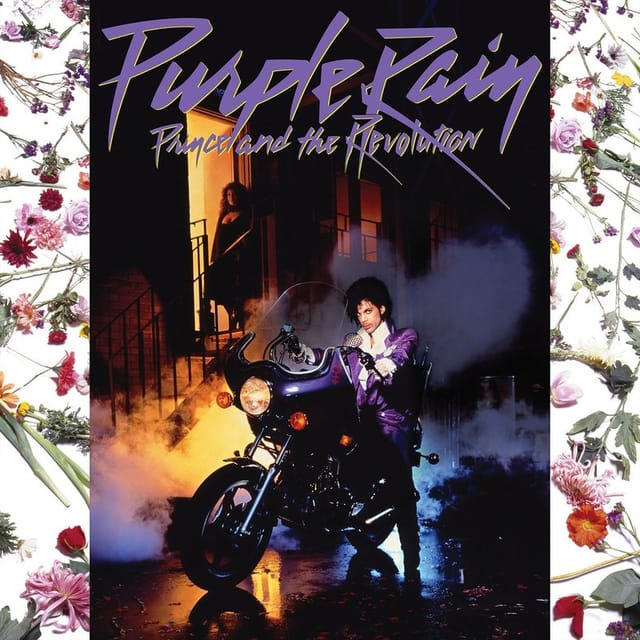
The Night First Avenue Recorded Purple Rain Live
A $25 charity show, a rented truck from New York, and the guitar solo that never left the room
 Trevor Fortune•🎵 Prince - Purple Rain•10 min read•July 16, 2026
On August 3, 1983, Prince and his band played a charity show at First Avenue, a club in Minneapolis. About 1,200 people paid $25 each to get in. Three songs from that night ended up on the Purple Rain album: “Purple Rain,” “I Would Die 4 U” and “Baby I'm a Star.” Overdubs were added later, but the basic recordings are from the club. The title song had been written only weeks before. The guitarist next to Prince was playing her first show with the band. And the famous vocal on “Purple Rain” was recorded live that night with a single microphone, not in a studio.
A Benefit Nobody Expected to Matter
The show existed because Minnesota Dance Theatre needed money. Artistic director Loyce Houlton approached Prince directly, asking for a benefit performance to help keep the financially struggling company afloat. Prince agreed, and the show was booked at First Avenue — the Minneapolis club recently rebranded from its earlier name, Sam's — for a Wednesday night in early August.
Tickets ran $25, a startling price for a room that normally charged $4 or $5. Roughly 1,200 people paid it, with another 252 comped, and the night raised about $23,000 for the dance company — real money for a struggling nonprofit in 1983, and a fraction of what the tape from that night would eventually be worth to Warner Bros.
None of that explains why a mobile recording truck from New York was parked outside. That part was Prince's idea, and it had almost nothing to do with the dance company.
Six New Songs in One Set
The 75-minute, twelve-song set that night included six live debuts, among them a Joni Mitchell cover (“A Case of You”) and the four songs that would anchor the album still being written. It was also the first live show with Wendy Melvoin on guitar, replacing Dez Dickerson and completing the lineup the world would come to know as the Revolution. She had been in grueling rehearsals for weeks, learning a set built and rearranged on the fly, and originated the open-chord intro that opens “Purple Rain” to this day.
The title track itself barely existed yet. “Prince didn't write that one 'til the very end, which is more about like mid-to-late July of '83,” keyboardist Dr. Fink recalled — meaning the band had rehearsed the song for only a couple of weeks before performing it in front of a paying crowd, and Prince didn't even play it identically to rehearsal once he was onstage.
The room itself worked against them. “It was pushing 90 degrees Fahrenheit and dense with cigarette smoke,” drummer Bobby Z said. “It was a toxic environment.” Fink remembered the band drenched in sweat within two minutes of taking the stage. And the crowd's reaction to the song that would become the album's centerpiece was, by most accounts, more attentive than euphoric — an eight-minute ballad holding a club audience's focus rather than whipping it into a frenzy.
A Truck From New York
There was no adequate remote recording truck in the Twin Cities in 1983, so road manager Alan Leeds arranged for Record Plant's “Black Truck” to make the trip from New York, crewed by Dave Hewitt and Kooster McAllister. Staff engineer David Z — Bobby Z's older brother — ran roughly two dozen mic inputs into a custom 44-channel console, tracking to a pair of Ampex 1200 two-inch multitracks. “At the time, you could not do better than that,” Z said, “between that equipment and Kooster and Dave Hewitt working with you.”
Prince also ran a hybrid drum setup that night — a live drummer alongside a LinnDrum, with one machine looping continuously and a second triggered off the snare mic in real time. “Prince was very innovative,” Bobby Z said. “He wanted the Linn's snare sounds but wanted the feel of a drummer.” It was an unusual thing to attempt live, let alone live and being recorded for a record nobody in the crowd knew was being made.
"Prince was really excited and kept pumping us up: 'We're making history tonight.' It all makes sense now: if you're going to record something, make sure you're as badass as you can be. Don't fuck around."
Prince could have taken the safer route — play the songs on a short tour, record several nights, and assemble the best takes later. He didn't. “He could have waited and done 20 shows and picked the best one, but he didn't,” David Z said. “He's kind of like that though — it's like first impressions are the most important.” One take, one night, and whatever the room gave him was what he was going to use.
What Stayed, What Got Rebuilt
The live version of “Purple Rain” ran around thirteen minutes; the album edit is 8:41, with an entire verse cut for pacing. “The third verse didn't really match the other two,” Coleman said. “It was a different spirit and it didn't belong.” The guitar solo, by contrast, is essentially the live take untouched — captured once, in the room, and never redone. So is most of the lead vocal. “I believe that most, if not all, of the lead vocal is from the club recording,” said David Leonard, the engineer who handled the Los Angeles overdubs. “He is a superhuman vocalist.”
The strings that swell under the song's final minutes are often misattributed to Clare Fischer, who became Prince's regular string arranger starting with 1986's Parade. The “Purple Rain” arrangement predates that relationship: it was written by Lisa Coleman, based on a part she'd played live that night on her Oberheim keyboard, then voiced for a string quartet and recorded afterward at Sunset Sound. BrownMark's bass, unreliable to capture wirelessly in a live room in 1983, was rebuilt in the studio as well. And when the recording needed more audience presence than the club mics had actually captured, David Z later layered in crowd noise from recordings of Minnesota Vikings games.
“I Would Die 4 U” and “Baby I'm a Star” followed the same pattern: the live basic tracks kept, then extended and layered at Sunset Sound over the following two weeks. BrownMark's choreography for “Baby I'm a Star” — a side-step shuffle he'd worked out for the stage — survived onto the record along with the performance itself; new strings, cleaned-up vocals, and backing vocals from Coleman and Jill Jones were added afterward.
The Film That Found Its Name in the Room
Director Albert Magnoli was in the club that night, still assembling the movie that would eventually take its title from the song. He had reportedly worked through roughly a hundred candidate tracks looking for a centerpiece; hearing “Purple Rain” performed live at First Avenue is widely credited with settling the question — the song, and eventually the club itself, became the film's visual and emotional anchor.
Prince's own reaction after the set was almost anticlimactic. “Prince drove up to the truck after the show and asked how it sounded,” David Z remembered. “That was pretty much our post-recording conversation. It was like a Fellini movie.” There was no listening party, no immediate declaration that he had just recorded the backbone of the biggest album of his career.
“Prince was really not a well-known figure back then,” David Z said. “This is the kind of recording that launched him into superstardom.” Forty-plus years later, the record still carries the sound of that specific, sweat-soaked room — a $25 benefit for a dance company that nobody, including some of the people onstage, realized was also the night Purple Rain got made.