A Tape Left Running
On December 4, 1956, Elvis Presley dropped in on a Carl Perkins session at Sun Records. By the end of the afternoon a newspaper had given the four men around the piano a name.
 Trevor Fortune•🎵 Elvis Presley, Carl Perkins, Jerry Lee Lewis and Johnny Cash - The Complete Million Dollar Quartet•6 min read•November 5, 2026
On Tuesday, December 4, 1956, Carl Perkins was cutting new songs at Sun Records in Memphis. Elvis Presley, by then the biggest star in America, walked in to say hello. Jerry Lee Lewis was on piano, and Johnny Cash came by. The engineer, Jack Clement, decided to leave the tape running.
What he caught was not a recording session. It was four young men from the same small label singing hymns, country songs and each other's hits around an upright piano for the fun of it. The next day the Memphis Press-Scimitar ran a photograph of them under the headline “Million Dollar Quartet.” The tape itself stayed in a box for the next quarter of a century.
A Perkins Session on a Tuesday
The afternoon belonged to Perkins. His “Blue Suede Shoes” had been Sun's big hit of 1956, and he was back in the studio looking for a follow-up, including a reworked version of the old blues “Matchbox.” He brought his brothers Clayton and Jay and his drummer, W.S. Holland. Sun's owner, Sam Phillips, wanted piano on the session, so he called in a young pianist he had recently signed.
That was Jerry Lee Lewis. He was a relative unknown outside Memphis, a session player whose first Sun single was due out within days. Johnny Cash, on the other hand, was already one of the label's stars. “I Walk the Line” had gone to No. 1 on the country chart that year. Cash later wrote in his autobiography that he dropped in because he wanted to hear what Perkins was doing.
Presley had been Sun's first breakthrough. Phillips had sold his contract to RCA Victor about a year earlier, and in 1956 Presley had become a national phenomenon. He arrived in the early afternoon, back in Memphis after a trip to Las Vegas, with his girlfriend, Marilyn Evans. He listened to a playback of Perkins's session in the control room, then went out into the studio.
“I Think I'd Be Remiss”
Nobody planned what happened next. Presley sat down at the piano and the others gathered round. They worked through gospel songs they had all grown up with, such as “Softly and Tenderly” and “Peace in the Valley,” then country songs, then rock and roll, including Chuck Berry's “Brown Eyed Handsome Man.” Perkins mentioned he had just come back from a five-week tour with Berry. “It was totally extemporaneous,” Phillips told the journalist Roy Carr in 1980.
Jack Clement was running the control room. He remembered thinking, “I think I'd be remiss not to record this,” and so he rolled tape. Nobody moved the microphones to suit a group of singers clustered round a piano, so much of what was said and sung ended up off-mic. That is part of why the tape sounds the way it does: casual, chatty, and full of half-finished songs.
One of the best moments is not a song at all. Presley tells the room about a singer he had just seen in Las Vegas with Billy Ward and His Dominoes, doing a take-off of his own “Don't Be Cruel.” He did not know the man's name. It was Jackie Wilson. “He tried so hard, till he got much better, boy; much better than that record of mine,” Presley says, and then sings it the way Wilson did.
A Phone Call to the Paper
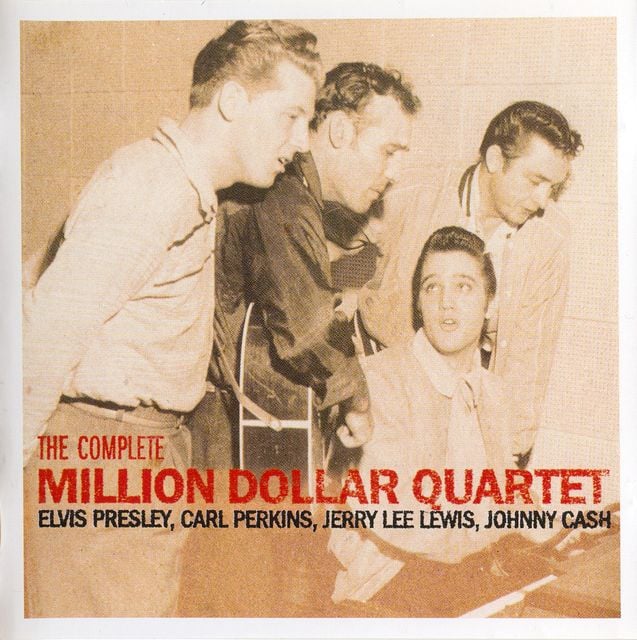
Phillips knew a story when he saw one. He phoned the Memphis Press-Scimitar, and its entertainment editor, Bob Johnson, came over with a man from United Press and a photographer. Johnson described what he walked into as an old-fashioned barrelhouse session with barbershop harmony. The photographer took the picture that has been reprinted ever since: Presley at the piano, with Lewis, Perkins and Cash leaning in around him.
The famous version is cropped. The full frame shows Marilyn Evans sitting on top of the piano. W.S. Holland, who had been drumming on Perkins's session all day, was left out of the pictures altogether. He later spent decades as Johnny Cash's drummer.
Johnson's story ran the next day, December 5, under the headline “Million Dollar Quartet.” On that Tuesday, only one of the four was a household name.
"That's why I hate to start these jam sessions. I'm always the last one to leave."
Was Johnny Cash Really There?
Presley was not, in the end, the last to leave. He and Evans slipped out while Lewis was playing. In Cash's version, nobody wanted to follow Lewis at the piano, “not even Elvis.” Lewis, for his part, remembered how easily he and Presley shared the old hymns. “Me and Elvis knew the words to every song, because we were raised up in the same church,” he said.
Cash is the puzzle. He is in the photograph, but his voice is hard to pick out on the tape, and for years people assumed he had left before the singing really started. Cash insisted otherwise. In his 1997 autobiography, Cash, he wrote that he was singing higher than usual to keep up with Presley, standing farthest from the microphone.
"Contrary to what some people have written, my voice is on the tape. I guarantee you, I'm there."
Twenty-Five Years in a Box
The tape was a souvenir, not a product, and it was quickly forgotten. In 1969 Shelby Singleton bought Sun Records and began working through its archive of tape. The session was among what he found.
Seventeen tracks were first released in 1981, in Europe, as The Million Dollar Quartet. More turned up over the following years. For the 50th anniversary in 2006, a fuller edition was assembled using reels from Presley's own collection, thought to cover about 95 percent of the time all four men were together.
The same year, a musical called Million Dollar Quartet opened in Florida. It reached Broadway in 2010, though it makes no claim to show what actually happened that afternoon. Jerry Lee Lewis, the session pianist nobody had heard of, outlived the other three. When he died in 2022, the last member of the Million Dollar Quartet was gone.