The $47.5 Million Handshake
How Paul McCartney's own advice helped Michael Jackson outbid him for the Beatles catalog
 Trevor Fortune•🎵 Michael Jackson - Thriller•9 min read•July 20, 2026
Paul McCartney gave Michael Jackson a piece of financial advice during the recording of “Say Say Say” in 1983: buy music publishing. Own the songs, not just the recordings, and the money follows you forever. Two years later, Jackson took that advice further than McCartney ever imagined — outbidding McCartney himself for the company that owned roughly 250 Lennon-McCartney compositions, the actual sheet-music and licensing rights to most of the Beatles catalog. The two men who had just spent a year making Number One records together never spoke again.
Good Advice, Taken Literally
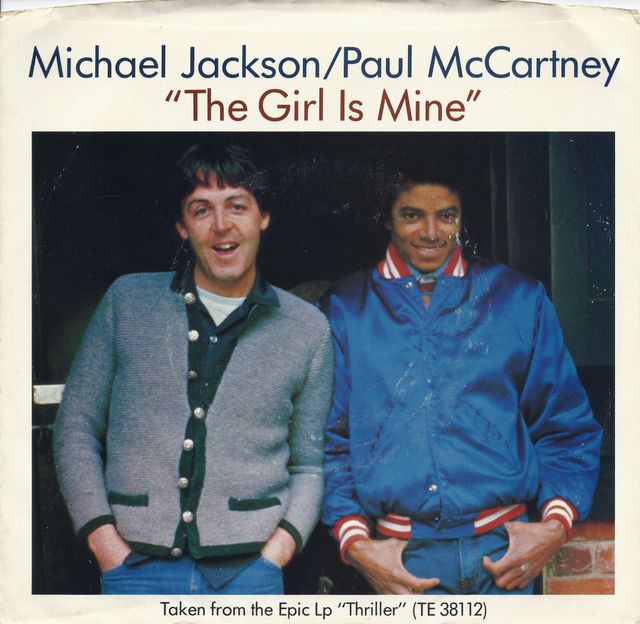
Jackson and McCartney recorded three songs together across 1982 and 1983 — “The Girl Is Mine” for Thriller, and “Say Say Say” and “The Man” for McCartney's Pipes of Peace — and by most accounts the two became genuine friends during the sessions, not just professional collaborators trading hit singles. Somewhere in that stretch, Jackson asked McCartney for general business advice. McCartney, who had recently bought the publishing rights to Buddy Holly's catalog, told him to look into music publishing specifically: ownership of the compositions themselves, separate from who performs them, is where the durable money sits.
McCartney had personal reasons to know exactly how valuable that kind of ownership was, and exactly how painful it was to lose. In 1963, the Beatles signed their songwriting over to a new publishing company, Northern Songs, in a deal that left John Lennon and McCartney with individual minority stakes rather than outright ownership. When the company went public in 1965, their stakes shrank further. By 1969, after publisher Dick James sold his holding to Lew Grade's ATV Music without warning the songwriters first, Lennon and McCartney tried and failed to counter-bid for control of their own songs. They ended up selling their remaining shares to ATV instead, keeping only their songwriting credit — not ownership — on the catalog they had written.
The Catalog Comes Up for Sale
In 1984, ATV's owner, Australian businessman Robert Holmes à Court, put the company's roughly 4,000-song catalog on the market. McCartney, who had spent fifteen years watching someone else profit from his own songwriting, moved to buy it back. He reached out to Yoko Ono, John Lennon's widow and co-heir to the Lennon-McCartney catalog's value, to see if she would join a joint bid. She declined, and McCartney was left pursuing the purchase largely on his own.
Jackson moved at the same time, with considerably more urgency. His attorney, John Branca, opened formal talks with Holmes à Court on November 20, 1984, with an offer of $47.5 million and a request for a meeting. A non-binding memorandum of mutual interest followed in December, and contract drafting began in January 1985. The deal nearly died in May, when the negotiations grew so tangled that Branca walked away from the table. Jackson's response was a short, direct note that left no room for further deliberation.
"Branca, the catalog is mine. Don't lose it by over-negotiating."
Branca went back to the table. Other parties had reportedly circled the sale too — Coca-Cola, EMI, CBS, and the Lawrence Welk Group among them — but by the time the deal closed on August 14, 1985, it was Jackson's name on the paperwork. He paid $47.5 million for ATV's full catalog, becoming the owner of roughly 250 Lennon-McCartney songs along with several thousand other compositions the company held. Branca later recalled turning down interest from at least one other potential buyer on the catalog's complexity alone, telling Richard Branson, who had asked about bidding, that anyone pursuing it would “have to deal with Yoko and you'd have to deal with Paul and the very difficult people and so forth and so on.”
“That's Just Business, Paul”
McCartney has been consistent, across multiple interviews spanning decades, about how the purchase landed. It wasn't only that he lost the auction — it was that the winner had been sitting across from him in a recording studio less than two years earlier, asking him how the music business worked.
"I think it's dodgy to do something like that. To be someone's friend, and then buy the rug they're standing on."
McCartney tried, at least once, to address it directly rather than simply resent it from a distance. He wrote to Jackson, framing the request almost as an employee might address a new owner. “I wrote a couple of letters,” McCartney recalled, “and I said, ‘Michael, don't you think that even if I was just a writer on the payroll after 30 years of being reasonably successful to this company that you now own, don't you think I could have a raise?’” Jackson's reply, in McCartney's retelling, was brief and unbothered: “Oh Paul, that's just business.” The two men, by McCartney's own account, did not speak again after that.
Never Fully His, and Never McCartney's Either
Jackson didn't hold the catalog outright for long. By the early 1990s, mounting personal and financial pressures pushed him to look for liquidity, and in 1995 he sold half of ATV's holdings to Sony for roughly $95 million, merging the companies into Sony/ATV Music Publishing under a 50/50 ownership split. Jackson kept his half of the Beatles catalog's value, but he no longer controlled it alone — and McCartney was no closer to owning his own songs than he had been in 1985.
Jackson died in 2009 still holding his 50 percent stake. In 2016, his estate sold that remaining half to Sony for $750 million, making Sony the sole owner of the full Sony/ATV catalog, Beatles songs included. The sale closed the loop Jackson had opened three decades earlier, but not in McCartney's favor: the catalog never returned to the men who wrote it. It simply passed from one corporate owner to another, permanently out of reach of the songwriter whose own advice had set the whole chain of events in motion.
McCartney did eventually win back something narrower and more durable: under U.S. copyright law, songwriters can reclaim their copyrights decades after signing them away, and McCartney has since filed to recover his individual songwriting rights to Beatles compositions on a song-by-song basis as each one becomes eligible. It is a slower, more limited path than simply buying the company that once outbid him — a reminder that the deal Jackson closed in a single August afternoon in 1985 is one McCartney has spent the decades since unwinding one song at a time.