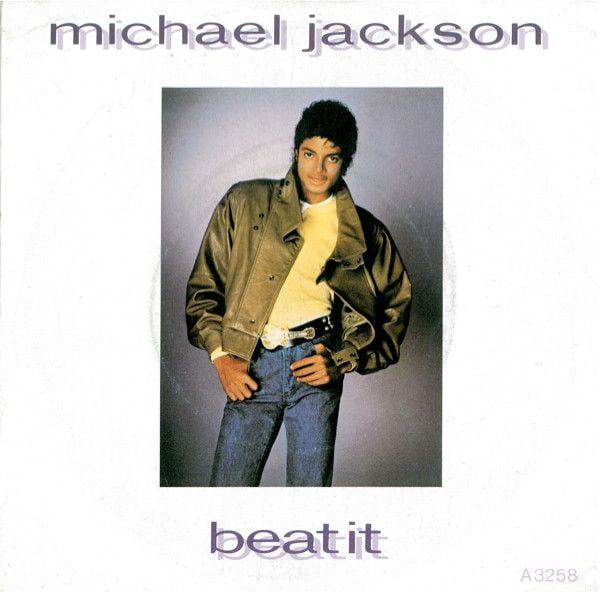
The Free Solo: Eddie Van Halen's Beat It Cameo
Twenty minutes, two six-packs of beer, and the most famous guitar solo he never got paid for
 Trevor Fortune•🎵 Michael Jackson - Thriller•9 min read•July 16, 2026
When Quincy Jones phoned Eddie Van Halen to ask him to play on a Michael Jackson song, Eddie thought it was a prank. He hung up on him four times. The next day he went to Westlake Recording Studios, spent about twenty minutes rearranging the track, and recorded a guitar solo. He wouldn't take any payment except the beer in the studio fridge. Van Halen had a rule against band members playing on other people's records, and Eddie didn't tell his bandmates he'd done it. The song was “Beat It,” and the solo helped make Thriller the best-selling album ever.
Four Hang-Ups Before He Believed It
Quincy Jones got Eddie Van Halen's phone number through Toto guitarist Steve Lukather — Toto's members were already deep in the Thriller sessions as first-call studio players — and called him directly to ask if he'd play a solo on a Michael Jackson track. Van Halen assumed it was a prank.
"I went off on him. I went, 'What do you want, you f-ing so-and-so!'"
He hung up on Jones four separate times, convinced a bandmate was winding him up. Toto keyboardist David Paich, who witnessed the real call from Jones's side, remembered it the same way: “This is Quincy Jones… Yeah, sure… and he hung up on him.” Once Van Halen accepted the call was genuine, he agreed to meet the next day. “I still wasn't 100% sure it was him,” he said. “I said, 'I'll tell you what. I'll meet you at your studio tomorrow.' And lo and behold, when I got there, there's Quincy, there's Michael Jackson and there's engineers.”
A Band With a No-Sessions Rule
Van Halen the band had an explicit policy against members playing on other people's records. Eddie went anyway, and he went alone — David Lee Roth was in the Amazon, Michael Anthony was at Disneyland, and Alex Van Halen was out of the country, so there was no one around to talk him out of it, and no one, he figured, who would ever find out. He took no fee and no royalty points, later joking to CNN when asked about payment: “I brought my own beer, if I remember right.” Multiple accounts put the studio's actual compensation at two six-packs.
The band did find out, and they were not pleased. “I was a complete fool, according to the rest of the band, our manager, and everyone else,” Van Halen said afterward. “I was not used. I knew what I was doing — I don't do something unless I want to do it.” His ex-wife, Valerie Bertinelli, recalled the same episode in Kevin Dodds's biography of the guitarist: “Ed never saw a dime, nor do I believe that he ever thought to ask to get paid. That was Ed.”
Twenty Minutes at Westlake
The section Jackson and Jones wanted a solo over had no chord changes underneath it — nothing built for a guitar part to play against. Jackson stepped out to record a separate children's project, leaving Van Halen to ask Jones directly what he wanted. “He goes, 'Whatever you want to do,'” Van Halen remembered. “Be careful when you say that. If you know anything about me, be careful when you say [that].”
"I listened to the song, and I immediately go, 'Can I change some parts?' I turned to the engineer and I go, 'OK, from the breakdown, chop in this part, go to this piece, pre-chorus, to the chorus, out.' Took him maybe 10 minutes to put it together. And I proceeded to improvise two solos over it."
Rearranging the tape physically had a side effect nobody anticipated. Cutting and splicing the master broke the timecode sync between two 24-track machines carrying Jackson's layered vocal takes. “Ed didn't want to play through the section that they wanted him to, so he cut the tape and played the part,” Lukather said. Jones refused to have Jackson re-record his vocals to fix it — “I don't want to transfer them, I want to keep it first generation” — so drummer Jeff Porcaro resynced the tracks by ear, listening for Jackson's vocal bleed to line the machines back up manually. Van Halen cut his solo in two takes and was done. “I didn't ask for anything,” he said later. “It was about 20 minutes out of my life.”
The Speaker That (Maybe) Caught Fire
Engineer Bruce Swedien has told a version of that afternoon in which a studio monitor caught fire from the sheer volume of Van Halen's amp. “I went in when Eddie Van Halen was warming up and I left immediately,” Swedien said. “It was so loud — I would never subject my hearing to that kind of volume level!” Quincy Jones told an even more dramatic version in his memoir, describing a speaker literally bursting into flame during the session.
A second engineer who was present, Matt Forger, has since complicated that story: the actual burnout, he says, was a Crown power amp failing during pre-mixing of backing vocals, not during Van Halen's take at all. “The thing was lighting up like a toaster,” Forger said. “It was glowing red.” Whichever version is more literally accurate, both agree on the underlying fact: whatever Van Halen was playing through that day was loud enough that people who'd spent careers in recording studios found it startling.
“Wow, Thank You for Caring About the Song”
Before Jackson heard the finished part, Van Halen warned him what he'd done to the arrangement. “Look, I changed the middle section of your song,” he told him. Jackson's reaction, as Van Halen recounted it, was gratitude rather than alarm: “Wow, thank you so much for having the passion to not just come in and blaze a solo, but to actually care about the song, and make it better.”
Jones, for his part, never stopped referencing the session. In a public tribute after Van Halen's death in 2020, he wrote: “Even though it took a couple calls to convince U it was actually me on the phone :) U killed it on Thriller, & your classic guitar solo on Beat It will never be matched. I'll always smile when I think of our time working together.”
Uncredited, Then Credited
The original 1982 pressing of Thriller did not list Van Halen's name anywhere on the sleeve. His own record label wouldn't even let him appear in the “Beat It” music video — the solo made the cut, the guitarist did not. It took decades and an anniversary reissue for the credit to catch up with the performance: the Thriller 40 vinyl edition lists Eddie Van Halen by name as featured soloist on the track.
Inside Van Halen's own camp, the fallout lingered. David Lee Roth took a public swipe in Rolling Stone: “What did Edward do with Michael Jackson? He played the same solo he's been playing in this band for 10 years. Big deal!” Alex Van Halen went further, tying the session to the band's next album underperforming: “Last time we let him do that he did a solo on that little… Michael Jackson's record. That was the only reason 1984 got stuck at number two.”
One Night in Texas
Van Halen played the part live with Jackson exactly once: July 14, 1984, at Texas Stadium in Irving, during the Jacksons' Victory Tour — completely unrehearsed, and on the same night his own band was performing across town at Reunion Arena in Dallas. Recordings of the show catch Jackson calling out “You got it, Eddie!” as the solo starts.
Van Halen liked to tell one more story about that solo, set well after the fact at a Tower Records in Sherman Oaks. “'Beat It' was playing over the store sound system,” he said. “The solo comes on, and I hear these kids in front of me going, 'Listen to this guy trying to sound like Eddie Van Halen.' I tapped him on the shoulder and said, 'Thatis me!' That was hilarious.” Twenty minutes, two six-packs, and a favor for a musician he'd never met had turned into a solo so identifiably his own that strangers couldn't believe it was really him — and for a long time, officially, it wasn't.