The Third Lion Roar
How a Usenet post, a teenage intern and one Boston DJ convinced the world that Pink Floyd secretly scored “The Wizard of Oz”
 Trevor Fortune•🎵 Pink Floyd - The Dark Side of the Moon•9 min read•August 18, 2026
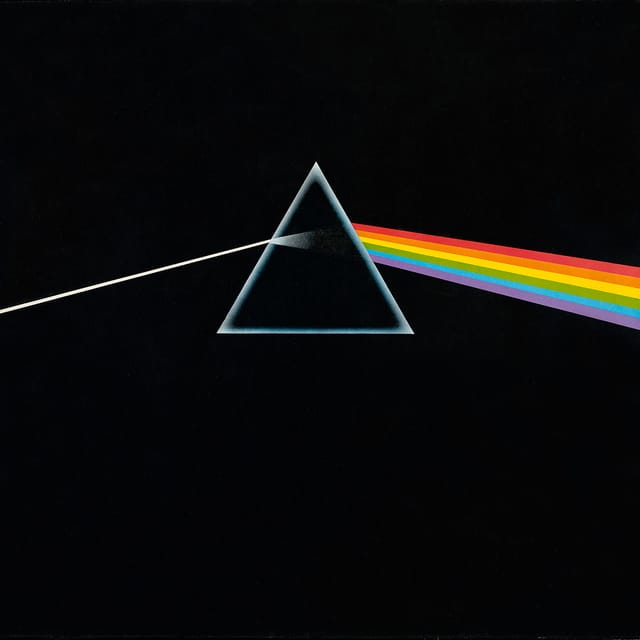
The instructions are precise enough to sound like a recipe, which is part of why they work. Mute the television. Start The Wizard of Oz. Wait for the MGM lion, count to the third roar, and press play on The Dark Side of the Moon. Do it correctly and for the next forty-three minutes a 1939 musical and a 1973 rock album behave as though they were built for one another: cash registers ringing as Munchkinland blooms into Technicolor, a wordless soprano climbing as the twister tears the farmhouse off its foundations, a human heartbeat fading out at the exact moment Dorothy leans in to listen to a hollow tin chest. Millions of people have run the experiment. A good number of them came away certain it could not possibly be an accident. And every man who made the record has spent the last thirty years explaining, with steadily decreasing patience, that it is.
The Intern and the Newsgroup
The myth has an unusually well-documented birth certificate, because the person who filed it has been apologizing for it ever since. In 1995, a nineteen-year-old college student named Charlie Savage was reading the Usenet group alt.music.pink-floyd when he came across a post claiming that muting The Wizard of Oz and playing The Dark Side of the Moon produced something remarkable. The poster credited the discovery to friends in Los Angeles. Savage tried it in his dorm room.
That summer he was interning at the Journal Gazette in Fort Wayne, Indiana, and he pitched it as a story. It ran on August 1, 1995, and it is the first known mainstream account of the phenomenon. Savage told readers exactly what to do: turn off the television sound, put the Pink Floyd CD in the player, and press play at the moment the MGM lion roars for the first time. The result, he wrote, was astonishing — as if the movie were one long art-film music video, with song lyrics and titles matching the action and the plot.
Two details from that article are worth holding onto. The first is that Savage never claimed the band had done it on purpose; he wrote it up as a curiosity, and noted that when the album was recorded there was no ready means of reproducing a film in the studio. The second is that his starting cue was wrong, or at least it did not survive. Savage said the first roar. By the time the ritual had hardened into folklore, the accepted cue was the third — a drift of several seconds in a myth whose entire appeal rests on split-second precision. Savage himself has acknowledged the change.
Boston Radio Does the Rest
A local newspaper item by an intern is not, on its own, a cultural event. What turned it into one was radio. In the spring of 1997, George Taylor Morris, a DJ at Boston's classic-rock station WZLX-FM, mentioned the trick on air. WNEW-FM in New York followed. Both stations were buried in calls from listeners who had gone home, tried it, and needed to tell somebody.
"I just mentioned it, just briefly on the air."
From there the escalation was quick and thoroughly late-nineties. The wire services picked it up. Helen Kennedy wrote it up in the New York Daily News. On May 30, 1997, MTV.com published a piece attempting to trace the phenomenon's origins, and found people who insisted they had been doing it for eighteen years already — an unverifiable claim that nonetheless gave the legend the crucial thing every legend needs, a prehistory. The name that stuck, “Dark Side of the Rainbow,” came out of this churn. Savage posted his old article to a personal website, where it became the thing anyone searching for the phenomenon found first.
The institutional blessing arrived in 2000, when Turner Classic Movies — which has held the rights to The Wizard of Oz since 1986 — broadcast the film with the album as a selectable alternate soundtrack on the second audio channel, calling the whole thing a fun concept. Repertory cinemas began booking it. Jam bands started performing the album live in front of the projected film. A coincidence had become a format.
What You Actually See
It is worth being honest about the evidence, because dismissing the sync as nothing is as lazy as believing it was designed. Several of the alignments are genuinely striking, and they are the same handful that Savage listed in 1995 — nobody has found many good new ones in thirty years.
The moments that convert people
The tornado
Clare Torry’s wordless vocal on “The Great Gig in the Sky” begins its climb as the twister bears down on the farm, breaks at the height of the storm, and softens into something dreamlike once Dorothy is knocked unconscious.
Munchkinland
Side two opens with the cash-register loop of “Money” almost exactly as Dorothy opens the farmhouse door and the film cuts from sepia to Technicolor.
The run down the road
“Time” arrives at its alarm-clock detonation and its warning about years slipping past as Dorothy bolts away from home with Toto under her arm.
The fortune teller
“Breathe” turns to its refrain about coming home again as Professor Marvel talks Dorothy out of running away and points her back toward the farm.
The Scarecrow
“Brain Damage,” the album’s song about madness and the people it swallows, starts up as the brainless Scarecrow flails through his first dance.
The Tin Man
The heartbeat that closes the record pulses as Dorothy presses her ear to the Tin Woodman’s empty chest — the single moment that does most of the convincing.
Six moments. Against them sit roughly forty minutes of nothing in particular, and a film that keeps going for another hour after the record has stopped. But nobody remembers the dead air. That is the whole mechanism.
Four Men Saying No
Every person with first-hand knowledge has denied it, repeatedly, for decades, in every register available to them. Nick Mason went with deadpan. Speaking to MTV in 1997, the drummer called the pairing absolute nonsense before offering a correction.
"It has nothing to do with The Wizard of Oz. It was all based on The Sound of Music."
David Gilmour was blunter, reducing the entire phenomenon to some guy with too much time on his hands who had the idea of combining the two. Roger Waters, asked about it on Joe Rogan's podcast in 2022, said it had nothing to do with anyone in Pink Floyd or anyone who wrote or recorded any of the music — before conceding, with the air of a man who has learned that flat denial only feeds the thing, that maybe it was a cosmic coincidence.
The most useful witness is Alan Parsons, who engineered the album at Abbey Road and was in the room for every decision. His objection is not philosophical but practical: the equipment did not exist where the work was happening. There was no way to run a film in the control room, and domestic video tape barely existed in Britain in 1972. When an American radio presenter finally told him about the sync, Parsons borrowed a copy of the film from his fiancée's children and sat down to watch it properly.
"It's such a non-starter, a complete load of eyewash. I tried it for the first time about two years ago. I was very disappointed."
The Album Was Already on Tour
The strongest argument against the myth is not a denial at all. It is the calendar. The Dark Side of the Moon was not composed in a studio in front of a screen; it was written and sequenced as a live suite and played to audiences for a full year before the band recorded a note of it. It had its public debut on January 20, 1972, at the Brighton Dome, where it fell apart mid-performance when the backing tape running under “Money” lost power and slowed to a crawl. The band stopped, apologized, and kept touring it — through Europe, Japan and North America — refining the running order night after night. The version Parsons captured at Abbey Road was the version the road had already settled. Its shape was fixed by what worked in front of a paying crowd, not by what landed on a cut of a Kansas farmhouse.
There is a second, sharper irony buried in that same year. Between February and April 1972 — in the gap between debuting the Dark Side suite and recording it — Pink Floyd were at the Château d'Hérouville in France writing music to picture for Barbet Schroeder's film La Vallée. They fell out with the production company and released the results in June 1972 under their own title, Obscured by Clouds, forcing the film to be retitled after the album. In other words, the band accused of secretly scoring a movie were, that exact spring, openly scoring a movie. They knew precisely how it was done, they had done it three times by then, and they took the credit every time.
Then there is arithmetic. Writing in Hollywood Urban Legends in 2001, Richard Roeper pointed out that a band deliberately soundtracking a 101-minute film would not hand in forty-three minutes of music. To carry The Wizard of Ozfrom the lion to the closing credits, the album has to be looped two and a half times — and the believers, tellingly, never agree on what the second and third passes are supposed to prove.
Why the Trick Works Anyway
The clinical name for what happens in the dark is apophenia: the mind's standing readiness to find meaningful pattern in unrelated data, keeping the hits and quietly discarding the misses. It is the same faculty that produces faces in clouds and the Lincoln-Kennedy coincidences. Carl Jung gave the flattering version of it a name too — synchronicity, meaningful coincidence without causal connection — and half the appeal of Dark Side of the Rainbow is that it lets an ordinary perceptual glitch feel like a visitation.
Parsons, characteristically, supplied the engineer's version of the same point. Any audio professional, he noted, will tell you that the scope for drift between a video and a record is enormous — anything up to twenty seconds by the time the record finishes. Which means that no two people running the experiment are watching the same sync, that the alignments people swear by are partly a function of which pressing, which transfer and which machine they happen to own, and that a myth demanding the third roar rather than the first is enforcing a precision it cannot actually deliver.
And yet the pairing is not random in the way a coin toss is random. Both works are, at bottom, about the same journey: a person leaves home, is overwhelmed by a bewildering and hostile world, meets madness, money and mortality on the road, and tries to get back. The Dark Side of the Moon is deliberately universal — Waters wrote it about the pressures that break ordinary people — which is exactly what makes it fit almost anything with a protagonist under strain. Set it against a film about a frightened girl trying to get home and it will find purchase, because the album was engineered to find purchase everywhere. The story of how the record came to be that universal is told in our review of the album itself.
Charlie Savage went on to win a Pulitzer Prize in 2007 for his reporting on presidential signing statements, and to spend his career covering national security for the Boston Globe and the New York Times. He has written, with visible weariness, that the world seems intent on treating this somewhat ridiculous thing as his defining contribution, and that he expects it to turn up in his obituary. He is probably right. The band cannot kill the myth, the engineer cannot kill it, and the man who published it cannot kill it either — because a legend that costs nothing to test, and rewards you the moment you try, does not need anyone's permission to survive.
Related Review
Read our comprehensive analysis of Pink Floyd's The Dark Side of the Moon
The Dark Side of the Moon Review →