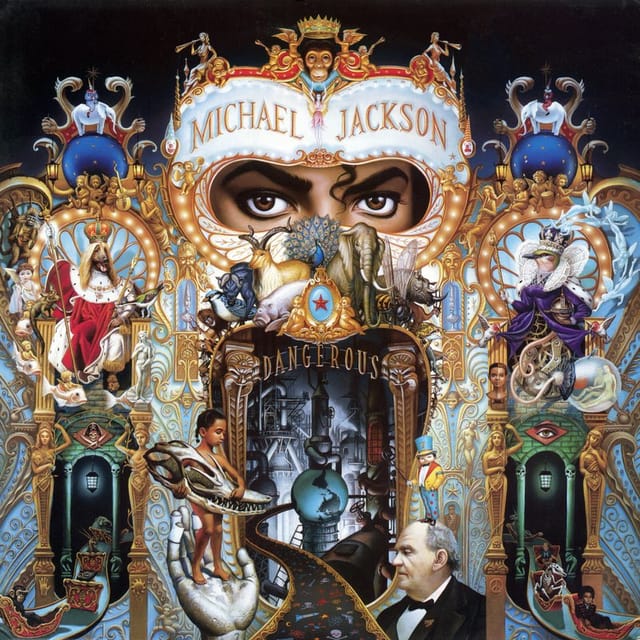
The Teddy Riley Gamble
Quincy Jones was gone after three straight blockbusters. In his place, a 23-year-old new jack swing producer who'd already been turned down for the job once before.
 Trevor Fortune•🎵 Michael Jackson - Dangerous•9 min read•September 22, 2026
Michael Jackson called Teddy Riley in New York in 1990 and got straight to it: “I want to shock the world, I want those lush melodies, I need that sound that's going to inspire us to write the greatest songs.” Jackson was calling from California and wanted Riley on a plane immediately. Riley asked for a week to prepare. Jackson agreed — and then shipped him a brick phone so the two of them could stay in constant contact before Riley had even left New York. It was a strange, almost comic level of urgency for what was, on paper, a serious risk: after three albums that Quincy Jones had shepherded into Off the Wall, Thriller, and Bad, the biggest pop star on Earth was handing his next album to a 23-year-old whose biggest production credits were Bobby Brown, Keith Sweat, and his own group, Guy.
The Producer Who Almost Made Bad
Riley wasn't actually a new discovery when the Dangerous call came. Jackson had tried to hire him years earlier, for Bad. “When Michael called he basically said [that] he wanted me on the Bad album,” Riley recalled. The deal fell apart before it started — Riley's manager at the time, Gene Griffin, piled on conditions the Jackson camp wouldn't accept, reportedly including a demand that no one be allowed in the studio with Riley unless Griffin himself was present. The opportunity evaporated, and Bad went on to become Bad without him.
Jackson didn't forget. Riley remembered him bringing it up years later, with real regret in his voice: “Man if we would've had you on that Bad album, it would've been amazing.” By the time Dangerous was taking shape, Riley wasn't a gamble pulled from nowhere — he was a second chance at a hire Jackson had wanted to make years before circumstances got in the way.
A Handoff, Not a Firing
The common version of this story treats Quincy Jones as a mentor Jackson outgrew and cast off. The actual mechanics were gentler than that. Jones and Jackson had always been working under a three-album arrangement that ended, on schedule, after Bad — and by Riley's own account, it was Jones himself who steered Jackson toward him: Riley was brought in “on the recommendation of Jackson's long-time producer” Quincy Jones, according to reporting on the sessions. Far from disappearing entirely, Jones stayed close to the process even without a production credit, checking in on finished material before release. Riley described him as functioning almost like a supervisor: “Quincy Jones was like a quality controller for Michael. If Michael had the chance he'd keep working on songs forever.”
When Jones finally heard the results, according to Riley, his verdict was immediate and generous: “He heard it before it was released and he said this was a masterpiece, and that it's ready to come out.” It is a strange coda to the era most retrospectives frame as a clean break — the outgoing producer effectively signing off on the record that replaced him.
"It was really difficult for me having to follow in Quincy Jones' footsteps. He left big footsteps!"
No Beatbox, No Drums — He Was the Beatbox
The popular image of Riley's method is all dense drum programming and sampled hits — the sound that had defined Guy and Bobby Brown's “My Prerogative.” The actual writing sessions with Jackson looked nothing like that. “The process of writing with Michael was being at an upright piano in his room,” Riley said. “No beatbox, no drums — he was the beatbox! That's how we came up with In The Closet; we made it up right there at the piano.” The dense, electronic layers that new jack swing was known for came afterward, built on top of songs that started as spare, vocal-percussion sketches between two people at a piano.
Once those bones existed, Riley rebuilt them with the tools that had made his name — working out of Record One in Sherman Oaks and Larrabee Sound in Los Angeles, and reaching for older analog gear rather than only the newest digital equipment: “I was using a lot of vintage stuff to get the sound we needed,” he said. His own description of what he thought Jackson needed was blunt: “For Dangerous, I brought R&B back to Michael in its barest form; R&B and Funk.” Jackson, by Riley's account, welcomed the shift without resistance: “When I came, Michael just opened up his heart to R&B and said, ‘I want to do that.’”
Jackson's own standard for the material, as Riley remembered it, was characteristically single-minded: “You are not a star until the music becomes a star.” It was a philosophy that cut against the pressure Riley was under to simply reproduce his existing hits — Jackson wasn't hiring new jack swing's sound so much as hiring the person who could keep inventing inside it.
A Deadline That Kept Moving
The album took roughly two years to finish, and Riley has been candid that the difficulty wasn't technical so much as psychological — the sheer weight of not wanting to be the one who let Jackson down. “There was more pressure,” he said. “I didn't want to be the one to fail Michael.” Jackson's own perfectionism compounded the problem: even as deadlines approached, he kept wanting more material rather than less. “When the deadline came, he wanted to do more and more songs,” Riley recalled, a habit that eventually required management to step in and force a stopping point.
One moment stuck with Riley more than any technical achievement on the record. It wasn't a beat or a mix — it was Jackson's singing. “One of the biggest things Michael really surprised me with on the Dangerous album was his vocal deliverance on Remember The Time,” Riley said. “That really blew me away.” Coming from the producer who'd built the track's rhythm bed, the comment underlines how much of Dangerous's success still rested on the thing Riley hadn't built at all.
The Gamble, Scored
Dangerous reached No. 1 on the Billboard 200 roughly three weeks after its November 26, 1991 release and held the top spot for a month before being displaced in early 1992 — the same commercial moment, as more than one retrospective has noted, that Nirvana's Nevermind was rewriting what a No. 1 album was supposed to sound like. Robert Christgau, reviewing it at the time for The Village Voice, gave it an A− and called it “plainly his most consistent album since Off the Wall,” crediting Riley's “abrasively unpredictable beats” directly.
The wager paid off commercially on a scale most producers never get near — tens of millions of copies sold worldwide, four Top 10 U.S. singles, and an album now widely credited as the best-selling new jack swing record ever made. PopMatters has described Riley outright as the genre's “pioneer” and framed Dangerous as the moment that took the sound from R&B radio into the absolute center of pop culture, a status confirmed by the world's biggest star choosing to build his comeback album entirely around it.
What makes the gamble worth telling as its own story, rather than a footnote inside Dangerous's wider history, is how little of it looked inevitable from the inside. A producer who'd already lost this exact job once to his own manager's conditions. A star who kept adding songs past every deadline. A mentor who stepped back from the credits but stayed close enough to bless the finished record before the public ever heard it. None of that reads, in the moment, like the blueprint for one of the best-selling albums of the decade — only in hindsight does it look like anything other than a risk.