Twelve Million Dollars for a Protest Song
How a song about an abandoned Vietnam veteran became a presidential campaign prop, a car commercial pitch and the most successfully misheard record in American history
 Trevor Fortune•🎵 Bruce Springsteen - Born in the U.S.A.•9 min read•August 18, 2026
In September 1984, the conservative columnist George Will went to see Bruce Springsteen at the Capital Center outside Washington, invited by the E Street Band's drummer, Max Weinberg. Will did not recognize the smell in the arena as marijuana. Three beats into the first song he pushed cotton wool into his ears to protect his hearing, and he kept it there for the rest of the show. Then he went home and wrote a column about what he had heard. Within six days the President of the United States was quoting Springsteen from a podium in a New Jersey field, and within two years the president of Chrysler would offer twelve million dollars for the right to sell cars with a song about a man whose brother died at Khe Sanh and who cannot get hired at the refinery when he comes home.
The Columnist With Cotton in His Ears
Will's column ran in the Washington Post on September 13, 1984, under the headline “A Yankee Doodle Springsteen.” It is a genuinely admiring piece, and it is also a perfect specimen of hearing a record with the words switched off. Will noticed the flags. He noticed the roar. He noticed, correctly, that the set list was a long recitation of closed factories and dead-end towns. And then he decided the recitation did not matter, because of how the chorus sounded.
"I have not got a clue about Springsteen's politics, if any, but flags get waved at his concerts while he sings songs about hard times. He is no whiner."
Will did not stop at describing the show. He suggested to contacts in the White House — among them Michael Deaver, Reagan's closest image-maker — that there might be something in it for the campaign. Deaver's staff approached Springsteen's people about using the song. They were politely turned down. The campaign proceeded anyway, on the sound political logic that you do not actually need a licence to praise a man in a speech.
A Podium in Hammonton
On September 19, 1984, Reagan campaigned in Hammonton, New Jersey, in the heart of the state's blueberry country, and delivered the line his speechwriters had built out of Will's column: that America's future rested in a thousand dreams inside the hearts of the people in front of him, and in the message of hope in the songs of a man so many young Americans admired — New Jersey's own Bruce Springsteen.
It was an almost surgically precise piece of appropriation. Reagan did not name a song, so nothing could be fact-checked. He said “message of hope,” which is not a claim about content. And he attached himself to the single most popular record in the country — released that June, on its way to seven top-ten singles and tens of millions of copies — at the precise moment its title chorus was audible from every open car window in America. The Reagan campaign was not misreading the song so much as correctly reading the sound of it.
Pittsburgh, Three Days Later
Springsteen answered from a stage in Pittsburgh a few nights afterwards, and the answer is a small masterpiece of restraint. He did not lecture and he did not name the President's policies. He simply pointed out, in the voice of a man genuinely puzzled, that whatever record Reagan had been listening to, it could not have been the one about a man who shoots a night clerk after losing his job at the Ford plant.
"The President was mentioning my name the other day, and I kinda got to wondering what his favorite album musta been. I don't think it was the Nebraska album. I don't think he's been listening to this one."
Then he played “Johnny 99,” the bleakest thing in his catalogue, to a hockey arena. It is the most useful line anyone has ever spoken about the misunderstanding, because it locates the problem exactly: not that Reagan had the wrong opinion about the song, but that he had almost certainly never heard the song at all — only the fact of it.
The Song Was Called “Vietnam”
What the record says is not ambiguous. It is a first-person account of a man sent to fight a war he did not choose, whose brother is killed at Khe Sanh, who comes home to a Veterans Administration official with nothing to offer and a foreman with no job to give, and who ends the song ten years down the road with nowhere left to run. The chorus is not a boast. It is what the character has instead of an argument.
Its origins point the same way. In the summer of 1981 Springsteen played a benefit in Los Angeles for Vietnam veterans and spent time with men who had come back to exactly the reception the song describes; the writing grew out of that, under the working title “Vietnam.” The finished title came from somewhere else entirely. The screenwriter Paul Schrader had sent Springsteen a script called Born in the U.S.A., hoping for a song. The script sat around the house. Springsteen, working on the Vietnam song, saw the cover page, sang the four words, and kept them. Schrader's film was eventually released under a different name, Light of Day, with a Springsteen title song by way of repayment.
The demo cut during the Nebraska sessions settles any remaining doubt about intent. Slow, bluesy, close-miked and almost unbearable, it is unmistakably a lament. Nobody who has heard that version has ever mistaken the song for a celebration. Almost nobody heard that version.
Six Notes on a Yamaha
What America heard instead was made in a few minutes at the Power Station in New York in April 1982, and the misunderstanding is built into the tape. Springsteen played the song for the E Street Band on acoustic guitar. Roy Bittan, listening to the chorus, pulled a six-note motif out of what Springsteen was singing, decided it was a riff, walked over to a newly acquired Yamaha CS-80 synthesizer and started shaping a sound — the enormous, bell-like fanfare that opens the record. Max Weinberg answered it with a drum part built for arenas. The take took shape almost immediately.
Springsteen kept it. That is the decision the whole forty-year argument turns on: he had a devastating acoustic version and a triumphant band version of the same lyric, and he chose the one that would be misheard, because the collision between the two was the point. A defeated man still shouting where he is from is a more truthful picture of the country than either the shout or the defeat on its own. It also happens to be irresistible on the radio, which is a risk that cannot be taken back once the record is pressed.
Iacocca Makes an Offer
The commercial version of the same misreading arrived with a number attached. Lee Iacocca, running Chrysler and mid-way through his own campaign to make American manufacturing feel patriotic again, offered twelve million dollars to license the song for a series of car advertisements. Springsteen refused, as he has refused every such offer since; Chrysler ran with a Kenny Rogers song instead. The story is usually told as an example of Springsteen's principles, and it is, but it is more interesting as evidence. The chief executive of an American car company listened to a song about a jobless veteran and heard a jingle about American cars.
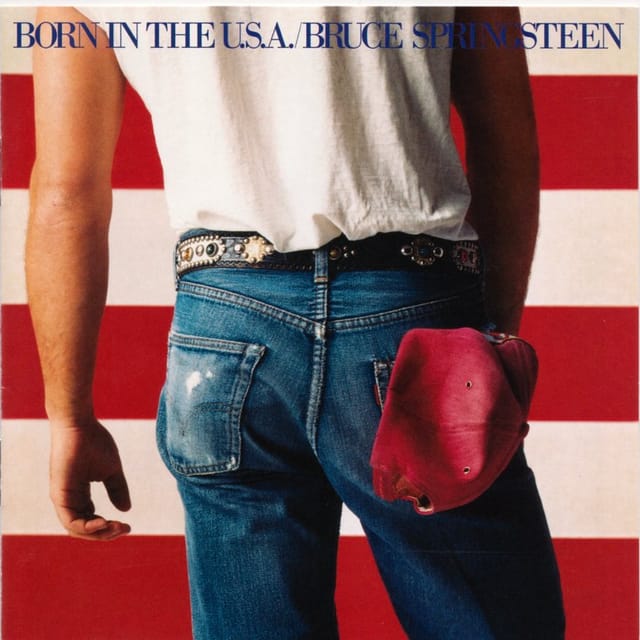
Even the sleeve got conscripted. Annie Leibovitz's photograph — Springsteen from behind, red cap in his back pocket, enormous flag filling the frame — was read by one camp as wholesome patriotism and by another as the singer urinating on the flag. Springsteen's explanation, offered to Rolling Stone in 1984, was less ideological than either faction wanted: the picture of his backside simply looked better than the picture of his face.
Forty Years of Not Listening
Reagan was not an aberration; he was the first in a queue. Bob Dole's campaign played the song at a rally in Red Bank, New Jersey, in October 1996, prompting Springsteen to state for the record that it had been used without his permission and that he was not a supporter of the Republican ticket. Pat Buchanan tried it in 2000 and drew a cease-and-desist. Others have followed, with the same result and the same expression of surprise. Nobody, in forty years, has been talked out of the chorus by the verses.
Springsteen has been notably unbitter about it, in part because he understood the mechanism before anyone else did. Explaining the sleeve in that same 1984 interview, he made a remark that reads now like a prophecy about the entire record.
"The flag is a powerful image, and when you set that stuff loose, you don't know what's gonna be done with it."
He set it loose anyway. The album that resulted is covered in full in our review; what the song itself proves is narrower and stranger. A writer can be completely clear, put the evidence in the first verse, sing it in the first person, refuse the money, correct the President from a stage in Pittsburgh, and still lose the argument to his own chorus — because a hundred thousand people singing four words in a stadium will always be louder than the man explaining what they mean.
Related Review
Read our comprehensive analysis of Bruce Springsteen's Born in the U.S.A.
Born in the U.S.A. Review →